Pack UWP Class Library with NuGet

Recently, my team is working on packing our UWP class library as a NuGet package. It turns out that it’s not that straight-forward, because even though there is a documentation from Microsoft, it is for Windows Runtime Component. So, the question on StackOverflow remains unsolved.

I thus decided to document down the steps on how I approach this problem to help the developers out there who are facing the same issue.

Step 1: Setup the UWP Class Library Project
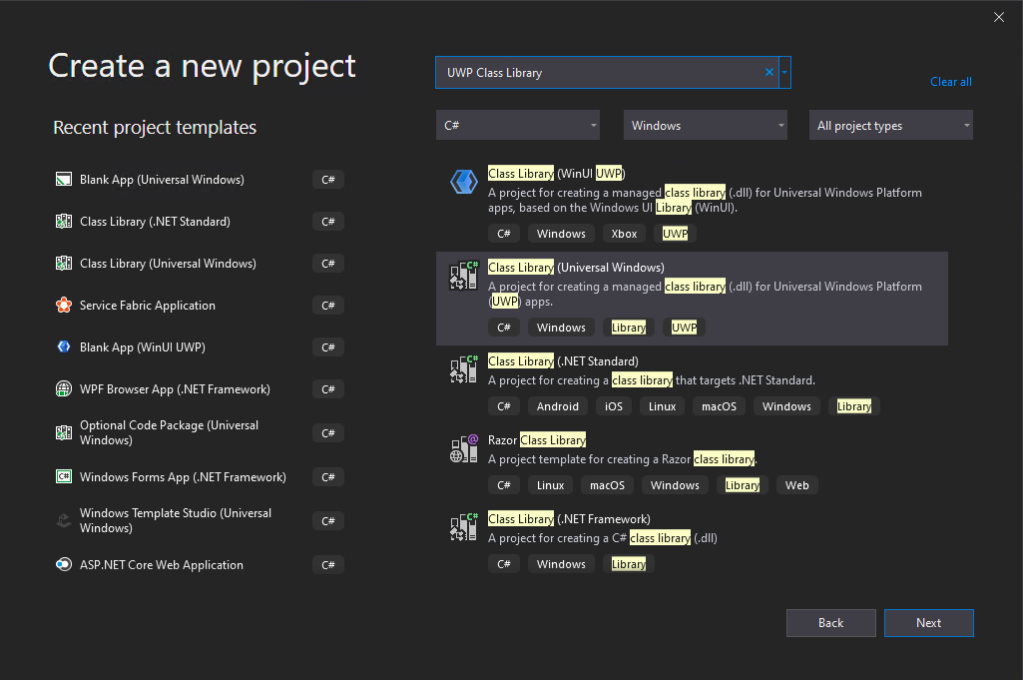
🎨 We will be using “Class Library (Universal Windows) in this post. 🎨

In this post, the new project we create is called “RedButton” which is meant to provide red button in different style. Yup, it’s important to make our demo as simple as possible so that we can focus on the key thing, i.e. generating the NuGet package.

Before we proceed with the new project, we need to configure the project Build properties, as shown in the following screenshot, to enable the XML Documentation file. This will make a XML file generated in the output folder which we need to use later.
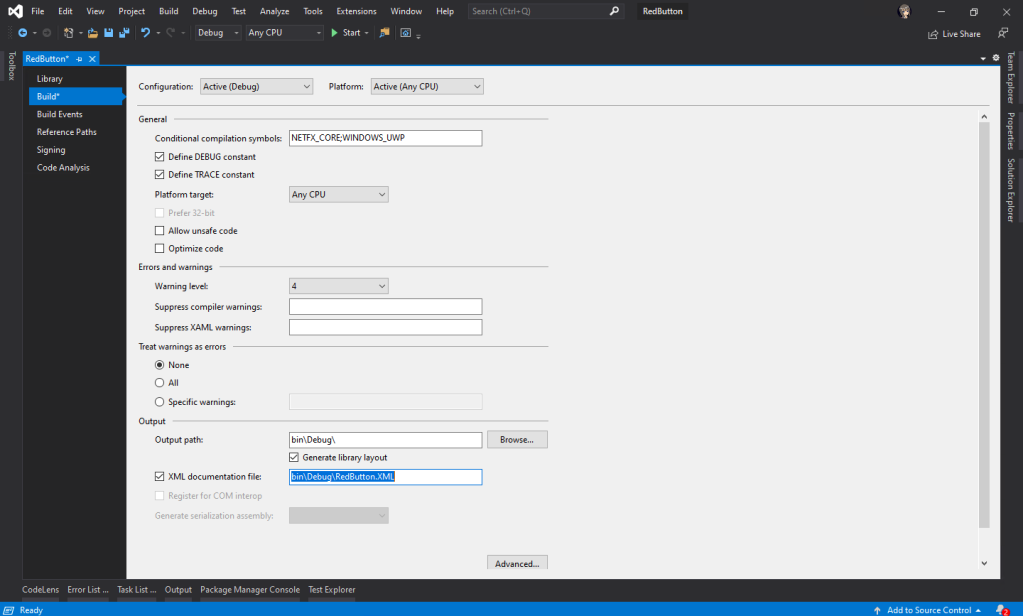
🎨 Enable the XML documentation file by checking the checkbox. 🎨

Now, we can proceed to add a new user control, called SimpleButton.xaml.
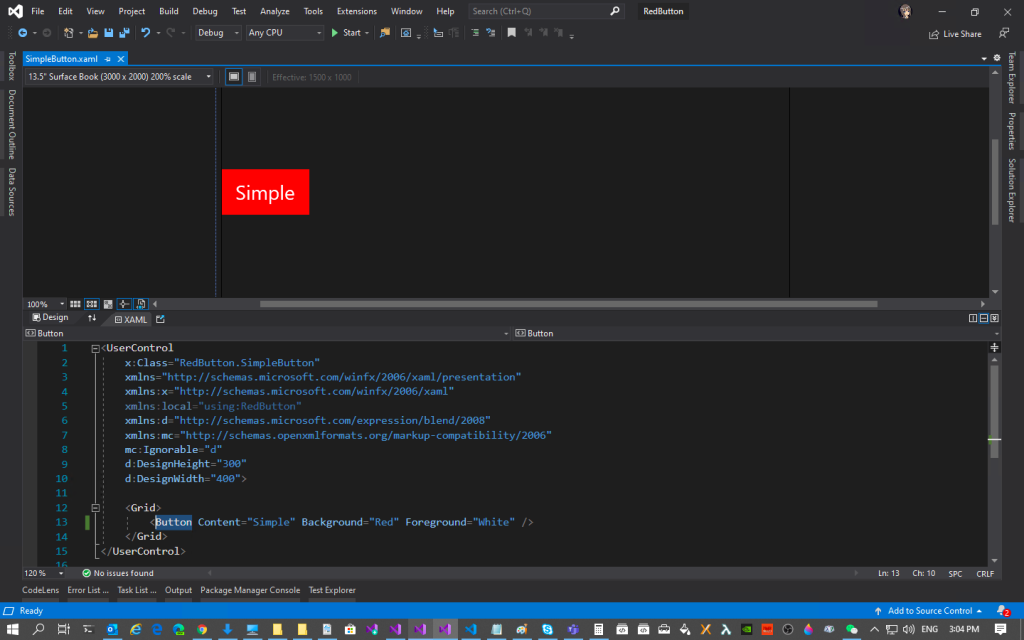
🎨 Yay, we have simple red button here. 🎨

So this marks the end of the steps where we create an UWP user control where we need to package it with NuGet.

Step 2: Install NuGet.exe

Before we proceed, please make sure we have nuget installed. To verify that, just run the following command in the PowerShell.

> nuget

If it is installed, it will show something as follows.
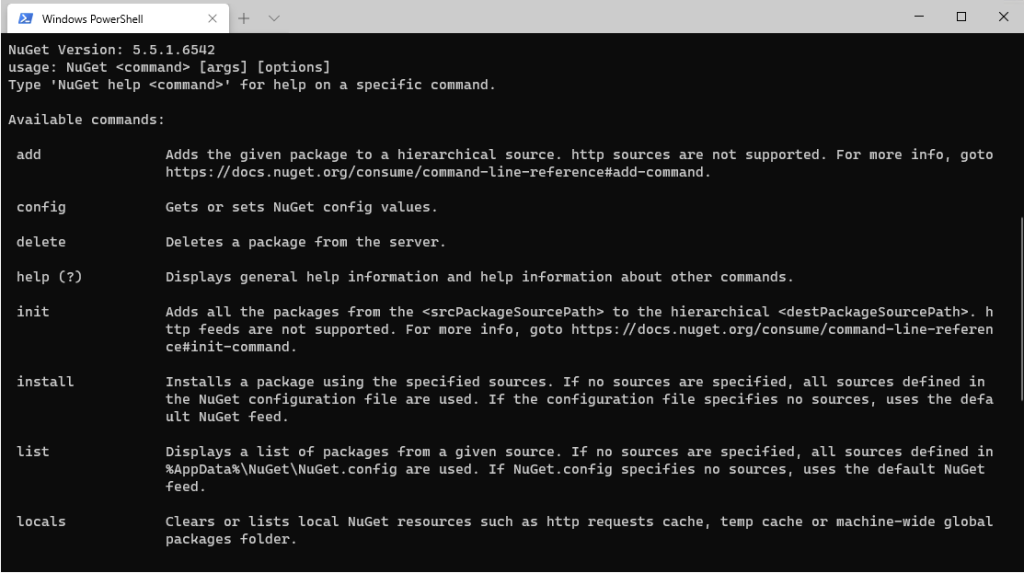
🎨 Yay, nuget is installed. 🎨

If it is not installed, please download the latest recommended nuget.exe from the NuGet website. After that, add the path the the folder containing the nuget.exe file in the PATH environment variable.

Step 3: Setup NuSpec

In order to package our class library with NuGet, we need a manifest file called NuSpec. It is a manifest containing the package metadata which provides information to be shown on NuGet and helps in package building.

Now we need to navigate in PowerShell to the project root folder, i.e. the folder containing RedButton.csproj. Then, we need to key in the following command to run it.

nuget spec

If the command is successfully executed, there will be a message saying “Created ‘RedButton.nuspec’ successfully.”

Now, we can open the RedButton.nuspec in Visual Studio. Take note that the file itself is not yet included in the solution. So we need to make sure we have enabled the “Show All Files” in the Solution Explorer to see the NuSpec file.

After that, we need to update the NuSpec file so that all of the $propertyName$ values are replaced properly. One of the values, id, must be unique across nuget.org and following the naming conventions here. Microsoft provides a very detailed explanation on each of the element in the NuSpec file. Please refer to it and follow its guidelines when you are updating the file.
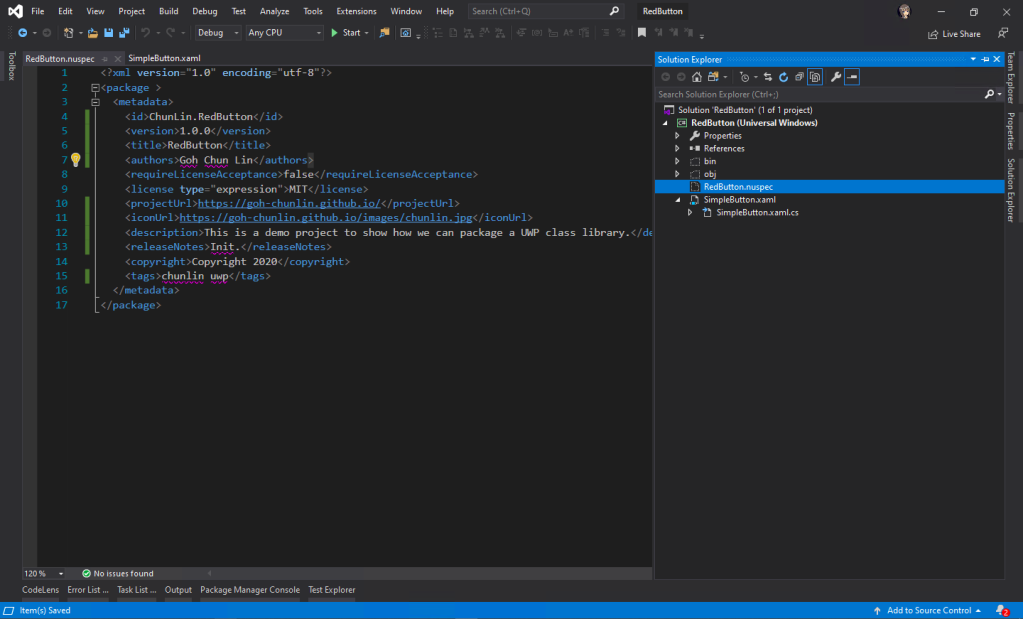
🎨 Finished updating the NuSpec. 🎨

Step 4: Connect with GitHub and Azure DevOps

In order to automate the publish of our package to the NuGet, we will need to implement Continuous Integration. Here, the tools that we will be using are GitHub and Azure DevOps.

After committing our codes to GitHub, we will proceed to setup the Azure DevOps pipeline.

Firstly, we can make use of the UWP build template available on the Azure DevOps.
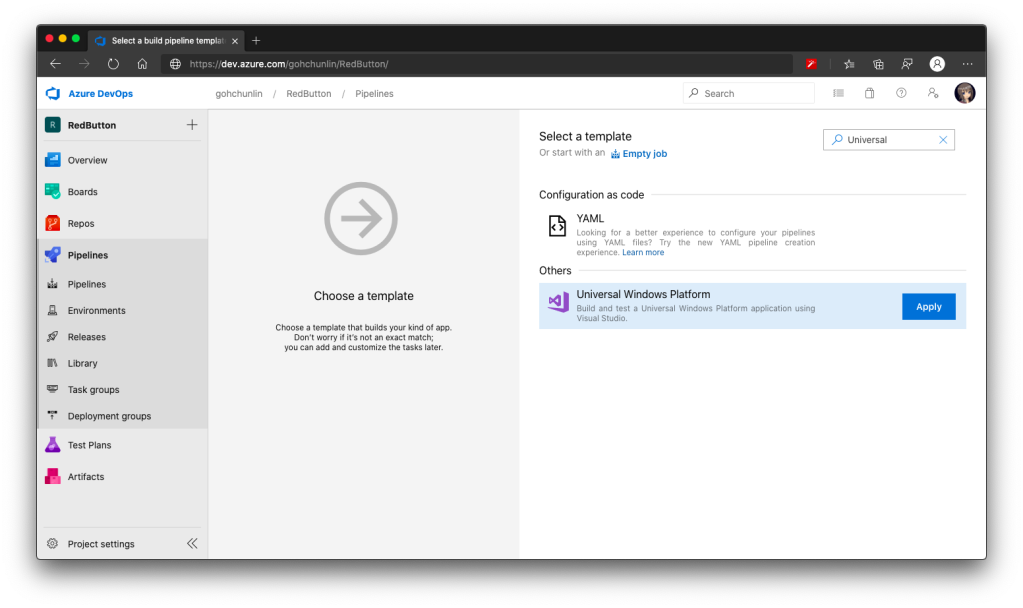
🎨 Yes, we can build UWP app on Azure DevOps. 🎨

At the time I am writing this port, there are 5 tasks in the agent job:

  1. Use NuGet 4.4.1;
  2. NuGet restore **\*.sln;
  3. Build solution **\*.sln;
  4. Publish artifact: drop;
  5. Deploy to Visual Studio App Center.

Take note that the NuGet version by default is 4.4.1, which is rather old and new things like <license> element in our NuSpec file will not be accepted. Hence, to solve this problem, we can refer to the list of available NuGet version at https://dist.nuget.org/tools.json.

At the time this post is written in April 2020, the latest released and blessed NuGet version is 5.5.1. So we will change it to 5.5.1. Please update it to any other latest number according to your needs and the time you read this post.

After that, for the second task, we need to update its “Path to solution, packages.config, or project.json” to be pointing at “RedButton\RedButton.csproj”.

Similarly, for the “Solution” field in the third task, we also need to point it to the “RedButton\RedButton.csproj”. Previously I pointed it to the RedButton folder which contains the .sln file, it will not work even though it is asking for “Solution”.

On the third task, we also need to update the “Visual Studio Version” to be “Visual Studio 2019” (or any other suitable VS for our UWP app). It seems to be not working when I was using VS2017. After that, I also updated the field “Configuration” to Release because by default it’s set to Debug and publishing Debug mode to public is not a good idea. I have also enabled “Clean” build to avoid incremental build which is not useful in my case. Finally, I changed the MSBuild Architecture to use MSBuild x64. The update of the third task is reflected on the screenshot below.
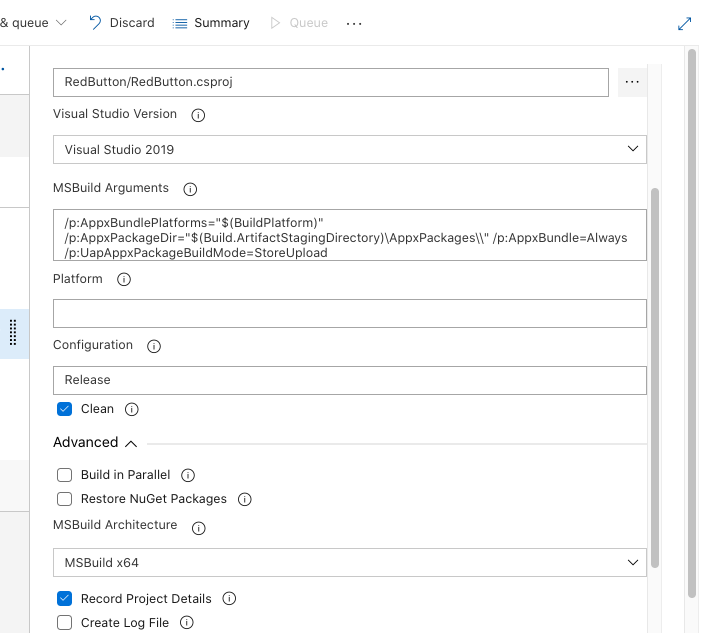
🎨 Third task configuration. 🎨

For the forth task, similarly, we also set its “Path to publish” to “RedButton”. Ah-ha, this time we are using the solution folder itself. By right, this fourth task is not relevant if we just publish our UWP class library to a NuGet server. I still keep it and set its path to publish to be the solution so that later I can view the build results of previous tasks by downloading it from the Artifact of the build.

I’d recommend to have this step because sometimes your built output folder structure may not be the same as what I have here depends on how you structure your project. Hence, based on the output folder, you many need to make some adjustments to the paths used in the Azure DevOps.
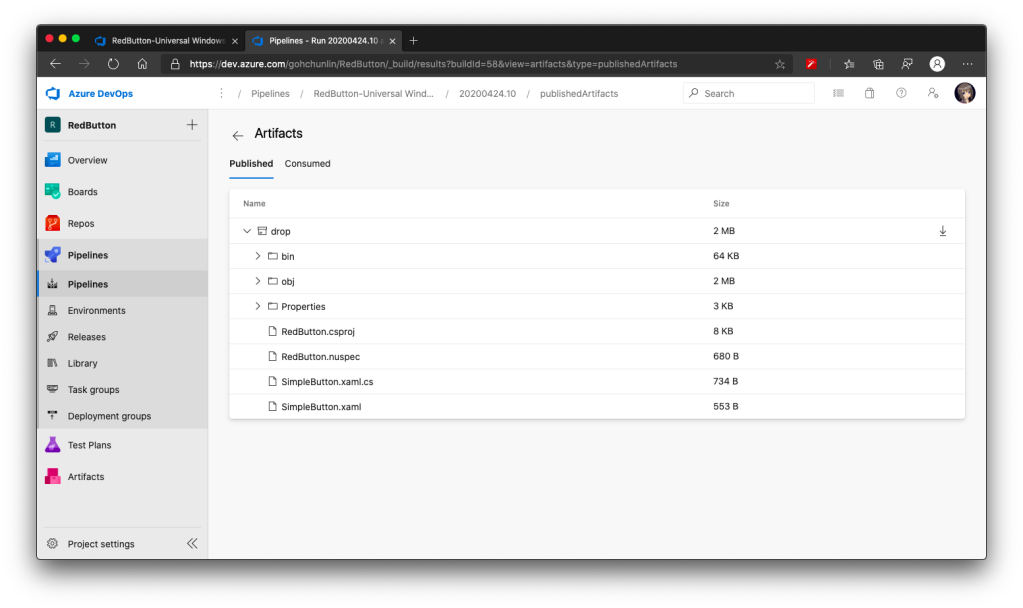
🎨 The fourth task helps to show build results from previous tasks. 🎨

By default, the fifth task is disabled. Since we are also not going to upload our UWP app to VS App Center, so we will not work on that fifth task. Instead, we are going to add three new tasks.

Firstly, we will introduce the NuGet pack task as the sixth task. The task in the template is by default called “NuGet restore” but we can change the command from “restore” to “pack” after adding the task, as shown in the following screenshot.
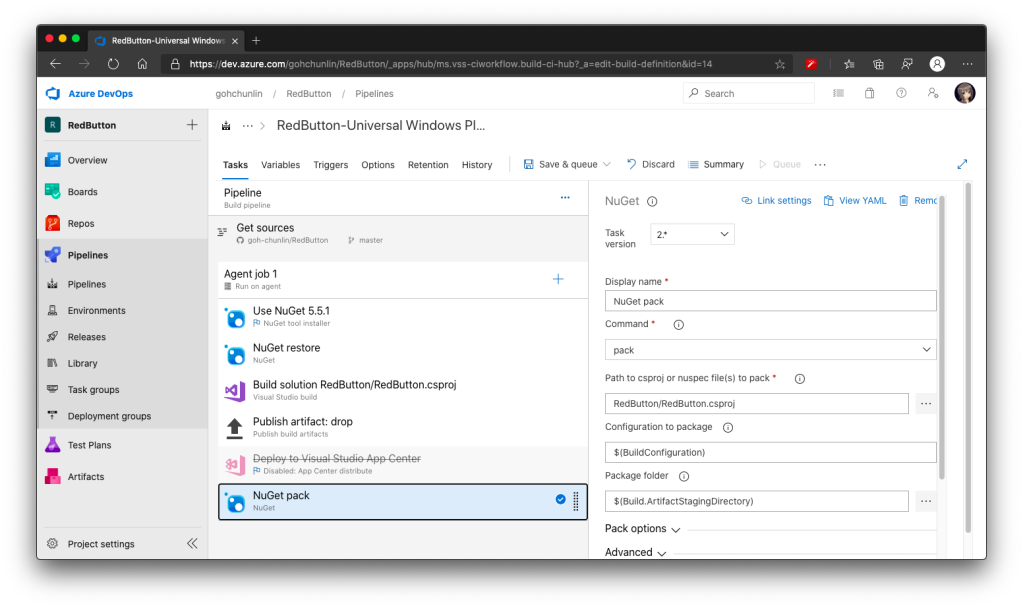
🎨 Remember to point the “Path to csproj” to the directory having the RedButton.csproj. 🎨

There is one more important information that we need to provide for NuGet packaging. It’s the version of our package. We can either do it manually or automatically. It’s better to automate the versioning else we may screw it up anytime down the road.

There are several ways to do auto versioning. Here, we will go with the “Date and Time” method, as shown in the screenshot below.
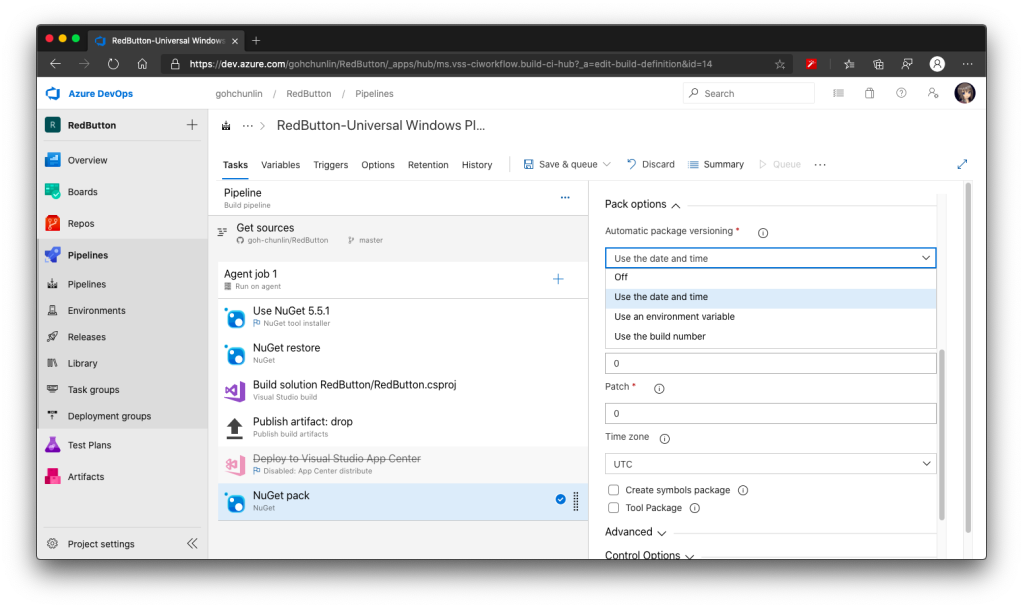
🎨 Choose “Use the date and time”. 🎨

This way of versioning will append datetime at the end of our version automatically. Doing so allows us to quickly test the release on the NuGet server instead of spending additional time on updating the version number. Of course, doing so means that the releases will be categorized as pre-released which users cannot see on Visual Studio unless they check the “Include prerelease” checkbox.
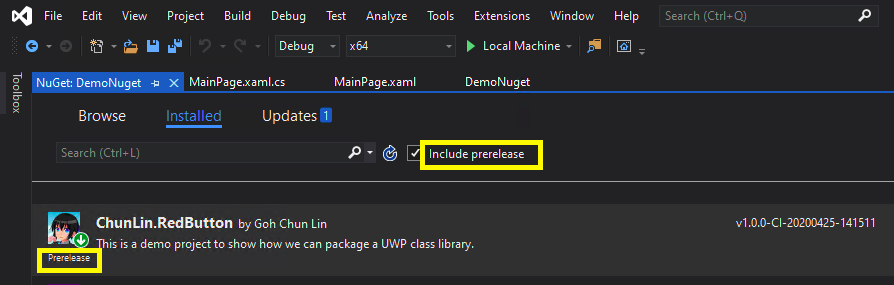
🎨 The prerelease checkbox on Visual Studio 2019. 🎨

Secondly, if you are also curious about the package generated by the sixth task above, you can add a task similar to the fourth task, i.e. publish the package as artifact for download later. Here, the “Path to publish” will be “$(Build.ArtifactStagingDirectory)”.

🎨 Publishing NuGet package for verifying manually later. 🎨

Since a NuGet package is just a zipped file, we can change its extension from .nupkg to .zip to view its content on Windows. I did the similar on MacOS but it didn’t work, so I guess it is possible on Windows only.

Thirdly, we need to introduce the NuGet push task after the task above to be the eighth task. Here, we need to set its “Path to NuGet package(s) to publish” to “$(Build.ArtifactStagingDirectory)/*.nupkg”.

Then, we need to specify that we will publish our package to the nuget.org server which is an external NuGet server. By clicking on the “+ New” button, we can then see the following popup.
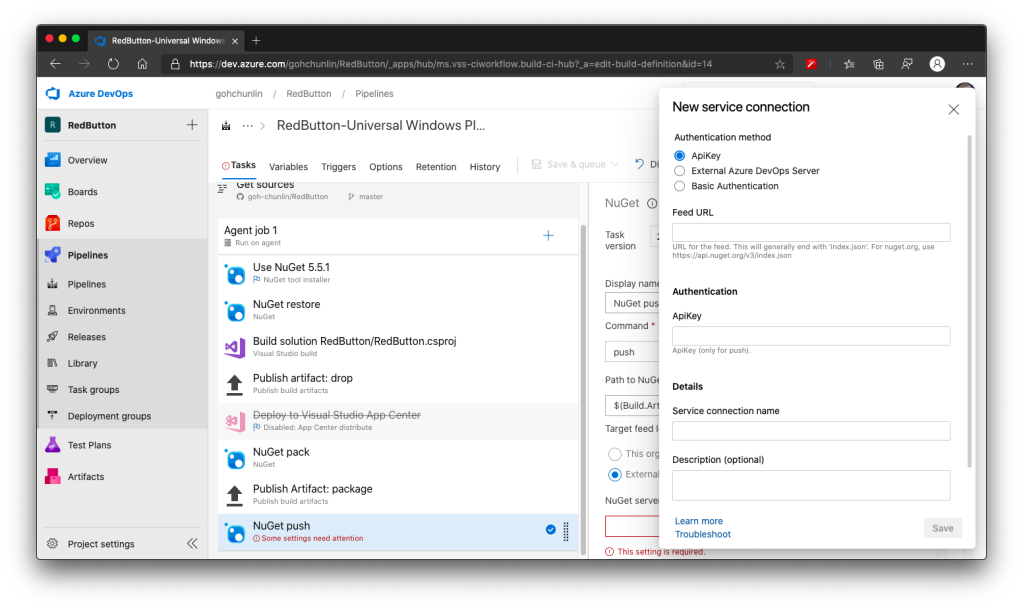
🎨 Adding a new connection to nuget.org. 🎨

Azure DevOps is so friendly that it tells us that “For nuget.org, use https://api.nuget.org/v3/index.json&#8221;, we will thus enter that URL as the Feed URL.
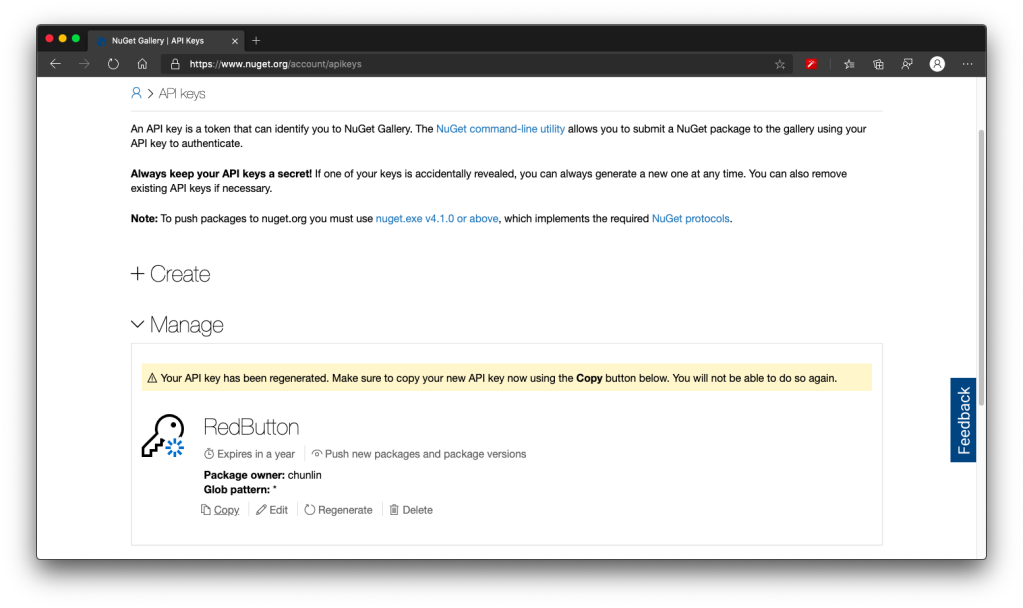
🎨 We will be using the API key that we generate in nuget.org for the NuGet push task. 🎨

With this NuGet push task setup successfully, we can proceed to save and run this pipeline.

After the tasks are all executed smoothly and successfully, we shall see our pre-released NuGet package available on the nuget.org website. Note that it requires an amount of time to do package validating before public can use the new package.
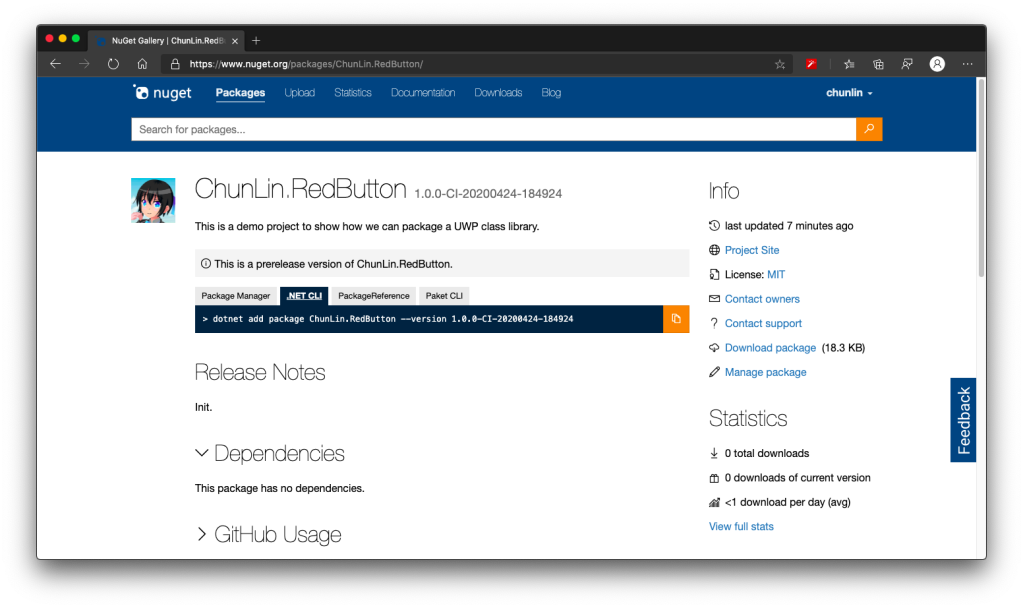
🎨 Yay, this is our first NuGet package. 🎨

This is not a happy ending yet. In fact, if we try this NuGet package, we will see the following error which states that it “cannot locate resource from ‘ms-appx:///RedButton/SimpleButton.xaml’.”
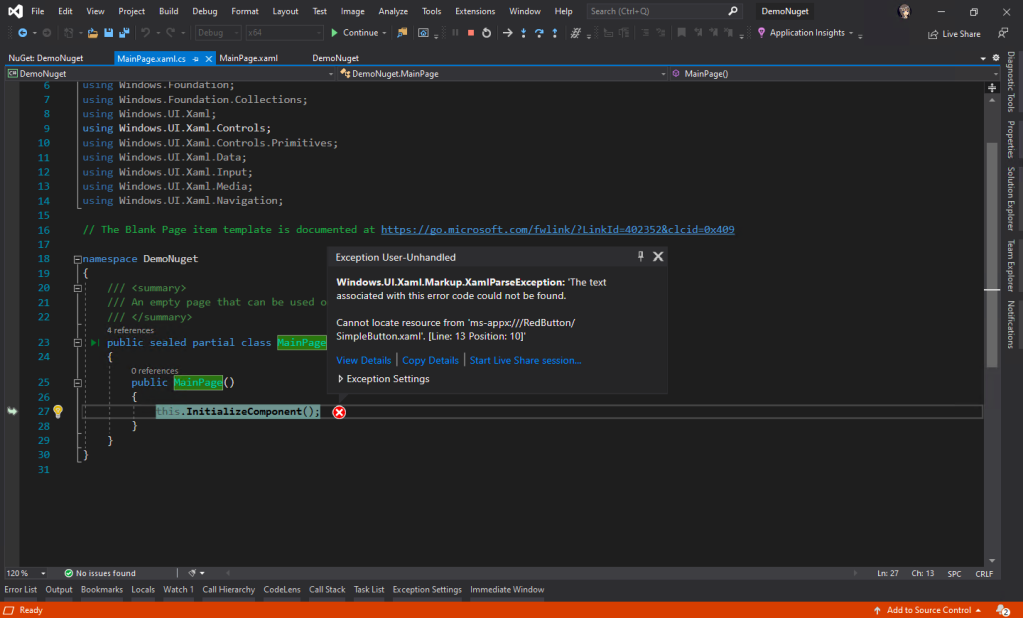
🎨 Windows.UI.Xaml.Markup.XamlParseException: ‘The text associated with this error code could not be found. 🎨

So what is happening here?

In fact, according to an answer on StackOverflow which later leads me to another post about Windows Phone 8.1, we need to make sure the file XAML Binary File (XBF) of our XAML component is put in the NuGet package as well.

To do so, we have to introduce a new task right after the third task, which is to copy the XBF file from obj folder to the Release folder in the bin folder, as shown in the following screenshot.
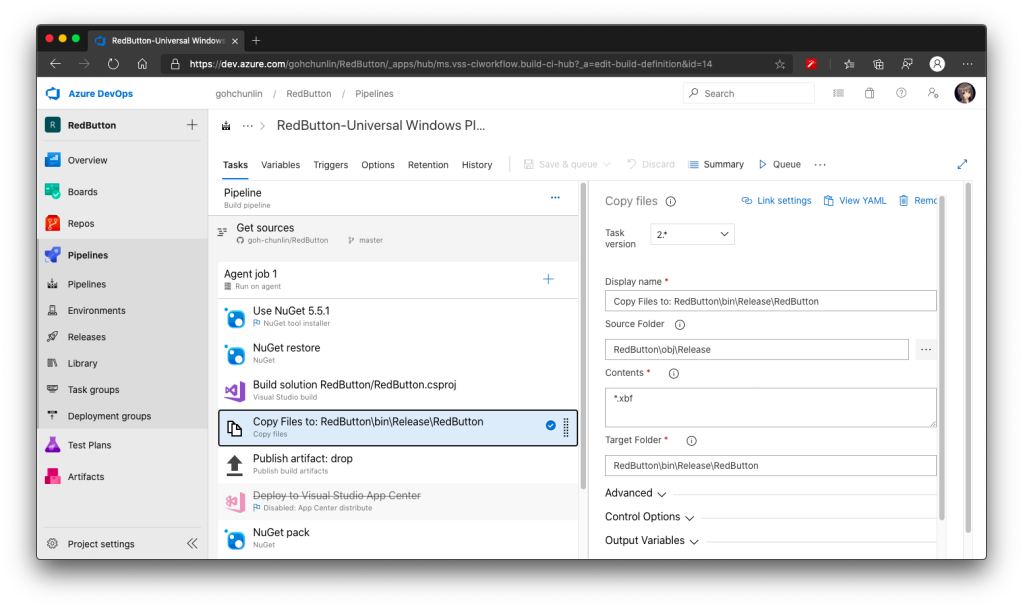
🎨 We need to add “Copy Files” task here. 🎨

Step 5: Targeting Framework

Before we make our NuGet package to work, we need to specify the framework it is targeting at. To do so, we need to introduce the <files> to our NuSpec.

So, the NuSpec should look something as follows now.
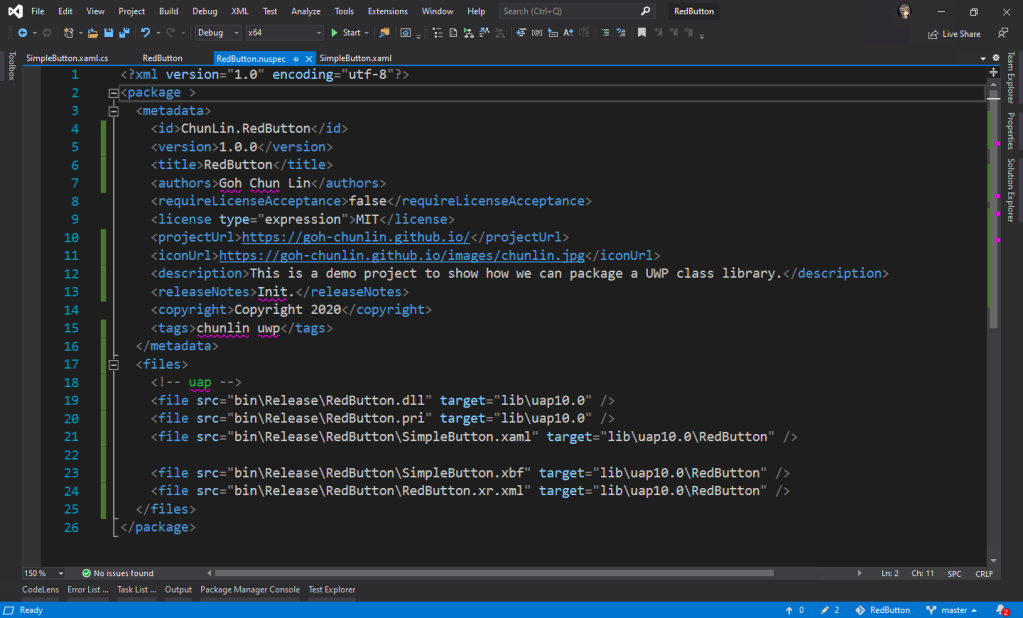
🎨 Finalised NuSpec. 🎨

Now with this, we can use our prerelease version of our UWP control in another UWP project through NuGet.
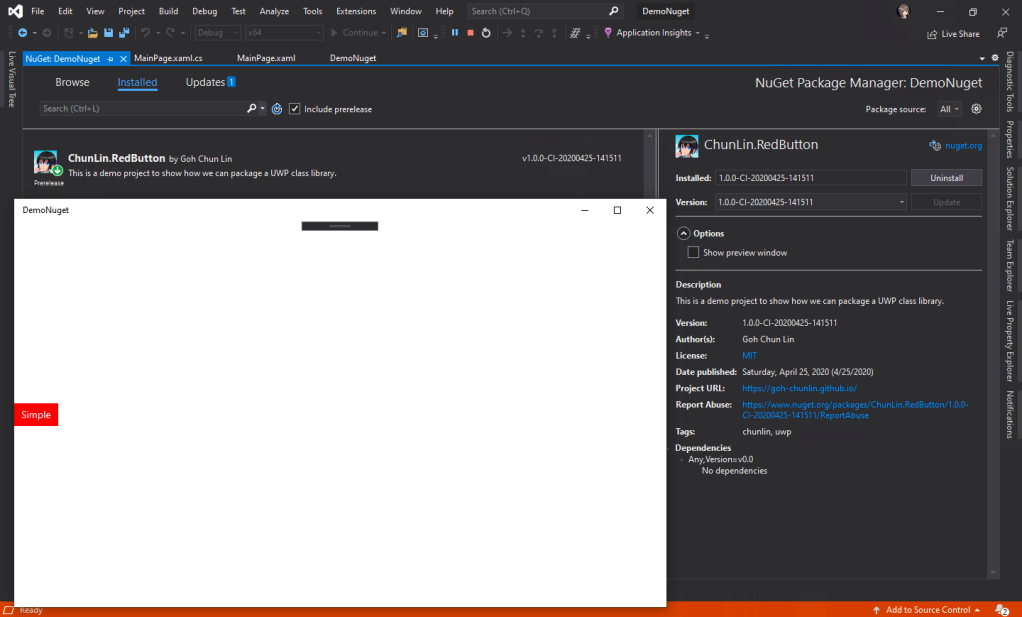
🎨 Yay, it works finally! 🎨

Step 6: Platform Release Issues

There will be time which requires us to specify the Platform to be, for example, x64 in the third task of the Azure DevOps pipeline above. That will result in putting the Release folder in both obj and bin to be moved to obj\x64 and bin\x64, respectively. This will undoubtedly make the entire build pipeline fails.

Hence we need to update the paths in the Copy File task (the fourth task) and add another Copy File task to move the Release folder back to be directly under the bin directory. Without doing this, the nuget pack task will fail as well.
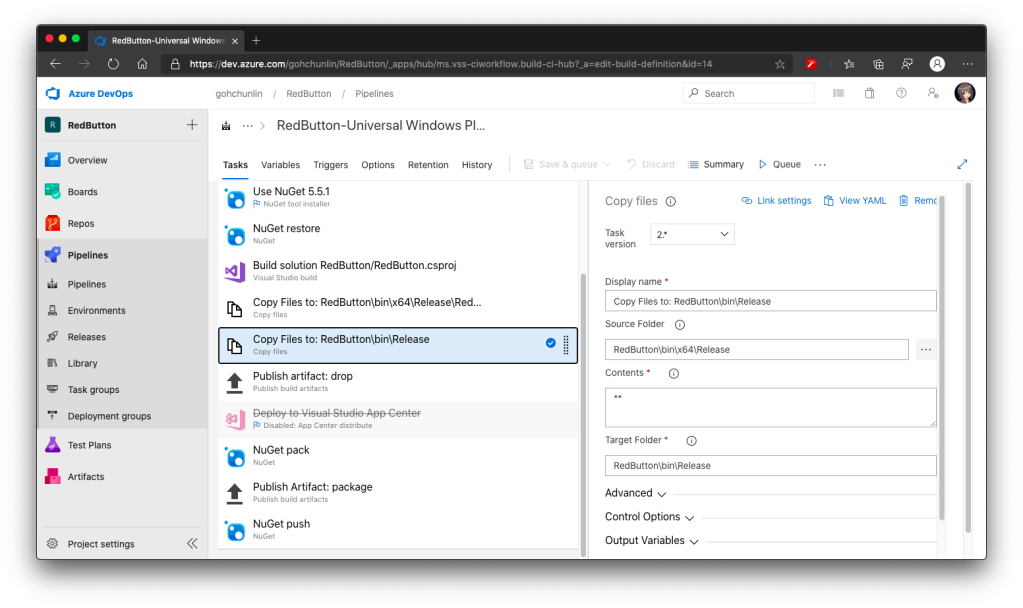
🎨 The new task to correct the position of the Release folder in bin. 🎨

Step 7: Dependencies

If our control relies on the other NuGet packages, for example Telerik.UI.for.UniversalWindowsPlatform, then we have to include them too inside the <metadata> in the NuSpec, as shown below.

<dependencies>
    <dependency id="Telerik.UI.for.UniversalWindowsPlatform" version="1.0.1.8" />
<dependencies>

Step 8: True Release

Okay, after we are happy with the prerelease of our NuGet package, we can officially release our package on the NuGet server. To do so, simply turn off the automatic package versioning on Azure DevOps, as shown in the screenshot below.
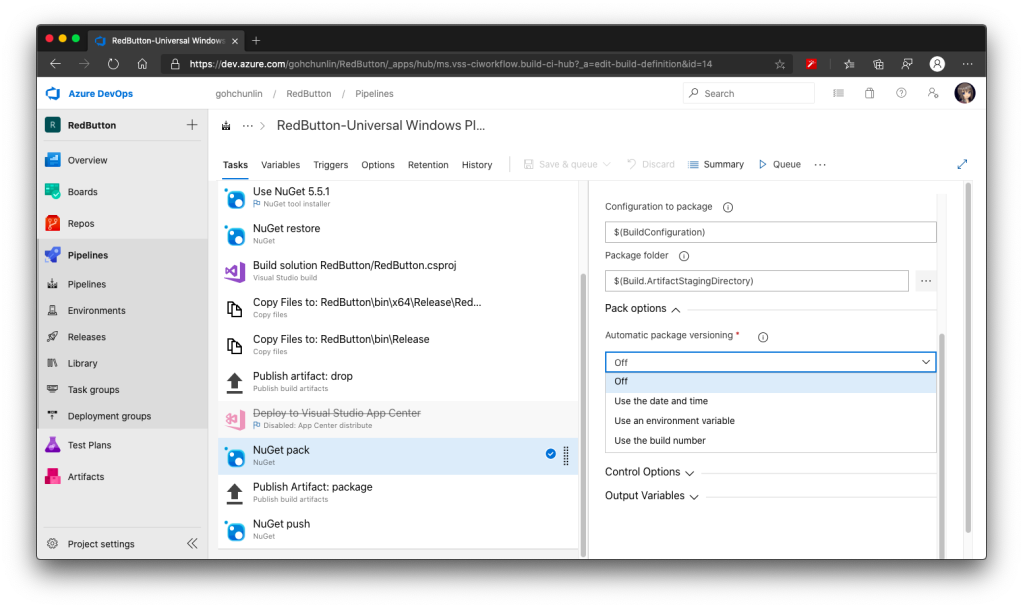
🎨 Turning off the automatic package versioning. 🎨

With this step, now when we run the pipeline again, it will generate a new release of the package without the prerelease label. The version number will follow the version we provide in the NuSpec file.
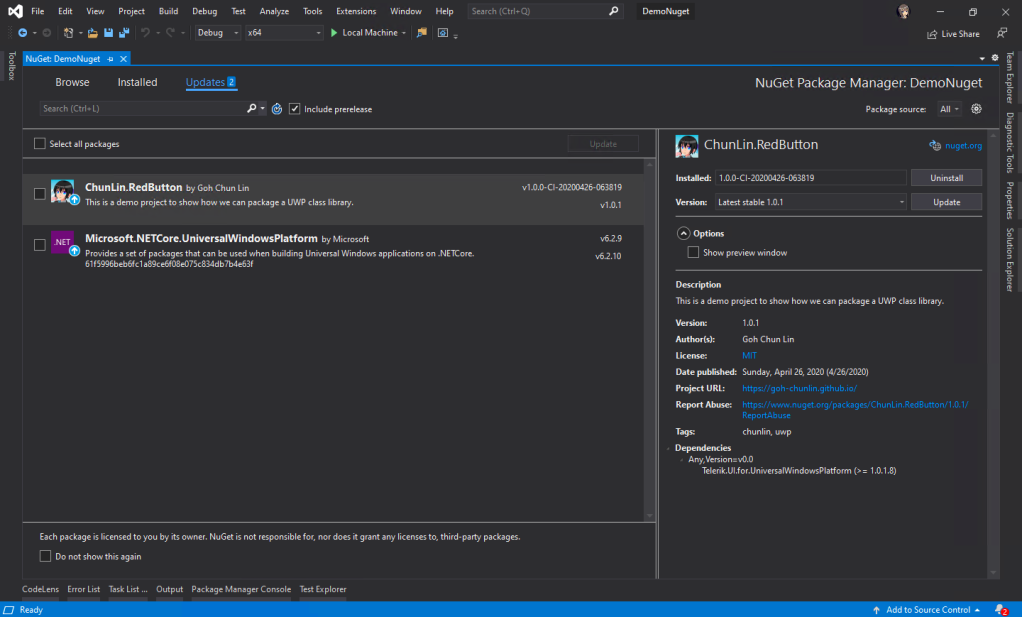
🎨 Now Visual Studio will say our package is “Latest stable” instead of prerelease. 🎨

Journey: 3 Days 3 Nights

The motivation of this project comes from a problem I encounter at workplace because our UWP class library could not be used whenever we consumed it as a NuGet package. This was also the time when Google and StackOverflow didn’t have proper answers on this.

Hence, it took me 1 working day and 2 days during weekend to research and come up with the steps above. Hopefully with my post, people around the world can easily pickup this skill without wasting too much effort and time.

Finally, I’d like to thank my senior Riza Marhaban for encouraging me in this tough period. Step 7 above is actually his idea as well. In addition, I have friend encouraging me online too in this tough Covid-19 lockdown. Thanks to all of them, I manage to learn something new in this weekend.

🎨 Yay. (Image Source: ARTE, Muse Asia) 🎨

References

Containerize Golang Code and Deploy to Azure Web App

Continue from the previous topic

Learning about containers is essentially a huge topic but for beginners, there needs to be something small to help them get started. Hence, in this article, we will focus only on the key concepts of containers and the steps to containerize the program and deploy it to Azure Web App.

In 2017, Azure introduced Web Apps for Containers. Before that, the Azure Web Apps actually ran on Windows VMs managed by Microsoft. So now with this new feature, we can build a custom Docker image containing all the binaries and files and then run a Docker container based on the image on Azure Web Apps. Hence, we can now bring our own Docker container images supporting Golang to Azure with its PaaS option.

As explained in the book “How to Containerize Your Go Code“, containers isolates an application so that container thinks it’s running on its own private machine. So, a container is similar to a VM but it uses the OS kernel on the host rather than having its own.

Firstly, we need to prepare the Dockerfile, a file having the instructions telling the Docker how to build the images automatically. So, a Dockerfile is simply a text file containing all the commands a user could call on the command line to assemble an image. Traditionally, the Dockerfile is named Dockerfile and located in the root of the context.

The Dockerfile we have for our project is as follows.

FROM scratch

EXPOSE 80

COPY GoLab /
COPY public public
COPY templates templates

ENV APPINSIGHTS_INSTRUMENTATIONKEY '' \
CONNECTION_STRING '' \
OAUTH_CLIENT_ID '' \
OAUTH_CLIENT_SECRET '' \
COOKIE_STORE_SECRET '' \
OAUTH2_CALLBACK ''

CMD [ "/GoLab" ]

The Dockerfile starts with a FROM command that specifies the starting point for the image to build. For our project, we don’t have any dependencies, so we can start from scratch. So what is scratch? Scratch is basically a special Docker image that is empty (0B). That means there will be nothing else in our container later aside from what we put in with the rest of the Dockerfile.

The reason why we build from scratch is because not only we can have a smaller image to build later, but also our container will have smaller attack surface. This is because the less code there is within our container, the less likely it is to include a vulnerability.

The EXPOSE 80 command is telling Docker that we need to open the port 80 because the web server is listening on port 80. Hence, in order to access our program from outside the container through HTTP, we need to define it in the Dockerfile that we need the port 80 to be always opened.

The next three COPY commands are basically copying firstly the GoLab executable into the root directory of the container and secondly the two directories, public and templates into the container. Without the HTML, CSS, and JavaScript, our web app will not work.

Now you may wonder why the first COPY command says GoLab instead of GoLab.exe. We shall discuss it later in this article.

After that, we use ENV command to set the environment variables that we will be using in the app.

Finally we have the line CMD [“/GoLab”] to directs the container as to which command to execute when the container is run.

Since the container is not a Windows container, the code that runs inside the container thus needs to be a Linux binary. Fortunately, this is really simple to obtain with the cross-compilation support in Go using the following command.

$ $env:GOOS = "linux"
$ go build -o GoLab .

Thus, in the Dockerfile, we use GoLab file instead of GoLab.exe.

We can now proceed to build the container image with the following command (Take note of the dot in the end of line).

$ docker image build -t chunlindocker/golab:v1 .

The -t flag is for us to specify the name and tag of the container. In this case, I call it chunlindocker/golab:v1 where chunlindocker is the Docker ID of my Docker Hub. Naming in such a way later helps me to push it to a registry, i.e. the Docker Hub.

My Docker Hub profile.

If we want to build the image with another dockerfile, for example Dockerfile.development, we can do it as follows.

$ docker image build -t chunlindocker/golab:v1 -f Dockerfile.development .

Once the docker image is built, we can see it listen when we perform the list command as shown in the screenshot below.

Created docker images.

Now the container image is “deployable”. That means we can run it anywhere with a running docker engine. Since our laptop has Docker installed, so we can proceed to run it locally with the following command.

$ docker container run -P chunlindocker/golab:v1

If you run the command above in the Terminal window inside VS Code, you will see that the command line is “stuck”. This is because the container is already running on local machine. So what we need to do is just open another terminal window and view all the running containers.

The docker ps command by default only shows running containers.

To help humans, Docker auto generates a random name with two words and assigns it to the container. We can see that the container we created is given a random name “nifty_elgama”, lol. So now our container has a “human” name to call. If you want to remove the container later, you not only need to Ctrl+C to stop it, but to totally remove it, you need to use the rm command as follows.

$ docker container rm nifty_elgama

The PORTS column shown in the screenshot is important because it tells us how ports exposed on the container can be accessed from the host. So to test it locally, we shall visit http://localhost:32768.

So our next step is to upload it to a container registry so that later it can be pulled onto any machines, including Azure Web Apps, that will run it. To do so, we do push the image we built above to Docker Hub with the following command.

$ docker push chunlindocker/golab:v1
Successfully push our new container image to Docker Hub.

So, now how do we deploy the container to Azure?

Firstly, we need to create a Web App for Containers on the Azure Portal, as shown in the screenshot below.

Creating Web App for Containers.

The last item in the configuration is the “Configure Container”. Clicking on that, we will be brought to the following screen where we can then specify the container image we want to use and pull it from Docker Hub.

We will be deploying single container called chunlindocker/golab:v4 from Docker Hub.

You can of course deploy a private container from Docker Hub by choosing “Private” as Repository Access. Then Azure Portal will prompt you for Docker Hub login credential for it to pull image from Docker Hub.

Once the App Service is created, we can proceed to read the Logs under “Container Settings”. Then we can see the container initializing process.

Logs about the container in App Service.

After that we can proceed to fill up the Application Settings with the environment variables we have in the web application and then we are good to go.

The website is up and running on Azure Web App for Containers.

References

Unit Testing with Golang

Continue from the previous topic

Unit Testing is a level of automated software testing that units which can be modular parts of the program are tested. Normally, the “unit” refers to a function, but it doesn’t necessary always be so. A unit typically takes in data and returns an output. Correspondingly, a unit test case passes data into the unit and check the resultant output to see if they meet the expectations.

Unit Testing Files

In Golang, unit test cases are written in <module>_test.go files, grouped according to their functionality. In our case, when we do unit testing for the videos web services, we will have the unit test cases written in video_test.go. Also, the test files need to be in the same package as tested functions.

Necessary Packages

In the beginning, we need to import the “testing” package. In each of our unit test function, we will take in a parameter t which is a pointer to testing.T struct. It is the main struct that we will be using to call out any failure or error.

In our code video_test.go, we use only the function Error in testing.T to log the errors and to mark the test function fails. In fact, Error function is a convenient function in the package that combines calling of Log function and then the Fail function. The Fail function marks the test case has failed but it still allows the execution of the rest of the test case. There is another similar function called FailNow. The FailNow function is stricter and exits the test case once it’s encountered. So, if FailNow function is what you need, you have to call the Fatal function which is another convenient function that combines Log and FailNow instead of the Error function.

Besides the “testing” package, there is another package that we need in order to do unit testing for Golang web applications. It is the “net/http/httptest” package. It allows us to use the client functions of the “net/http” package to send an HTTP request and capturing the HTTP response.

Test Doubles, Mock, and Dependency Injection

Before proceeding to writing unit test functions, we need to get ready with Test Doubles. Test Double is a generic term for any case where we replace a production object for testing purposes. There are several different types of Test Double, of which a Mock is one. Using Test Doubles helps making the unit test cases more independent.

In video_test.go, we apply the Dependency Injection in the design of Test Doubles. Dependency Injection is a design pattern that decouples the layer dependencies in our program. This is done through passing a dependency to the called object, structure, or function. This dependency is used to perform the action instead of the object, structure, or function.

Currently, the handleVideoRequests handler function uses a global sql.DB struct to open a database connection to our PostgreSQL database to perform the CRUD. For unit testing, we should not depend on database connection so much and thus the dependency on sql.DB should be removed. The dependency on sql.DB then should be injected into the process flow from the main program.

To do so, firstly, we need to introduce a new interface called IVideo.

type IVideo interface {

GetVideo(userID string, id int) (err error)
GetAllVideos(userID string) (videos []Video, err error)
CreateVideo(userID string) (err error)
UpdateVideo(userID string) (err error)
DeleteVideo() (err error)

}

Secondly, we make our Video struct to implement the new interface and let one of the fields in the Video struct a pointer to sql.DB. Unlike in C#, we have to specify which interface the class is implementing, in Golang, as long as the Video struct implements all the methods that IVideo has (which is already does), then Video struct is implementing the IVideo interface. So now our Video struct looks as following.

type Video struct {
Db *sql.DB
ID int `json:"id"`
Name string `json:"videoTitle"`
URL string `json:"url"`
YoutubeVideoID string `json:"youtubeVideoId"`
}

As you can see, we added a new field called Db which is a pointer to sql.DB.

Now, we can create a Test Double called FakeVideo which implements IVideo interface to be used in unit testing.

// FakeVideo is a record of favourite video for unit test
type FakeVideo struct {
ID int `json:"id"`
Name string `json:"videoTitle"`
URL string `json:"url"`
YoutubeVideoID string `json:"youtubeVideoId"`
CreatedBy string `json:"createdBy"`
}


// GetVideo returns one single video record based on id
func (video *FakeVideo) GetVideo(userID string, id int) (err error) {
jsonFile, err := os.Open("testdata/fake_videos.json")
if err != nil {
return
}

defer jsonFile.Close()

jsonData, err := ioutil.ReadAll(jsonFile)
if err != nil {
return
}

var fakeVideos []FakeVideo
json.Unmarshal(jsonData, &fakeVideos)

for _, fakeVideo := range fakeVideos {
if fakeVideo.ID == id && fakeVideo.CreatedBy == userID {
video.ID = fakeVideo.ID
video.Name = fakeVideo.Name
video.URL = fakeVideo.URL
video.YoutubeVideoID = fakeVideo.YoutubeVideoID

return
}
}

err = errors.New("no corresponding video found")

return
}
...

So instead of reading the info from the PostgreSQL database, we read mock data from a JSON file which is stored in testdata folder. The testdata folder is a special folder where Golang will ignores when it builds the project. Hence, with this folder, we can easily read our test data from JSON file fake_videos.json through relative path from video_test.go.

Since now the Video struct is updated, we need to update our handleVideoAPIRequests method to be as follows.

func handleVideoAPIRequests(video models.IVideo) http.HandlerFunc {
    return func(writer http.ResponseWriter, request *http.Request) {
        var err error

       ...

        switch request.Method {
        case "GET":
            err = handleVideoAPIGet(writer, request, video, user)
        case "POST":
            err = handleVideoAPIPost(writer, request, video, user)
        case "PUT":
            err = handleVideoAPIPut(writer, request, video, user)
        case "DELETE":
            err = handleVideoAPIDelete(writer, request, video, user)
        }

        if err != nil {
            util.CheckError(err)
            return
        }
    }
}

So now we pass an instance of the Video struct directly into the handleVideoAPIRequests. The various Video methods will use the sql.DB that is a field in the struct instead. At this point of time, handleVideoAPIRequests no longer follows the ServeHTTP method signature and is no longer a handler function.

Thus, in the main function, instead of attaching a handler function to the URL, we call the handleVideoAPIRequests function as follows.

func main() {
...

mux.HandleFunc("/api/video/",
handleRequestWithLog(handleVideoAPIRequests(&models.Video{Db: db})))

...
}

Writing Unit Test Cases for Web Services

Now we are good to write unit test cases in video_test.go. Instead of passing a Video struct like in server.go, this time we pass in the FakeVideo struct, as highlighted in one of the test cases below.

func TestHandleGetAllVideos(t *testing.T) {
    mux = http.NewServeMux()
    mux.HandleFunc("/api/video/", handleVideoAPIRequests(&models.FakeVideo{}))
    writer = httptest.NewRecorder()

    request, _ := http.NewRequest("GET", "/api/video/", nil)
    mux.ServeHTTP(writer, request)

   if writer.Code != 200 {
        t.Errorf("Response code is %v", writer.Code)
    }

    var videos []models.Video
    json.Unmarshal(writer.Body.Bytes(), &videos)

    if len(videos) != 2 {
        t.Errorf("The list of videos is retrieved wrongly")
    }
}

By doing this, instead of fetching videos from the PostgreSQL database, now it will get from the fake_videos.json in testdata.

Testing with Mock User Info

Now, since we have implemented user authentication, how do we make it works in unit testing also. To do so, in auth.go, we introduce a flag called isTesting which is false as follows.

// This flag is for the use of unit testing to do fake login
var isTesting bool

Then in the TestMain function, which is provided in testing package to do setup or teardown, we will set this to be true.

So how do we use this information? In auth.go, there is this function profileFromSession which retrieves the Google user information stored in the session. For unit testing, we won’t have this kind of user information. Hence, we need to mock this data too as shown below.

if isTesting {
        return &Profile{
            ID: "154226945598527500122",
            DisplayName: "Chun Lin",
            ImageURL: "https://avatars1.githubusercontent.com/u/8535306?s=460&v=4",
        }
    }

With this, then we can test whether the functions, for example, are retrieving correct videos of the specified user.

Running Unit Test Locally and on Azure DevOps

Finally, to run the test cases, we simply use the command below.

go test -v

Alternatively, Visual Studio Code allows us to run specified test case by clicking on the “Run Test” link above the test case.

Running test on VS Code.

We can then continue to add the testing as one of the steps in Azure DevOps Build pipeline, as shown below.

Added the go test task in Azure DevOps Build pipeline.

By doing this, if any of the test cases fails, there won’t be a build made and thus our system becomes more stable now.

Deploy Golang App to Azure Web Apps with CI/CD on DevOps

Continue from the previous topic

After we have our code on Github repository, now it’s time to automate our builds and deployments so that our Golang application will always be updated whenever there is a new change to our code on Github.

Sample Golang Web App DevOps Pipelines

To do that, we will use Azure DevOps and its Pipelines module. We can easily create a DevOps project in Azure Portal for our Golang application because there is a template available.

Golang is one of the supported languages in Azure DevOps.

As a start, we will focus on “Windows Web App” instead of containers. After that, we just need to configure basic information of the web app, such as its name, location, resource group, pricing tier, and application insights.

We can configure Application Insights while creating the DevOps project.

After that, we shall be able to see a new DevOps project created with the following two folders, Application and ArmTemplates, in Repos. Application folder contains a sample Golang application.

However, why is there an ArmTemplates folder? This is because by default when we create a new Azure DevOps project for Golang application using the steps above, it will also automatically create a web app for us. Hence, this is the ARM (Azure Resource Manager) template Azure uses to do that.

Content of ArtTemplate which is used to create/update the Azure web app.

With this pipeline setup, we can simply update the default Golang code in the Repos to launch our Golang application on Azure. However, what if we want to link Azure DevOps with the codes we already have on our Github repo?

Connecting DevOps with Github

To do that, let’s start again by creating a new project on Azure DevOps, instead of Azure portal. Here, I will make the DevOps project to be Public so that you can access it while reading this article.

Creating a new public DevOps project.

Once the project is created, we can proceed to the Project Settings page of the project to disable some modules that we don’t need, i.e. Boards and Repos.

We need to hide both Boards and Repos because Github provides us similar features.

Setting up Build Pipeline

After this, we then can proceed to create our Build pipeline by first a connecting to our Github repo.

If our code is neither on DevOps or Github, we can click “Use the visual designer” to proceed.

Before continuing to choose the corresponding Github repo, we need to have a azure-pipelines.yml. To understand the guidelines to write proper Azure DevOps Pipelines YAML, we can refer to the official guide. For Golang, there is another specific documentation on how to build and test Golang projects with Azure DevOps Pipelines.

For our case, we will have the following pipeline YAML file.

# Go 
# Build your Go project.

resources:
- repo: self

pool:
vmImage: 'vs2017-win2016'

steps:
- task: GoTool@0
inputs:
version: 1.11.5
displayName: 'Use Go 1.11.5'
- task: Go@0
displayName: 'go get'
inputs:
arguments: '-d'
workingDirectory: '$(System.DefaultWorkingDirectory)'
- task: Go@0
displayName: 'go build'
inputs:
command: build
arguments: '-o "$(System.TeamProject).exe"'
workingDirectory: '$(System.DefaultWorkingDirectory)'
- task: ArchiveFiles@2
displayName: 'Archive Files'
inputs:
rootFolderOrFile: '$(Build.Repository.LocalPath)'
includeRootFolder: False
- task: PublishBuildArtifacts@1
displayName: 'Publish Artifact'
inputs:
artifactName: drop

There are a few virtual machine images from Microsoft-hosted agent pool. We choose the “Visual Studio 2017 on Windows Server 2016 (vs2017-win2016)” image because I normally use Visual Studio 2017 for development.

The first task is the Go Tool Installer task. It will find and download a specific version of the Go tool into the tool cache and add it to the PATH. Here we will use the latest version of Golang which is 1.11.5 at the point of writing this article.

The subsequent step will be running go get. This command will download the packages along with their dependencies. Since the -d argument is present, it will only download them but not install them.

After that, it will run go build. This step compiles the packages along with their dependencies, but it does not install the results. By default, the build command will write the resulting executable to an output file named after the first source file (or the source code directory). However, with the -o flag here, it forces build to write the resulting executable to the output file named $(System.TeamProject).exe, i.e. GoLab.exe.

Next we use the Archive Files task to create an archive file from a source folder. Finally, we use the Publish Build Artifacts task to publish build artifact to DevOps pipelines. With Archive Files task, it will generate a zip file called as such D:\a\1\a\54.zip where 54 is the build id. Publish Build Artifacts task will then upload the zip file to file container called drop.

Details of the Archive Files task.

To find out what is inside the file container drop, we can download it from the Summary page of the build. It is actually a folder containing all the files of our Golang application.

We can download the drop from the Summary page of the build.

Setting up Release Pipeline

Now we can proceed to create our Release pipeline. Luckily, there is already a template available to help us kick starting the Release pipeline.

The “Deploy a Go app to Azure App Service” pipeline is what we need here.

After selecting the template, we will need to specify the artifact, as shown below. There is version that we can choose, for example, the latest version from a specific branch with tags. Here we choose Latest so that our latest code change will always get deployed to Azure Web Apps.

Adding artifact.

Next, we need to enable the CD trigger as shown in the following screenshot so that a new release will be created every time a new build is available.

Enabling CD trigger.

Now we are at Pipeline tab. What we need to next is to move on to the Tasks tab, which is now having a red exclamation mark. We just need to authorize the Release pipeline to our Azure subscription and then connect it to the Azure Web App in the subscription.

Completing tasks.

Now, as you can see, the agent basically does three steps:

  • Stop the Azure Web App;
  • Deploy our code to Web App;
  • Start the Web App.

What interests us here is the second step. The reason why we need to generate a zip file in Build pipeline is also because in the second step, we need to specify the file path to the zip files to deploy.

Default configuration of second step.

Finally, we can just Save the pipeline and rename the “New release pipeline” to another friendlier name.

Now we can manually create a Release to test it out.

Create a new release manually.

Since we trigger this release manually, we also need to click in to deploy it manually.

Deploying to Azure App Service in progress.

After the deployment is done, we can view its summary as shown below.

The deployment process of the agent.

Conclusion

That’s all for setting up simple build and release pipelines on Azure DevOps to deploy our Golang web app to Azure Web Apps.