Last week after uploading an updated version of my ASP web app to the server, it showed an error at the place where data is inserted into the database using a stored procedure.
The error message is “Procedure or Function ‘A’ expects parameter ‘@B’, which was not supplied”.
I double checked my code. Yes, all the required parameters present in the web service code. Yes, the stored procedure is written correctly. Yes, the code does supply the parameter. So, why is there an error?
I searched on Google and found that there were many people facing this problem. Yet, their solutions are all different from each other. So, I decided to share those I found. Besides, in the end, I will also talk about how I solved it eventually.
publiv void insertData()
{
 SqlConnection con = new SqlConnection(str_con);
 con.Open();
 SqlCommand cmd = new SqlCommand();
 cmd.CommandText = "InsertInfo";
 cmd.CommandType = CommandType.StoredProcedure;
 cmd.Connection = con;

 string name = Convert.ToString(txtName.Text);

 cmd.Parameters.Add("@s_name", SqlDbType.VarChar).Value = name;

 cmd.ExecuteNonQuery();
 con.Close();
}
Stored Procedure
SET ANSI_NULLS OFF
GO
SET QUOTED_IDENTIFIER OFF
GO
ALTER PROCEDURE [dbo].[bkg_Insert_Members_FromCompanyID]
@s_name varchar(50)
AS
-- Variable Declaration
DECLARE @iReturn INT
INSERT INTO Members (member_name) Values (@s_name)
SET @iReturn = @@error
RETURN @iReturn
Although both CS code and stored procedure are written correctly, due to the fact that there is one line “exec <stored procedure name>” at the end of the stored procedure, the error happens. To solve the problem, just need to remove the unnecessary line.
The same error will be thrown if the name of the data field used in the CS code is different from the parameter name of the stored procedure or the name of the field in the table. I don’t know what to say besides \bat the programmer.
Yes, there is a value assigned to the parameter of the stored procedure in the CS code. However, the SQLCommand object is later replaced. Oh my… I have no comment about this.
Ah-ha-ha-ha, problem solved!. Image Credits: Little Busters! EX
So, how about my one? It turns out that it is because my web service project is not updated after doing the compilation. After rebuilding the web service project, everything is working again.
Few days after the Dream Build Launch hackathon held at Microsoft Singapore office, Desmond and I received an email from Microsoft. The email is to inform us that our app, EsplanadeGo!, that we built during the 24-hour hackathon was selected as one of the applications with high potential on the Windows Store and thus both of us got the opportunity to take part in the Premier Field Engineer (PFE) consultation sessions.
I had been excited about it ever since I received the email and confirmed the 2-hour timeslot for our PFE consultation session. We’re actually invited twice to the PFE consultation session. The first time was in 25 July. During the consultation session, we received feedback from Noemi, Premier Field Engineer from Microsoft Philippines, through Skype. During the consultation session, we went through each item listed on Application Profile Survey. In the survey, as the developers of the app, we needed to answer the questions related to the user experience, user interface and performance of our app.
Through the PFE consultation session, we found out some of the mistakes we made in our app. With the suggestion given by Noemi, we were able to further improve our app which was later reviewed again in 16 August. After the second review, we were finally granted a token which allowed us to submit our Win8 app to the Windows Store. Hence, I decided to have this post to share the problems we encountered in our Win8 app development journey as well as some of the solutions we tried.
Network Connectivity Detection
As what Justin shared in his talk “HTML5 – The road to multi-platform serenity” during the Geekcamp.SG, it’s important to check for the network connection status of a mobile device and to make sure the mobile apps that we build can function properly even in an environment without the Internet access.
In order to have the event handler to be added to the NetworkStatusChanged event at the moment our app runs, we have the following code in our App.xaml.cs.
namespace EsplanadeGo
{
    public delegate void NetworkStatusKenaChangedEventHandler(object sender, NetworkStatusKenaChanged e);
    ...

    sealed partial class App : Application
    {
        public static event NetworkStatusKenaChangedEventHandler NetworkKenaChanged;
        public static bool registeredNetworkStatusNotif = false;
        ...

        public App()
        {
            ...
            if (!registeredNetworkStatusNotif)
            {
                NetworkInformation.NetworkStatusChanged += new NetworkStatusChangedEventHandler(OnNetworkStatusChange);
                registeredNetworkStatusNotif = true;
            }
    }

    public statis bool isConnected()
    {
        ConnectionProfile profile = NetworkInformation.GetInternetConnectionProfile();
        return (profile != null && profile.GetNetworkConnectivityLevel().Equals(NetworkConnectivityLevel.InternetAccess));
    }

    void OnNetworkStatusChange(object sender)
    {
        NetworkKenaChanged(this, new NetworkStatusKenaChanged(isConnected()));
    }

    ...
}
The reason why we have another event defined by us triggered when OnNetworkStatusChange event occurs is that we need to show a message to our user telling him/her that there is currently no Internet access. However, we cannot directly add the code in OnNetworkStatusChange() because a change to the UI through a non-GUI thread will raise an error: Element not found.
After doing some searching on the Internet, I found a solution suggested by invalidusername on StackOverflow. Although that is a Windows Phone 7 related discussion, his method works very well in our Win8 app. So, when App class receives a notification about the change of network connectivity status, it will trigger another event, NetworkKenaChanged, which is subscribed by all the pages in our app. As a result, no matter where the user enters our app, the user will always receive the notification about the change of network connectivity.
Here is what we have in our NetworkStatusKenaChanged class (By the way, “kena” is Singlish, which is served as the passive marker as “by” in English).
public class NetworkStatusKenaChanged:EventArgs
{
    bool isConnected = false;

    public NetworkStatusKenaChanged(bool isConnected):base()
    {
        this.isConnected = isConnected;
    }

    public book ConnectionStatus
    {
        get { return isConnected; }
    }
 }
Thus, in every single page in our app, after subscribing the event, what we need to do is just having the following code to show the message telling our user that there is no Internet connection.
private async void App_NetworkKenaChanged(object sender, NetworkStatusKenaChanged e)
{
    if(App.isConnected())
    {
        await Dispatcher.RunAsync(Windows.UI.Core.CoreDispatcherPrority.Normal,
            async() => { RetrieveItemInfoFromWeb(); });
    }
    else
    {
        await Dispatcher.RunAsync(Windows.UI.Core.CoreDispatcherPrority.Normal, async() =>
            {
                MessageDialog msg = new MessageDialog("There is no Internet connection.",
                    "No Internet Access");
                await msg.ShowAsync();
            });
    }
}
Since EsplanaGo! uses data from the Internet, so it’s important to inform the user if there is no Internet connection.
Local Storage
In the first design of our app, Esplanade web pages would be crawled each time when the app was launched. As suggested in the Application Profile Survey, unnecessary or repeated downloads should be minimized. Thus, now, our app will crawl one Esplanade web page only when a certain tile is clicked by the user.
In addition, since the data we use in our app is live data. So, we need to store the data in local storage so that our app is still usable under the environment without the Internet access.
There are nothing much to store in local storage for our app. What we are going to store is just be the info of the events, such as date, venue and description of the event. Since they are just texts, so we can easily do the local storing with ApplicationData.LocalSettings, as shown below.
// For storing local settings
Windows.Storage.ApplicationDataContainer localData = Windows.Storage.ApplicationData.Current.LocalSettings;
// Save event info to Local Settings
localData.Values["Title"] = individualEvent.Name;
localData.Values["Subtitle"] = individualEvent.DateTime;
localData.Values["ImagePath"] = individualEvent.ImagePath;
localData.Values["Description"] = individualEvent.Venue;
localData.Values["Content"] = synopsis.ToString();
To retrieve the information from local storage, we simply need to use the ApplicationDataContainer.Values property to access the setting in the localData container.
Cached Images Hide-and-Seek
Something that I did not find out before attending the second PFE consultation session is that how come the event thumbnails are cached without us doing anything in our code.
During the second consultation session, we spent about half an hour just to find out the place where the thumbnails were cached. It turns out that the cached thumbnails are actually located in “C:\Users\<UserName>\AppData\Local\Packages\<AppName>\AC\INetCache”. It is a hidden folder which “Hide protected operating system files (Recommended)” under the Folder Views needs to be unchecked first before it can be visible.
Allow to display protected OS files.The images are actually cached and stored in separate folders.
For the <AppName>, it can be found in the Windows App Certificate Kit Test (WACK) Results report.
The AppName can be found in the Windows App Certificate Kit (WACK) Test Results.
It is interesting to know that the caching of images used in the app is automatically handled without doing any programming. Thus, we only store the path to the image in the local settings without storing the image itself.
Besides, under the directory “C:\Users\<UserName>\AppData\Local\Packages\<AppName>\Settings”, there should be a file named settings.dat where values stored in local settings can be found.
Handle PLM State Appropriately
PLM stands for “Process Life-cycle Management”. As stated in the Application Profile Survey, handling PLM is “to allow your users to switch across apps and feel like they never left your app”.
One way of doing that is saving the application data when the app is being suspended. This helps the app to be resumed even if it is terminated by Windows. There is, in fact, a list of official guidelines for app suspend and resume available as well.
For our app, EsplanadeGo!, due to the fact that we already store the relevant information when the user clicks on a tile, so we do not need to write any code for the app suspend. What we do is actually just to have the following code in the App.xaml.cs to load the saved states of the app.
/// <summary>
/// Invoked when the application is launched normally by the end user. Other entry points
/// will be used when the application is launched to open a specific file, to display
/// search results, and so forth.
/// </summary>
/// <param name="args">Details about the launch request and process.</param>
protected override async void OnLaunched(LaunchActivatedEventArgs args)
{
    // Do not repeat app initialization when already running, just ensure that
    // the window is active
    if (args.PreviousExecutionState == ApplicationExecutionState.Running)
    {
        Window.Current.Activate();
        return;
    }
    // Create a Frame to act as the navigation context and associate it with
    // a SuspensionManager key
    var rootFrame = new CharmFrame { CharmContent = new CustomCharmFlyout() };
    SuspensionManager.RegisterFrame(rootFrame, "AppFrame");
    if (args.PreviousExecutionState == ApplicationExecutionState.Terminated)
    {
        // Restore the saved session state only when appropriate
        await SuspensionManager.RestoreAsync();
    }
    if (rootFrame.Content == null)
    {
        // When the navigation stack isn't restored navigate to the first page,
        // configuring the new page by passing required information as a navigation parameter
        if (!rootFrame.Navigate(typeof(ItemsPage), "AllGroups"))
        {
            throw new Exception("Failed to create initial page");
        }
    }
    // Place the frame in the current Window and ensure that it is active
    Window.Current.Content = rootFrame;
    Window.Current.Activate();
}
If you are using a template project offered by Visual Studio 2012, then all these are actually done for you already. Thanks nice guy Visual Studio. =P
So, when will the app terminated? According to MSDN on the topic of application life-cycle, “Windows may terminate your app after it has been suspended for a number of reasons. The user may manually close your app, or sign out, or the system may be running low on resources.” Thus, in the code above, there is this line which helps us to check if the app is terminated by Windows or not:
The capabilities of the app can be hidden through the Package.appxmanifest in Visual Studio.
Meanwhile, it is also important to not show permissions that are not even used in the app. For example, an app like our EsplanadeGo! which only display data should not have permission settings like Webcam, Microphone, Location and so on. All these can be managed under the Capabilities tab in Package.appxmanifest.
App Bar
In the second version of EsplanadeGo!, we introduce a Refresh function in the App Bar. The position of the button in App Bar is important. Based on and the UX design guidelines in MSDN and the official guidelines for commands in the App Bar, we should always places persistent and default commands on the right side of the App Bar and starts our commands on the right.
Refresh function is available in EsplanadeGo!.
The following is the XAML code to include a Refresh button in the App Bar.
Previously, we wrongly put a Share command in the App Bar to invoke sharing. This is, in fact, not a recommended way of using the App Bar, as specified in the guidelines for sharing content.
RenRen with Our App: Share Fun with Your Friends
The reason why we had a Share command in the App Bar is because we implemented Share Source Contract in our app. When I first heard about Sharing Charm two month ago, I had always wanted to tried it out once myself.
To have this feature, I use DataTransferManager in our app. The following code is what I have in one of our pages to allow user to share an event info, such as event name and description to other app (RenRen HD, Mail, etc.).
DataTransferManager dataTransferManager;
protected override void OnNavigatedTo(NavigationEventArgs e)
{
    base.OnNavigatedTo(e);
    // Register this page as a share source.
    this.dataTransferManager = DataTransferManager.GetForCurrentView();
    this.dataTransferManager.DataRequested += new TypedEventHandler<DataTransferManager, DataRequestedEventArgs>(this.DataRequested);
}
protected override void OnNavigatedFrom(NavigationEventArgs e)
{
    base.OnNavigatedFrom(e);
    // Unregister this page as a share source.
    this.dataTransferManager.DataRequested -= new TypedEventHandler<DataTransferManager, DataRequestedEventArgs>(this.DataRequested);
}
private void DataRequested(DataTransferManager sender, DataRequestedEventArgs e)
{
    var selectedItem = (SampleDataItem)this.itemsViewSource.View.CurrentItem;
    if (selectedItem != null)
    {
        DataRequest request = e.Request;
        request.Data.Properties.Title = selectedItem.Title != null ? selectedItem.Title : "";
        request.Data.Properties.Description = selectedItem.Subtitle != null ? selectedItem.Subtitle : "";
        request.Data.SetText(selectedItem.Content);
    }
}
Sharing event info with RenRen friends.
Here, I need to apologize to my friends on RenRen because I spammed their wall when I was testing this feature. =P
Logos: Design Is Important Also
During our first PFE consultation session, we were asked to have a better design for our app logo. To give the users a better experience when they are using our app, we were advised to have the same logo used for Wide Logo, Small Logo and Splash Screen.
EsplanadeGo! Logo on Start MenuEspanadeGo! Small Logo now uses the same logo as the Wide Logo.
In addition, it is important not to have app name appeared on both logo and the tile at the same time. Hence, it there is already a word “Esplanade” as part of the logo, then we should hide the app name”EsplanadeGo!” on the tile on Start page.
ProgressRing, Not Onion Ring: The App Is Still Loading!
Back in the old days, we have only things like progress bar to show the loading speed of tasks. Now, in Windows 8, we have a cooler control known as the Progress Ring. I love how a progress ring can be added to the GUI easily with just one line in XAML.
To implement that look-and-feel, I modified the sample code generated by Visual Studio in SampleDataSource.cs as follows.
namespace EsplanadeGo.Data
{
    public interface IResizable
    {
        int Width { get; set; }
        int Height { get; set; }
    }

/// <summary>
/// Base class for <see cref="SampleDataItem"/> and <see cref="SampleDataGroup"/> that
/// defines properties common to both.
/// </summary>
[Windows.Foundation.Metadata.WebHostHidden]
public abstract class SampleDataCommon : HelloWorldSplit.Common.BindableBase, IResizable
{
    ...
    public SampleDataCommon(String uniqueId, String title, String subtitle, String imagePath, String description, int width, int height)
    {
        ...
        this._width = width;
        this._height = height;
    }

    ...
    private int _width = 0;
    public int Width
    {
        get { return this._width; }
        set { this.SetProperty(ref this._width, value); }
    }
    private int _height = 0;
    public int Height
    {
        get { return this._height; }
        set { this.SetProperty(ref this._height, value); }
    }
}
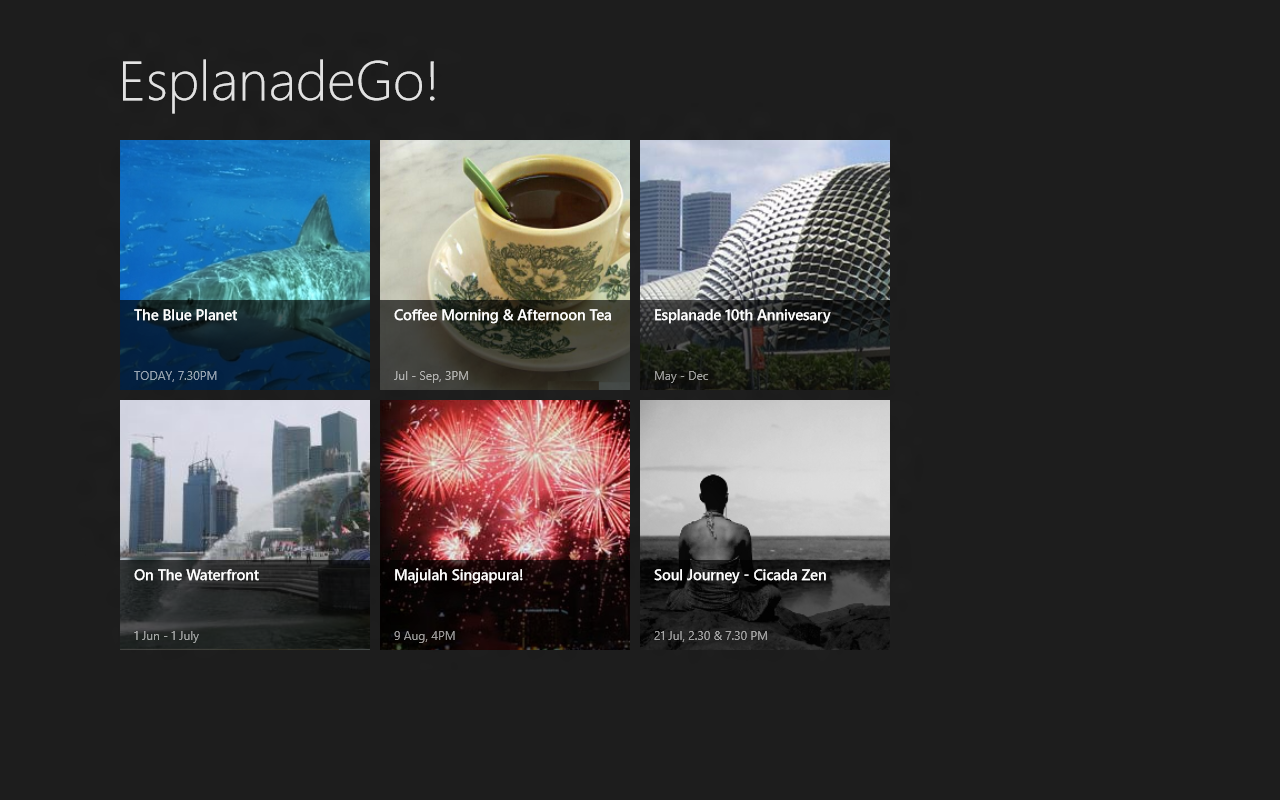
The latest version of EsplanadeGo! homepage design with VariableSizedWrapGrid.
Having Dinner with EsplanadeGo!
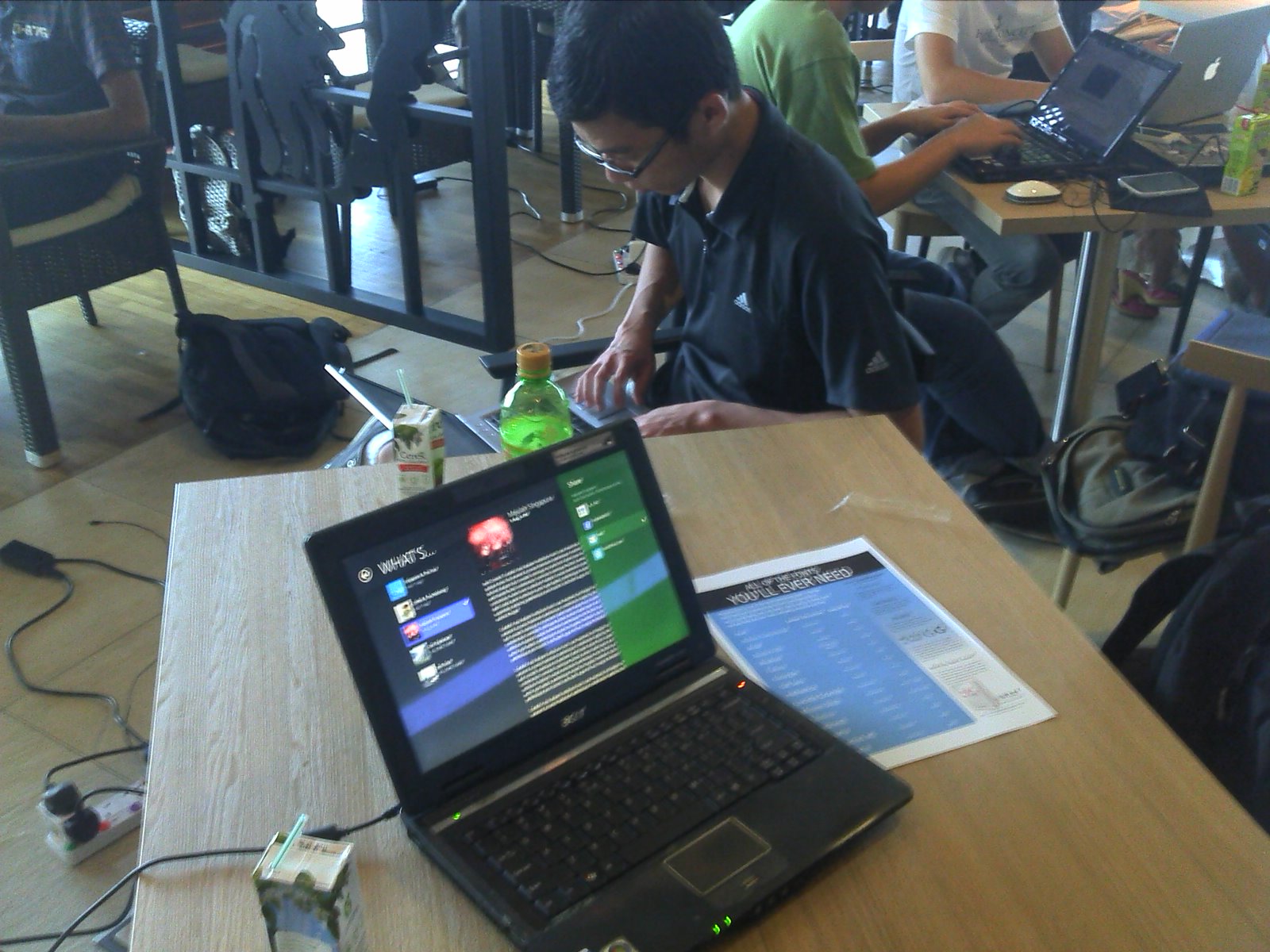
In the last few weeks, I went to Bugis Junction and some other restaurants with Internet access to have dinner so that I can work on our EsplanadeGo! project after work. Although my daily work is already all about C# and ASP.NET and I have only my dinner time to work on this project, it is still quite fun to work on EsplanadeGo! (Imagine, coding with nice food in a comfortable environment. How fun is that? =P).
Thanks to this project, I get to try many new stuff that I haven’t seen before and share the new technology with my colleagues and my boss. Yup, they all love it very much and would like to learn more about Windows 8 app development. Who knows? Maybe one day our company will have our first mobile app on Surface. =P
Last month when I read a Facebook post from Spiffy that Microsoft Singapore was going to organize a hackathon, I immediately emailed my friends about it. Desmond, one of my OneSync Dev Team teammates, gave me a prompt reply saying that he was interested to join it as well.
The event is called Dream Build Launch. It’s an event specially prepared for local developers to build their (first) Windows 8 metro-style app. Since the event was held on Saturday, I can happily participated in it without applying for leave. There are a few reasons why I would like to join the hackathon. Firstly, I wanted to learn more about WinRT. After listening to the talk delivered by Hammad Rajjoub and Bruce Wang from Microsoft in the Microsoft Campfire, I always wanted to try out the interesting features offered by WinRT.
Secondly, it’s a very good opportunity to meet imba software developers in Singapore. So, during the event, I was quite happy to see many friends from School of Computing (SoC), NUS taking part in the event also. Some of them were actually Microsoft interns. It’s also fun to share our ideas about what we’re going to build with them.
Thirdly, due to the fact that the event was held at Microsoft Singapore office, so I was very excited to see the working life in Microsoft. Their workplace was just renovated not too long ago. The office shared the same building as the NTUC centre. It’s a very clean and comfortable workplace.
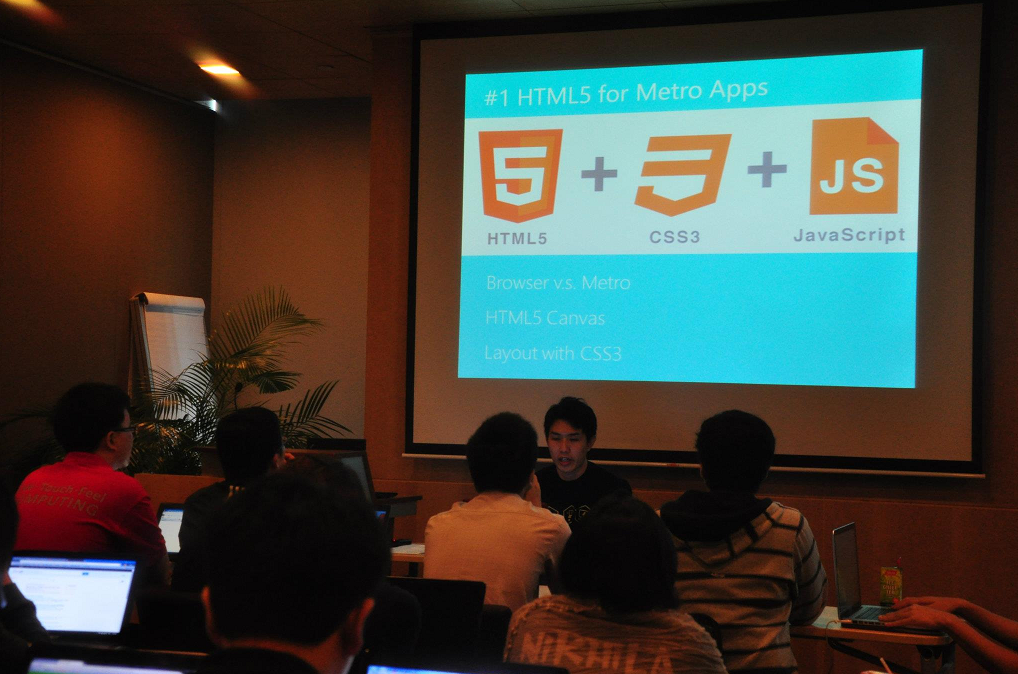
HTML5 for Metro Apps talk given by Alex Goh. Photo Credits: Spiffy
Before the hackathon began, there were two lab sessions held. Since both of the lab sessions were held at the same time, so the participants could only choose to attend one of them, either JavaScript lab or C# lab. Desmond and I finally decided to attend the JavaScript one because we’re interested to see how a metro-app could be built using HTML5 and JavaScript. I couldn’t find the slides they used in the JavaScript lab session. However, Hammad Rajjoub did share some links to the related topics on the Facebook group of the event, for example how to style controls to your preferences in metro-style apps using JavaScript and HTML. For the C# lab session delivered by Bruce Wang which both of us didn’t attend, his slides can be found here.
The hackathon began at around 1pm. We had about 22 hours to complete our app. According to the rules of the hackathon, our app needed to have a theme and the theme was ” I ❤ SG” (I love Singapore).
Introducing EsplandeGo! – The First Esplanade App on Windows 8
Three days before the event, I was thinking what kind of app we should build. After having dinner at Raffles City, I walked to CityLink Mall and then I saw an advertisement about the events in Esplanade. Then I suddenly had an idea. Why don’t we build an app about Esplanade? So, I walked to Esplanade which is located nearby to get more ideas for the app that we’re going to build.
Photo was taken when I visited Singapore River with Desmond and Thuat
After coming back from Esplanade, I was so excited about the idea. Thus I immediately wrote the first version of our app and emailed some screenshots of the app to Desmond to explain to him the idea of building an app which listed Esplanade events. I named the app “EsplanadeGo!”.
The screenshot of the first version that I built in half an hour
Yup, so during the event, we continued on building the app.
There is one thing that I forgot to do is making sure our program could run in an environment which had no Internet access. So, when I tried to run it on MRT after the end of the hackathon, then I realized our app actually crashed because there was no Internet connection. >__<
Nice People, Nice Food
I like the Dream Build Launch hackathon very much. I like the workplace as well. Coding in such a nice environment is truly enjoyable. I could see the beautiful Singapore Strait clearly from the office. Watching sea, drinking free coffee, coding stuff. That partially explains why people like to work in Microsoft Singapore.
Besides the nice view, I enjoyed the speeches given by the developers and staff from Microsoft Singapore. The lab session also helped me to understand more about the possibility of WinRT, especially the way we could use JavaScript to build a Win8 app.
In the event, I also met some friendly participants during the event. It’s fun to talk to them and listen to their ideas.
Last but not least, the lunch, dinner and supper provided by Microsoft Singapore are extremely good. So, Desmond and I had to queue for about 20 minutes just to get the food.
This year, I once again travelled to Kuala Lumpur. Same as two years ago, I was fortunate enough to get the chance to join the computing workshops organized by NUS School of Computing (SoC) and Chong Hwa Chinese Independent High School at Kuala Lumpur (CHKL).
Again, thanks to my boss, he happily allowed me to take leave to join the 4-day SoC computing workshops.
Introduction
The workshops were organized for the students from Malaysia Chinese independent high schools. During the event, the students got the opportunity to listen to the talks given by SoC lecturers on several interesting topics, such as PHP programming, E-commerce, Android app development, Arduino and so on. Before the event, when I read through the list of talks, I was so surprised that students nowadays were so fortunate to learn about all these exciting technology when they were still studying in high school.
There were other several interesting topics about algorithm, Facebook and iPad app development modules, and so on. I won’t talk about them here since I will be sharing more about the app development workshops in the 4-day event.
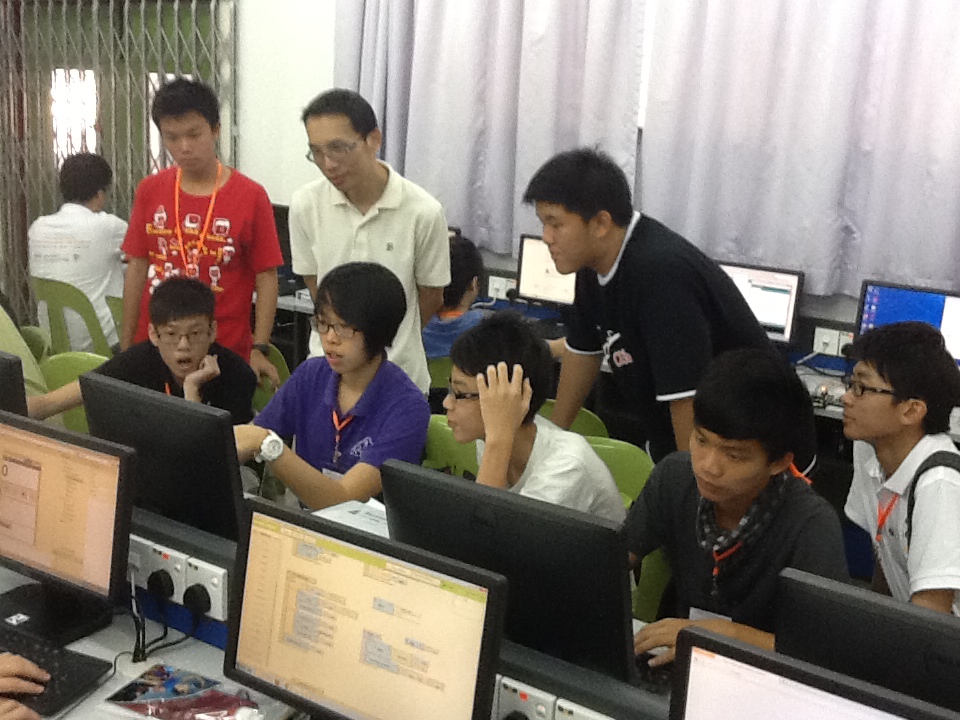
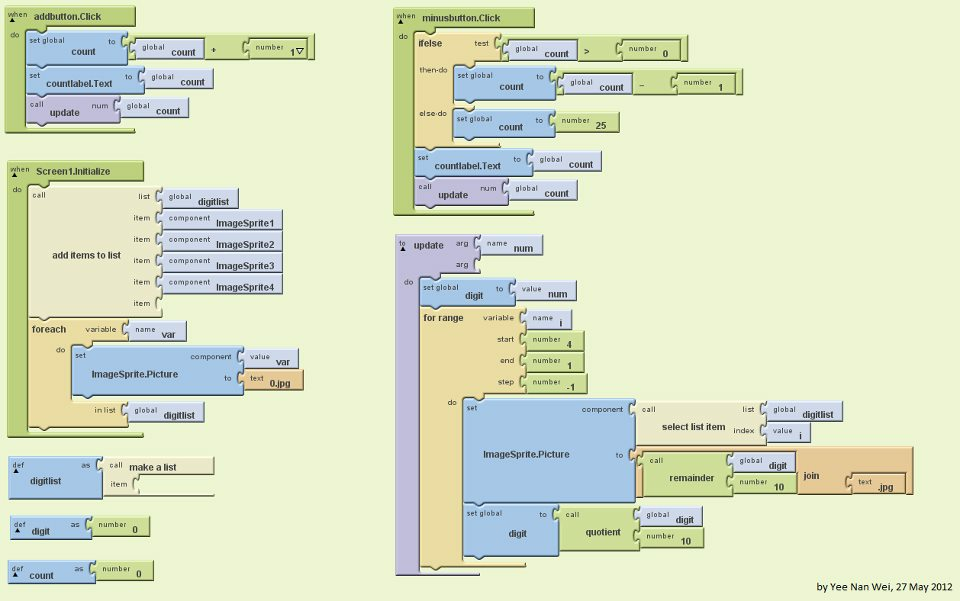
Learning Android App Development I like how they chose MIT App Inventor as the tool for the students to learn building an Android app. App Inventor uses a graphical interface. Thus, instead of writing codes in text, students could just drag-and-drop the blocks to “write” their program. The blocks are actually those statements and expressions like if…else, assignment, for loop and so on. It is similar to Alice, a 3D programming environment, that we used in last year workshop. So now programming becomes easier because the students can just build their Android apps without writing single line of code and the whole experience is just like playing Tetris.
Students were showing their Android app to Dr ChiaA simple counting program written and designed by Nan Wei (Keat Hwa High School)
Having Fun with Arduino
In order to let the students have a little idea about the world of Computer Engineering, we had Arduino for the students to play. Arduino is a prototyping platform. It comes with an IDE which allows the user to compile their code and then upload it to the Arduino Board. So with the tools, students could easily write their simple C++ program to control the LED on the board. Some of the students learnt quite fast and they were able to do some amazing stuff like playing music and controlling LED brightness with the help of sensors. It’s amazing to see how the students nowadays get so much learning opportunity. When I was a student in SoC, I didn’t even know what Arduino was. Haiz.
Arduino demo proudly brought to you by Nan Wei and Yek Xian (Foon Yew High School)Arduino programming exercises done by the students
Not Just Coding, But Also Thinking
During the 4-day workshops, students also got to learn building a simple E-commerce website. Many of the students didn’t have PHP background. Due to the time constraint, the lecturer didn’t manage to cover everything in details. Luckily there was two lab sessions for the students to ask questions. Interestingly, some of their questions were actually quite good because from their questions, we could tell that the students really think a lot. One of the students even went further to learn JavaScript and came up with a beautiful website.
Cheng En (CHKL) and his PHP web app (The one with extra features done in JS)
Fun
Before the end of the workshops, one of the student helpers asked me whether I would join the workshops again as student helper next year. Well… I do hope that I will be invited by the school again. Frankly speaking, event or workshop like this is very tiring, especially for those who have to go back to work on next day of the event. However, it’s still fun to talk to the high school students and share our campus life experience with them. It’s also glad to see that most of them actually liked learning very much (Note: The students actually travelled from different cities across Malaysia just to participate in the workshops. Also that was during their school holiday).






 cuteprogramming