EF Media Player 3

Project Description
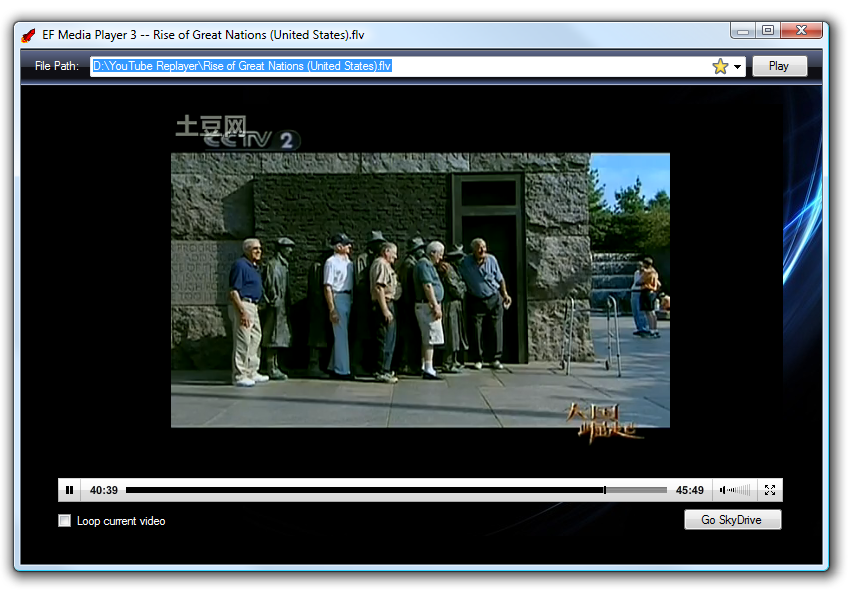
The purpose of upgrading EF Media Player 2 to EF Media Player 3 is to, firstly, fix the bugs and problems found in the second version and, secondly, to implement some new features to make the application become more user-friendly. Same as the previous two versions, useful features like playing FLV and other types of audio and video files as well as streaming videos stored in SkyDrive are still available.

In this project, there are additional features implemented, such as full screen mode, history recording and video bookmarking. The challenging part of this project will be the implementation of video bookmarking which caused me to spend about two days to figure out the way to do it (Read more: https://cuteprogramming.wordpress.com/2010/12/02/ef-media-player-3-the-code-the-idea/).

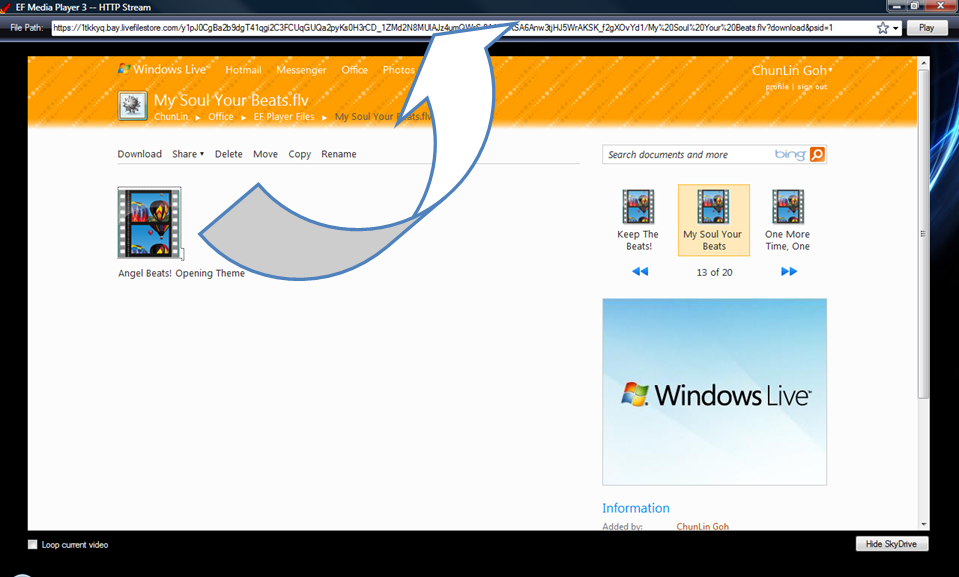
In addition, there is a minor change made to the SkyDrive videos viewing. User is now allowed to play the videos by directly dragging and dropping the, to the File Path area.
EF Media Player 3
EF Media Player 3

Full Screen Mode
In both the YouTube Re-Player (Desktop) and EF Media Player 2, there is no full screen mode available although there is a “Full Screen” button which basically does not trigger anything. Full Screen mode is previously not necessary because YouTube Re-Player is built for collecting and playing favourite music videos from YouTube site, not watching those videos. In addition, due to the fact that the player was embedded in AxShockwaveFlash object, the “Full Screen” functionality that comes together with the YouTube player cannot be easily triggered.

Full Screen mode become important in EF Media Player because it is an application used to watch videos. Same as YouTube Re-Player (Desktop), the “Full Screen” button in JW Player which is used in EF Media Player does not trigger anything as well. This may be due to the fact that the JW Player is put inside the AxShockwaveFlash object.

Hence, this project is to figure out how to add the Full Screen functionality to the application. In this version, for users using more than one screen, they can also have EF Media Player to be in full screen mode in one of the screens while they are doing their work on other screens. This is something which cannot be done in the YouTube site itself.

History Recording and Video Bookmarking
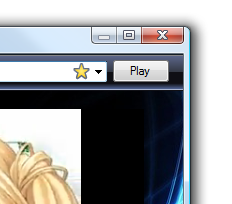
Yellow Star Means Video Is Bookmarked

Another exciting feature implemented in EF Media Player 3 is keeping the videos viewing history. All the video watched previously will be kept and thus the user can play those videos again by choosing them from the drop-down selection box.

For those videos which were watched previously but not watched again in the next run of EF Media Player 3 will be removed away from the history. By doing so, the list will always keep track of the videos that are always watched by the user.

In addition, Video Bookmarking is also an interesting feature available in EF Media Player 3. It enables user to basically bookmark the videos that they like. Those videos which are bookmarked will stay forever in the history list. Hence, the users can watch again next time when they run EF Media Player 3.

SkyDrive Videos Drag-and-Drop
Users can already watch videos stored in their SkyDrive using EF Media Player 2. In this project, a new functionality is added to the application. It allows users to directly drag and drop the SkyDrive videos into the application and play them. It also allows user to download the videos by directly clicking on them.
SkyDrive Videos Drag-and-Drop

Future Work: What Is the Next Related Video?
YouTube XL is YouTube optimized for the TV. It is made to be simple to use and interact with on big screens. Among all its features, auto playing the next related video is very interesting. However, for some unknown reasons, this feature is not working correctly most of the case. Hence, for the next release of EF Media Player, the focus will be on implementing this functionality which make the application to auto play the next related video. It requires an algorithm which can cleverly analyze limited knowledge and decides the next related video based on those knowledge. After the completion of this feature, EF Media Player can be also be shown on TV as well, just like YouTube XL.

EF Media Player 2

Motivation
EF Player was successfully built in July. It is a media player tool which makes use of the JW Player and the ideas from YouTube Re-Player (Desktop). Because of EF Player, I now can view FLV and MP4 video files easily. Whatever videos that I watched on YouTube and Tudou can be easily converted into FLV files from the browser cache folder. Hence, EF Player provides an alternative to view and store YouTube or Tudou videos locally.

After the creation of EF Player, I started storing many interesting videos that I watched on YouTube and Tudou to my local hard disk. Soon, I found that I did not have too much space to store other stuff in my local machine. This led to the birth of the EF Media Player 2 with a new feature which allows it to connect to SkyDrive.

The following diagram illustrates the idea of having EF Media Player 2 to work together with YouTube from Google and SkyDrive from Microsoft.

EF Media Player 2
EF Media Player 2

Stream Videos From SkyDrive Easily
In order to implement the feature of viewing videos stored on SkyDrive, the EF Media Player 2 requires the Windows Live username and password of the user. After the username and password are varified to be correct, the user can then view the videos stored on the SkyDrive. The videos can be either shared or private. Because of this new feature, the users of the EF Media Player 2 are in fact allowed to share their videos with their friends.

One of the serious problems that YouTube Re-Player series has is that even though the basic info of the YouTube videos, such as their name, description, URL and so on, are stored in the database, their content is not kept locally. Hence, if the videos are removed by the YouTube online, then the videos will no longer be available in YouTube Re-Player as well. EF Media Player solves this problem by transfering the YouTube or Tudou video files to the SkyDrive so that the user can manage the videos without worrying the videos being deleted away on YouTube site.

Actually, there are a few big challenges for implementing this feature. Firstly, the URL of the files in SkyDrive is not fixed. The file URL will be changed every eight hours. So, having a fixed link point to the URL is not a solution at all. Hence, EF Media Player 2, unlike YouTube Re-Player, does not store any URL in local machine. So, the user needs to copy-and-paste the URL of the SkyDrive video file and then pastes it to the File Path textbox in EF Media Player 2 for each time he or she wants to watch the video.

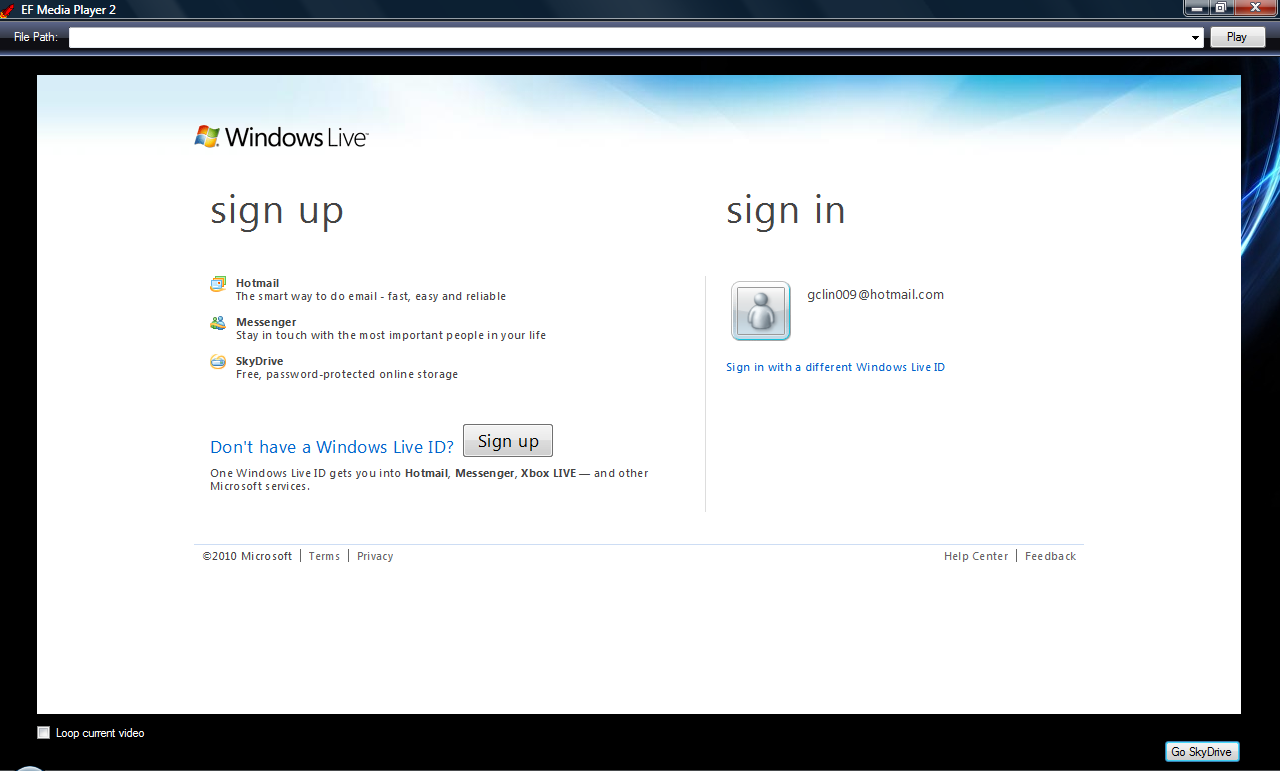
Secondly, it is currently impossible for me to actually pass the username and password to the Windows Live server with the auto-login code. Actually, auto-login has been successfully achieved last month. However, recently Microsoft changed the UI of the login page, so the auto-login function can no longer work. Eventually, the webBrowser control is used to temporarily solve the problem of logging in to Windows Live.

Windows Live Login Page in EF Media Player 2

Playlist Implementation
In EF Media Player 2, the user is able to play not only a single video file each time, but also a playlist which contains more than one video. This is actually the feature offered by the JW Player. Hence, what EF Media Player 2 does is taking in the XML file which contains the list of videos in the playlist and then pass it to the JW Player.

Because of the implementation of playlist, EF Media Player 2 can loop both single video file and playlist. Hence, instead of listening to a song over and over again (like what is done in YouTube Re-Player), now it allows listening to a set of songs and musics over and over again.

Playlist feature also allows me to watch video series and anime series without keep dragging and dropping the files to the player. The playlist feature enables the player to automatically play from the first episode until the last episode of the video series.

Since the playlist files must always stay in the same folder as the JW Player, playing playlist files which are on the SkyDrive is theorectically alright as long as the JW Player file is also on the SkyDrive. However, I have not tried this because the playlist files normally do not occupy too much space on my hard disk. Hence, I am now still keeping the playlist files in local machine.

Future Work
Streaming video from SkyDrive is not that easy actually. Also, Microsoft is still going to improve the Windows Live services in a rapid speed. Hence, I should always keep track of the new updates available, especially the SkyDrive API, in order to make EF Media Player eventually able to work with SkyDrive in a more advanced way.

There is still room for GUI improvement in EF Media Player 2. For example, adding a progress bar to display the progress of the login process. In addition, the username and password validation is actually not yet implemented. Now it always assume the user to give correct username and password for the Windows Live login. Hence, all these will be done in the future version.

From PC to Mobile: EF Player

In the beginning of last month, I joined a computing camp at Kuala Lumpur. After coming back from there, I was basically busy at maintaining YMCA Volunteer Management System (VMS) together with my teammates. Although I was quite busy, I still contributed time to do GCL Project, my personal projects, as well.

However, due to the fact that the first two activities mentioned above: Computing camp and VMS maintenance were time consuming, there were only two products successfully completed one month after Google Docs Notifier was released. The two products are EF Player and EF Player (Mobile).

The Motivation
In December 2008, I was finding a way to store and play the music in YouTube. Downloading the videos from YouTube seemed like a simple way. However, in January 2009, I found a more simple way to do it, which is using YouTube API. Thus, I built several versions of YouTube Re-Player to do the job.

Last month, I couldn’t find the full version of the song Emotional Flutter in YouTube. However, there was one available in Tudou. In this case, YouTube Re-Player couldn’t be used. I remembered that my tutor once told me that browsers, such as Firefox and Chrome, actually downloaded videos to their cache folder when a YouTube video was loaded. So, I tried to look for the cache folder and later found that Chrome actually kept one copy of playing video from Tudou in its cache folder as well.

Since the copy in the cache folder is in .flv format, I had to find another player to play it. Hence, I built a new player: EF Player. I named it EF Player as I started this project because of the song Emotional Flutter.

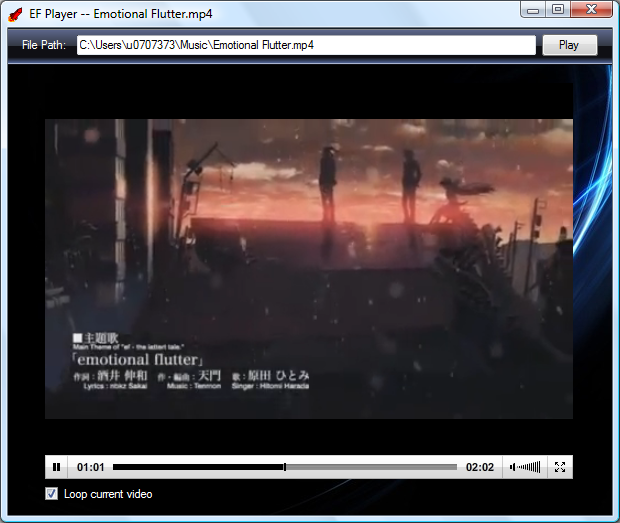
EF Player
EF Player

Third Party Plugin: JW Player
After searching on Google for few days, I found a very powerful FLV player known as JW Player (http://www.longtailvideo.com/players/jw-flv-player/). By referencing the code used in YouTube Re-Player (Desktop) that I built last year, I easily built another C# app which worked together with SWF (The JW Player itself is just a swf file).

Supported File Types: FLV, MP4, MP3 + YouTube Online Video

JW Player is so powerful that it can actually play quite a lot of different types of audio and video files. Hence, by doing simple C# coding, I can easily make EF Player supports the following file types: .flv, .mp4 and .mp3. Hence, because of EF Player, I not only don’t have to download FLV player, but also stop using QuickTime Player because most of my audio and video files are in these three formats. Besides playing local files, EF Player can also play online YouTube videos by the help of JW Player. Thus, JW Player plays an important role in EF Player.

Different Approach To The Problem
The reason why I build EF Player and YouTube Re-Player is the same. I want to not only view, but also store my favourite YouTube (or other sites such as Tudou) music videos. In YouTube Re-Player (Desktop), I tries the parallel video downloading approach to solve the problem of viewing YouTube videos offline. However, it is not efficient. The correct way is to store the videos in the local machine, instead of always retrieving videos from YouTube site. Well, since I don’t want to get the video through direct downloading, I have to use the cache to help me achieve the goal of having YouTube videos stored in my computer.

As the browser already caches the YouTube videos that I watched before, now by using EF Player, I can use EF Player to watch the videos again without visiting YouTube site. So, I basically can keep a collection of YouTube videos in local machine so that I can view them anytime, anywhere without the requirement of having internet connection.

EF Player is more powerful than YouTube Re-Player in terms of the number of supported file types and EF Player actually makes replay to be optional, EF Player becomes a threat to another product of GCL Project: YouTube Re-Player. Hence, I currently try not to do anything related to the YouTube API in the EF Player.

However, the replay function in EF Player does not work as good as the one in YouTube Re-Player. EF Player will actually retrieve the video every time it replays it. I have no idea why.

From PC To Mobile
After I finished the EF Player, I tried to build one in Windows Phone 7.

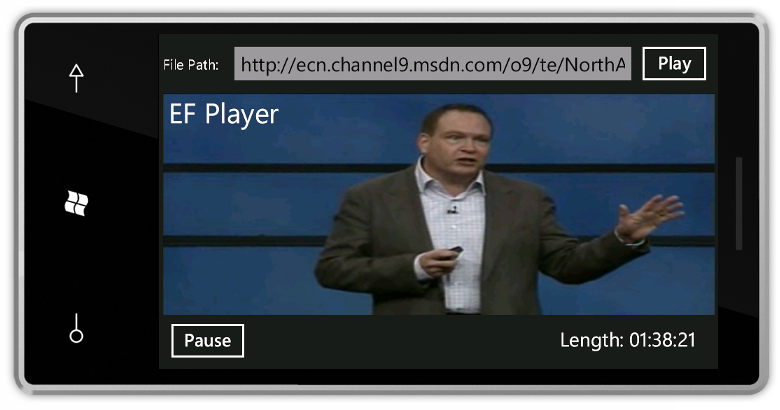
EF Player (Mobile) on Windows Phone 7

It is not a simple task. First of all, Flash is not supported in Windows Phone 7 (poor Flash T.T). Hence, the JW Player cannot be used on Windows Phone 7. Secondly, my computer performance is highly decreased when I deploy my app on the Windows Phone 7 Emulator. So, I usually need to wait after pressing F5 in Visual Studio because the emulator takes time to setup my app. Thirdly, XAML returns. Well, I am still learning XAML, so I am not that pro in XAML yet (although I did a lot of XAML programming in CS3215 project).

Anyway, the EF Player (Mobile) does not support FLV, MP4 and YouTube online videos. It still supports MP3 though. Also, it can now play WMV and WMA files.

Learning While Doing
When I was doing CS3215 project, VS2010 was released few days before the end of the course. So, unfortunately, we didn’t have too much opportunity to use VS2010 in our project. Hence, I decided to learn how to use it in this summer vacation. EF Player and the GCL Homepage (completed in May) are then chosen to be the first three projects done using VS2010. Of course, EF Player is just a starting point. Starting from now, I will try to explore VS2010 more.

This is the first time I try out the third party tool in GCL Project, I think. Fortunately, the API documentation of JW Player is well written. Hence, I can easily learn how to make my C# code work together with their API.

This is also the first time that I build application for Windows Phone 7. As I said earlier, it is not that simple because it is a bit different from building app for PC. There are a lot of stuff working in PC cannot be run on Windows Phone 7. However, it is fun to see your app running on mobile phone, isn’t it? =)

Auto Rotate Feature (Thanks WP7)

Future Work
Summer holiday is going to end soon. However, I still need to plan the future work for EF Player Project.

First, learn how to improve it by adding in more useful features. Here, I try not to give any example of “useful features” that I want to add.

Second, make it to be another open source GCL Project. However, due to the fact that YouTube Re-Player is not yet an open source project and EF Player is more powerful than YouTube Re-Player, I will only publish EF Player after YouTube Re-Player is made open source. In addition, I am using third party app in EF Player, so I am not sure whether I’ll be sued if I publish EF Player.

Third, improve EF Player (Mobile) because there are still some features missing in the app. =)

YouTube Re-Player Anywhere, Google Docs Notifier and My Personal Homepage

Last month, I was basically fixing YMCA Volunteer Management System. Meanwhile, I was also doing my personal projects. Unlike previous vacations, I tried to finish three small applications within two weeks. Now, let me introduce them one by one.

YouTube Re-Player Anywhere (finished in 3 days)

Introduction

I started my YouTube Re-Player project since 2009. After the first version of YouTube Re-Player was successfully done in January 2009, many other versions of it had been developed. I tried to build it in several language, such as PHP, JavaScript, C#. Last December, I also deployed one of them on Windows Azure and won a prize from Microsoft.

The version which is on Windows Azure is called YouTube Re-Player at Cloud. It does not need a database because it only stores the video temporarily somewhere. After my Windows Azure account was terminated, I decided to build a similar version of it by using Java.

YouTube Re-Player Anywhere

What is so special about YouTube Re-Player Anywhere? Basically, it is an improved version of YouTube Re-Player at Cloud. It solves some problems that I can’t do it in YouTube Re-Player at Cloud easily. In addition, it requires no installation. Unlike YouTube Re-Player (Desktop) which requires user to install .NET 3.5 Framework. In YouTube Re-Player Anywhere, user can just go to the URL and use the application.

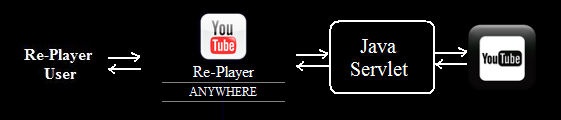
I use Java Servlet in YouTube Re-Player Anywhere to store all the video links in session. Hence, as long as the session is not deleted, the videos will be available in the application.

YouTube Re-Player Anywhere Structure

In addition, since YouTube Re-Player (Desktop) was done using WPF, it cannot be run on non-Windows OS. Hence, YouTube Re-Player Anywhere is designed for those who are not using Windows. Also, as it is a web-based application, it can run on phone as long as the phone can access to the Internet. This is where the word “Anywhere” comes from.

Due to the fact that I can’t find a place to host it, currently it is not available to public yet.

What do I learn from doing this project?

The main purpose of doing several GCL Projects is to learn what I can’t learn in school and CVWO. In fact, I use the knowledge and skill that I learn from doing GCL Projects in my school projects and CVWO project. For example, I used the WPF skill that I learnt from doing YouTube Re-Player (Desktop) in my CS3215 project, OneSync. Hence, our team was one of the few teams that built a nice looking application in CS3215.

This time, I learnt quite a lot from doing YouTube Re-Player Anywhere also. First of all, I learnt how to build a Java Servlet application. Before that, I had no idea what Java Servlet is. Actually, it is just like a normal Java class that I wrote in CS1102S class, except the fact that I need to import some libraries and so on. Secondly, I also learnt how to parse XML in Java. Since the feeds retrieved from the YouTube server is in XML, so I have to parse it in order to get the required information such as video title, video description and video length.

I used only three days to learn Java Servlet and finish building this application. This enables me to continue doing my second GCL Project in this summer: Google Docs Notifier.

Google Docs Notifier (finished in 5 days)

Background

When I was writing the proposal for my CS3215 project, my friend, James, asked me whether I had a way to notify the users when their documents in Google Docs were updated. The reason he asked me the question is because in my original CS3215 proposal, Google Docs was chosen to be the online intermediate storage, instead of Dropbox. Hence, I read the Google Documents List Data API and started developing it.

In April, I finished the version 0.9 of Google Docs Notifier and presented it in my team’s lightning talk in CS3215. However, since I was developing OneSync with my friends at the same time, I did not spend too much time on it. Thus, I decided to complete it and added a few more features to it after I finished my exams.

The most interesting part is that I finished it when I was visiting Penang. =D

Motivation

Although Google Docs is popular now, there are still a lot of improvements needed for Google Docs. One of them is notifying the user when his file is edited and updated by his fiends. Currently, users will not know whether their files are updated until they log in to the Google Docs webpage to check or they check their email inbox.

To solve this problem, Google Docs Notifier is chosen as the project of GCL Project 2010. The goal of this project is to build a small application which notifies the user when his files are updated and shows all the recently updated files.

Introduction

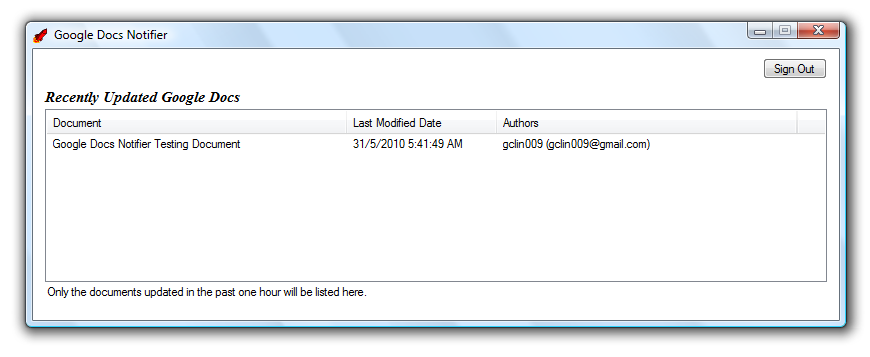
Last month, the Google Docs Notifier 1.0 was successfully done. Now, the user can easily know the date and time that the document is modified. In addition, user can view the document by just double clicking on the document name in the program itself.

Google Docs Notifier Login Page
Listing All Recently Updated Documents in Google Docs

This is the first GCL Project which is available to the public and open source. You can view the project homepage at here: http://googledocsnotifier.googlecode.com/.

What do I learn from doing this project?

In January, Google announced that the user can now upload any file to Google Docs. However, it does not provide the API of doing that (the fact is that this feature is only available to Google Apps Premier domains). This is the main reason why our CS3215 team chose Dropbox as the online intermediate storage provider.

However, I learnt more about Google Documents List Data API, for example the XML format of the feeds, the information available from the API, how to use the information and so on.

My Personal Homepage (finished in 4 days)

Motivation

Every time I am asked for my personal website, I always give them my Facebook Account URL. It is not really a good idea because Facebook is just a social networking site. Hence, I decide to build a personal web page that introduces me.

Introduction

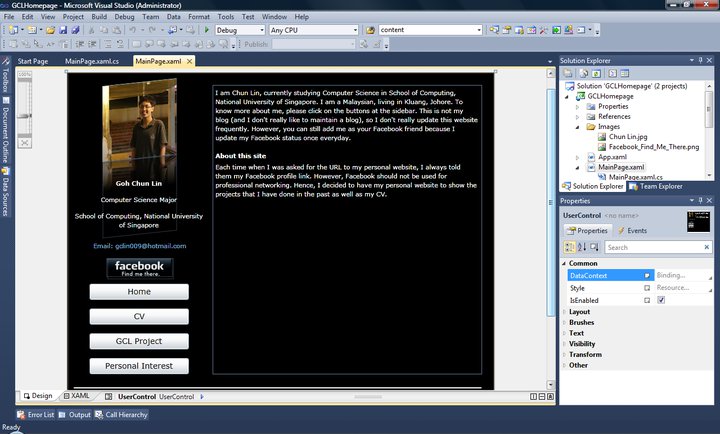
Building Silverlight Web Pages in Visual Studio 2010

I built it using Silverlight. Yup, I know that there are a lot of people who don’t like Silverlight. However, I still think a Silverlight site is cool, especially it provides an easy way to do simple animation, for example, storyboard.

The site has four sections. You can view my CV, GCL projects done before and so on.

Future Work

Since there are a lot of computer users not installing Silverlight in their computer, I decide to have a normal HTML page for my website also.

Also, I am still finding a place to host this personal homepage.

What do I learn from doing this project?

Silverlight. Yes, the only thing I learnt is Silverlight. Since I am not allowed to take CS3216, so the only way that I can learn Silverlight is self-learning. In addition, I received a Silverlight reference book from Microsoft as a gift in January. Hence, I think I should spend time on learning Silverlight well. =)