Modernizr and Progressive Enhancement

Modernizr

Since Visual Studio 2012, we can always find this file called modernizr-(version).js in the default ASP .NET 4.5 MVC template. So, what is Modernizr (can be downloaded from Nuget)?

Modernizr is a JS library which is able to detect HTML5 and CSS features in the user’s browser. During page load, Modernizr will start to test those next-generation features. After that, it will create a JS object which contains the test results. For example, Modernizr.canvas will be true if the browser supports the HTML5 <canvas> element.

Modernizr then adds CSS classes to the <html> tag that tell us which CSS / HTML5 features are supported on the current user’s browser. For example, in my Chrome browser, touch feature is not supported, thus, there is a no-touch class added. The other features like video, audio are all supported.

<html class=" js flexbox flexboxlegacy canvas canvastext webgl no-touch geolocation postmessage websqldatabase indexeddb hashchange history draganddrop websockets rgba hsla multiplebgs backgroundsize borderimage borderradius boxshadow textshadow opacity cssanimations csscolumns cssgradients cssreflections csstransforms csstransforms3d csstransitions fontface generatedcontent video audio localstorage sessionstorage webworkers applicationcache svg inlinesvg smil svgclippaths">

With this information, we will then be able to provide alternative look-and-feel for those users who are using older versions of browser instead of telling those users “Best view in version xxx of browser yyy”.

With YepNope.js, we will also be able to tell Modernizr what to test and then what JS/CSS to load if the test passes or fails.

Finally, please remember that Modernizr only provides us information about which features are (not) supported. It won’t magically enable those features for us. We need to write corresponding JS/CSS to provide alternative views when the features are not supported on the browser.

In short, Modernizr is a good tool for designers to implement the idea of Progressive Enhancement.

Graceful Degradation

When I was reading about Progressive Enhancement, I read this term called Graceful Degradation. It basically means the way of using the newest and best web technologies while maintaining support for older browsers.

The famous border-radius feature in CSS3 is supported in modern browsers like IE11, Edge, Chrome, and Firefox but it’s not supported in Internet Explorer 7 and 8. Does this stop us from using border-radius in our website? Nope. This is because for users who are still using IE7/8, they can still use the website in the same way as those who are using modern browsers. Just that those who are using old browsers cannot see the beautiful effect of border-radius.

Different visual effect in IE8 and IE11.

So basically the idea of Graceful Degradation is that it starts at ideal user experience level and it decreases depending on browser capability down to a minimum level.

Progressive Enhancement

Progressive Enhancement does in the opposite way as Graceful Degradation. It starts at a board minimum user experience and increases depending on browser capability. For example, when user switches from old browser to modern browser, he/she will be able to experience more advanced functionality that will be automatically enabled on the modern browser. So, Modernizr helps us to achieve this by checking if a certain feature is enabled or not on the current browser.

References

Summer 2015 Self-Learning Project

This article is part of my Self-Learning in this summer. To read the other topics in this project, please click here to visit the project overview page.

Summer Self-Learning Banner

Entertainment Connected to Android

GCL Project + Android + OneDrive

It has been two months since I completed Entertainment Connect for Windows 8 platform. Entertainment Connect is an application that is able to play those MP3 and MP4 media files stored in your Microsoft OneDrive storage.

Soon after I completed the application for Windows, I found out that more and more of my family and friends were buying Android phones. Thus, I decided to build another version of Entertainment Connect for Android.

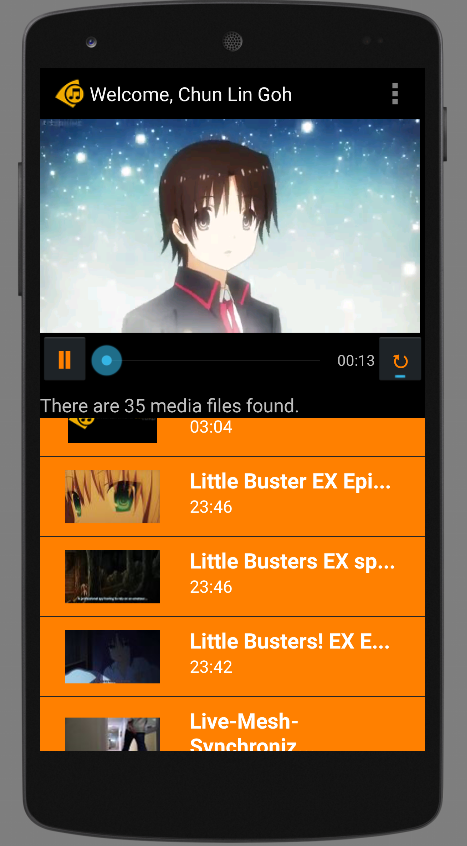
Entertainment Connect is now available on Android devices!

Today, I would like to share what I had learnt in developing my first personal Android app which makes use of Microsoft Live SDK for Android.

New IDE: Android Studio

I have been using Eclipse for Android app development in my work. Coding with Eclipse is not easy. Luckily, Google just released Android Studio, an official IDE built specifically for Android with much powerful GUI designer. In addition, due to the fact that Google encourages developers to migrate to Android Studio, I decided to try it out.

Android Studio with the login page of Entertainment Connect.

Working with Microsoft Live SDK

Yesterday, I just received notifications from Live SDK Github saying that the team was going to support and migrate to Android Studio. Finally. When I started this project, the Live SDK only supports Eclipse ADT.

It is very easy to include Live SDK to the project in Android Studio. Firstly, I need to download the Live SDK. Just download the whole project via ZIP is enough. The project consists of some useful samples which teach us how to properly use the SDK.

Secondly, I need to add new module under Project Structure.

Add new module in Project Structure.

Thirdly, I just choose the “Import Existing Project” option which will import the Eclipse project (Live SDK) as a module.

Import existing Eclipse project as module.

Finally, to make my application being able to use the Live SDK, I need to create introduce a module dependency to my app module, as shown in the screenshot below.

Introduce module dependency between app and src (Live SDK).

That’s all. If you would like to know more details about adding SDK in Android Studio, please checkout a post in StackOverflow about the import of Facebook SDK.

Can It Be More Complicated?

When I did Entertainment Connect for Windows 8 using WinJS, to create a media player, I basically just used the following codes.

var playerContainer = document.getElementById('playerContainer');
videoPlayer = document.createElement('video');
videoPlayer.id = videoStaticUrl;
videoPlayer.controls = "controls";
var videoSource = document.createElement('source');
videoSource.src = videoUrl;
videoSource.type = 'video/mp4; codecs="avc1.42E01E, mp4a.40.2"';
videoPlayer.appendChild(videoSource);
playerContainer.appendChild(videoPlayer);

With these few lines of code, I can already get a working media player with all the controls, such as play, pause, progress bar, etc.

However, this is not the case in Android app development. I am using VideoView. Hence, I also need to build my own play/pause functions and progress bar.

Also, I realized there was a bug if I switched from playing video file to audio file on VideoView. The image part of the previous video will stay even though the audio starts playing already. Hence, I added the following few lines of code to reset the background image of the VideoView so that the image of previous video will be “erased”.

videoPlayer.setBackgroundColor(Color.TRANSPARENT);
if (availableMedia.get(position).getmMediaFileName().toLowerCase().endsWith(".mp3")) {
    videoPlayer.setBackgroundColor(Color.BLACK);
}

Loading the thumbnail of media from OneDrive is also a headache in Android.

In Windows 8 app, after adding the items returned from Live SDK to a collection, I can easily bind the items to the template easily. After that, the thumbnails will be automatically shown on the screen smoothly.

<!-- Template of the list items to show available music/videos -->
<div id="mediumListIconTextTemplate" data-win-control="WinJS.Binding.Template" style="display: none">
    <div class="mediumListIconTextItem">
        <img onerror="this.src='/images/default-video-preview.png';" class="mediumListIconTextItem-Image" data-win-bind="src : picture" />
        <div class="mediumListIconTextItem-Detail">
            <h4 data-win-bind="innerText: name"></h4>
            <h6 data-win-bind="innerText: duration"></h6>
        </div>
    </div>
</div>

In Android, I have to create a background worker to retrieve the thumbnail with the following code. Then sometime when I scroll the list, the thumbnail won’t be updated immediately. Also, I need to use some tricks to make sure the correct images are displayed on the list view.

URL thumbnailUrl = new URL(imageView.getTag().toString());
HttpsURLConnection imageConnection = (HttpsURLConnection) thumbnailUrl.openConnection();
imageConnection.setDoInput(true);
imageConnection.connect();
InputStream inputStreamOfImage = imageConnection.getInputStream();
return BitmapFactory.decodeStream(inputStreamOfImage);

Building Android App Is Fun

Yes, it is fun. However, it’s slower than Windows 8 app development. It’s just too bad that not a lot of my friends really go Windows Store to download desktop apps. So I have no choice but to build Android version of my app also.

I will try to publish Entertainment Connect to Google Play soon after I have fixed my debit card issue. Currently, I still encounter problems on paying developer registration fee with Google Wallet. Oh well.

Meanwhile, feel free to read rest of Entertainment Connect (Android) code on Github: https://github.com/goh-chunlin/EntertainmentConnectAndroid.

Entertainment Connect (Android) GitHub Banner

Dream – Build – Publish: My Experience in Microsoft Hackathon (2012 – 2014)

I already forgot how I got to know about Microsoft hackathon back in 2012, few months after I entered my first job.

Dream Build Launch, Wowzapp~

The first hackathon that I took part in is Dream Build Launch. I worked together with my C# guru, Desmond, to build our first Windows 8 app (which was called Metro App back then). We successfully published the app to Windows Store after two rounds of Microsoft Premier Field Engineer (PFE) consultation sessions. We named our first Windows 8 app “EsplanadeGo!”, which has 51 downloads today.

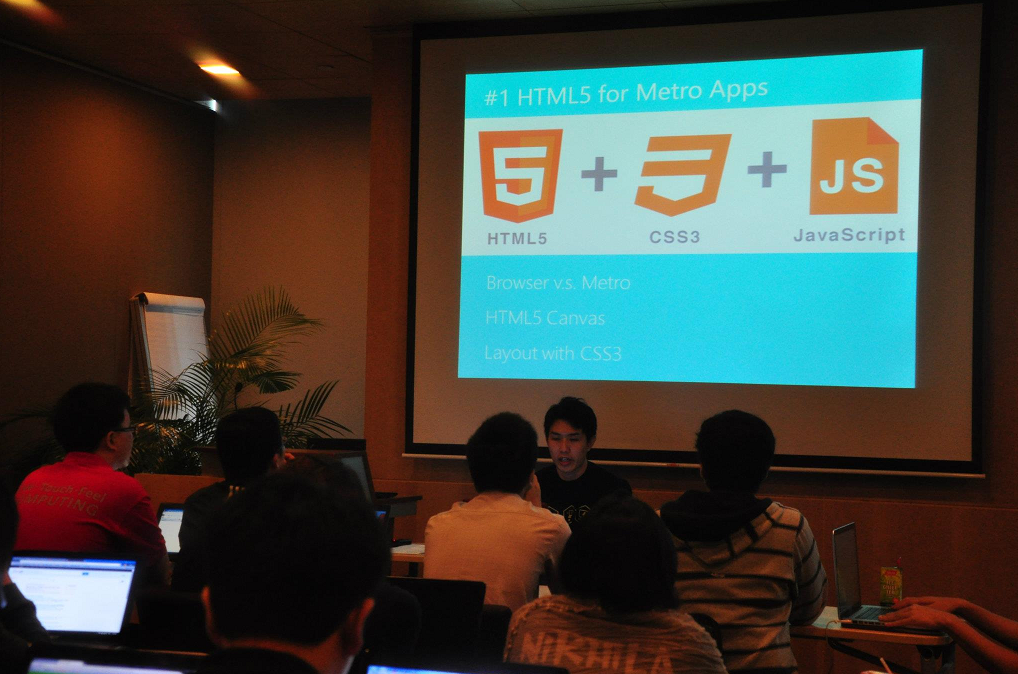
HTML5 for Metro Apps talk given by Alex Goh. Photo Credits: Spiffy
HTML5 for Metro Apps talk given by Alex Goh during Dream Build Launch event. Photo Credits: Spiffy

In December 2012, I participated in another Microsoft hackathon, Wowzapp. That was the first time I won the first prize in Microsoft competition after I graduated from university. The app that I built was called Entertainment Connect, also a Windows 8 app. User can use it to connect to his/her Dropbox account to retrieve media files and then play them in the app.

Near the end of the Wowzapp hackathon, one of the judges from Microsoft Singapore, Eugene, suggested me to build another app which connected to SkyDrive (which was later renamed to OneDrive) because he would love to use such an app and SkyDrive API was still quite new back then.

Because of Eugene’s idea of the app, I challenged myself again in the hackathon organized by Microsoft Singapore in 2014, //publish/. I decided to make Eugene’s dream come true.

//publish/

The special thing about //publish/ was that participants were allowed to bring their own existing Windows 8/8.1 projects. The focus of the event was more about publishing app to Windows Store. Hence, I took the opportunity to complete my second personal Windows 8 app, Entertainment Connect.

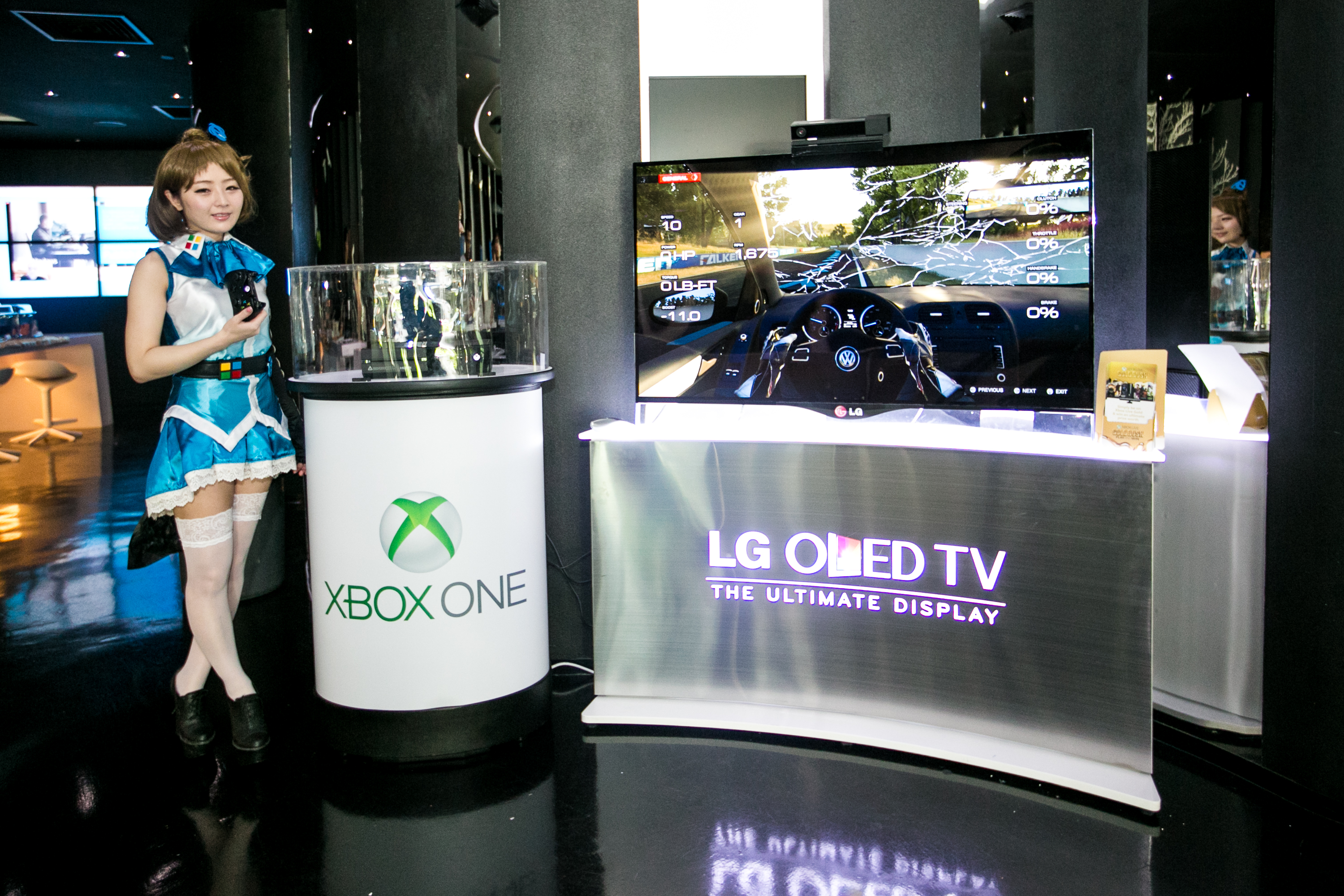
//publish/ hackathon was actually a 2D1N event happening worldwide. Personally, I thought the one in Singapore was the most special one because Inori Aizawa was invited as special guest to the event as well! Participants got the chance to take photo with her and won cute prizes. Also, we had the chance to try out Xbox One, the device that people were willing to queue up at Funan DigitaLife Mall for a few hours just to buy one.

Inori Aizawa and Xbox One! Photo Credits: Microsoft Singapore
Where else can you see Inori Aizawa playing Xbox One? Photo Credits: Microsoft Singapore
//publish/ organized by Microsoft in Singapore.
//publish/ organized by Microsoft in Singapore. Photo Credits: Microsoft Singapore

The event took place at The Co., a very comfortable place just next to my office. So, I got to bring laptop external keyboard and mouse, which helped to improve my coding speed.

There were tech talks given in the first morning. One of them was about Push Notification with Microsoft Azure. This talk in fact helped me a lot in my work when our company decided to do a push notification to Android and iOS phone.

Tech talk about Cortana delivered by Chun Siong.
Tech talk about Cortana delivered by Chun Siong. Photo Credits: Microsoft Singapore

Meet People

One of the great things that I love about Microsoft hackathon is that I always can meet imba people here. By just having a chat with them, I get to learn more technologies out there, such as Arduino, Azure Media Services, iOS development, and so on.

Because of this event, I also had the opportunities to make friend with Microsoft Singapore engineers who help me a lot in my work.

Entertainment Connect

Entertainment Connect is my submission for //publish/ in 2014.

Entertainment Connect
Entertainment Connect (Available now at Windows Store)

What’s so special about Entertainment Connect? Isn’t it just a media player that can play videos and songs? What else?

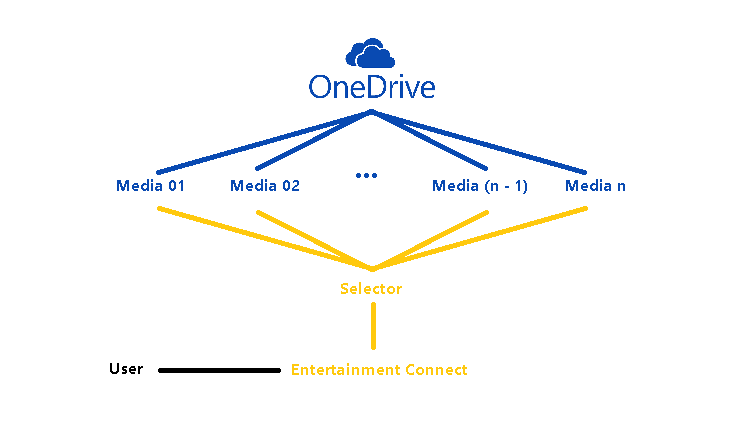
Firstly, yes, it is a media player. However, it is not a normal media player which can only play the local media files. It connects to your OneDrive account and retrieves available media files from there.

Secondly, I make it so that when you switch from one media file to another, the previous media file is paused and is hidden in the background. So, you can, let’s say, click on one video, play it halfway, then click on another song, then jump back to the same video again and continue from where you stop earlier. So this is actually similar to the “Parallel Video Downloading” feature that I introduced back then in YouTube Re-Player (Desktop) in 2009. The only difference is that now it does not limit the number of videos to be just 5.

Parallel Media Downloading from OneDrive to Entertainment Connect

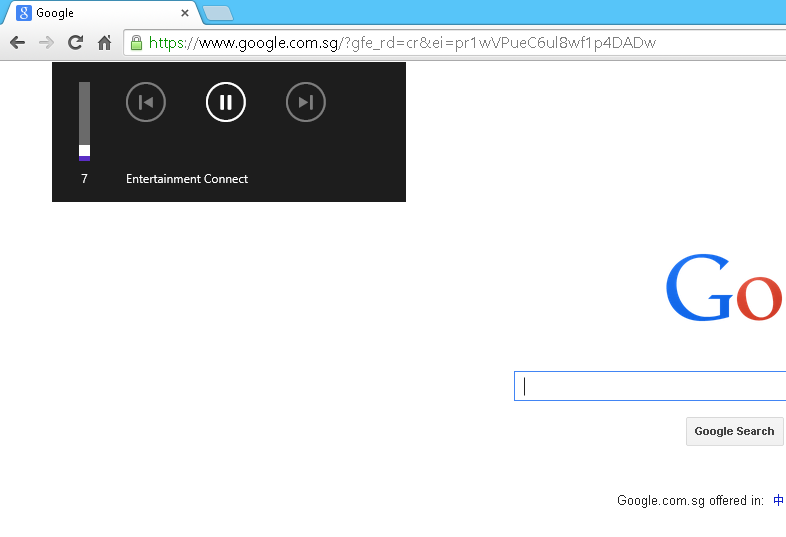
Thirdly, it supports playing audio in the background. This means that even though the app is running in the background, users can still continue listening to the music and at the same time they can also control the media player.

SystemMediaTransportControls

Finally, it can loop songs and videos. Yup, re-playing is always the must-have feature in the media player programs that I build. =)

Wait, It Was 6 Months Ago!

Some of the readers by now should have realized that //publish/ actually happened 6 months ago. Why do I only blog about it now? Well, the answer is that I choose to blog about it after I successfully publish Entertainment Connect to Windows Store. So, why does it take so long for me to publish an app? This is because I have little time to work on it after the event.

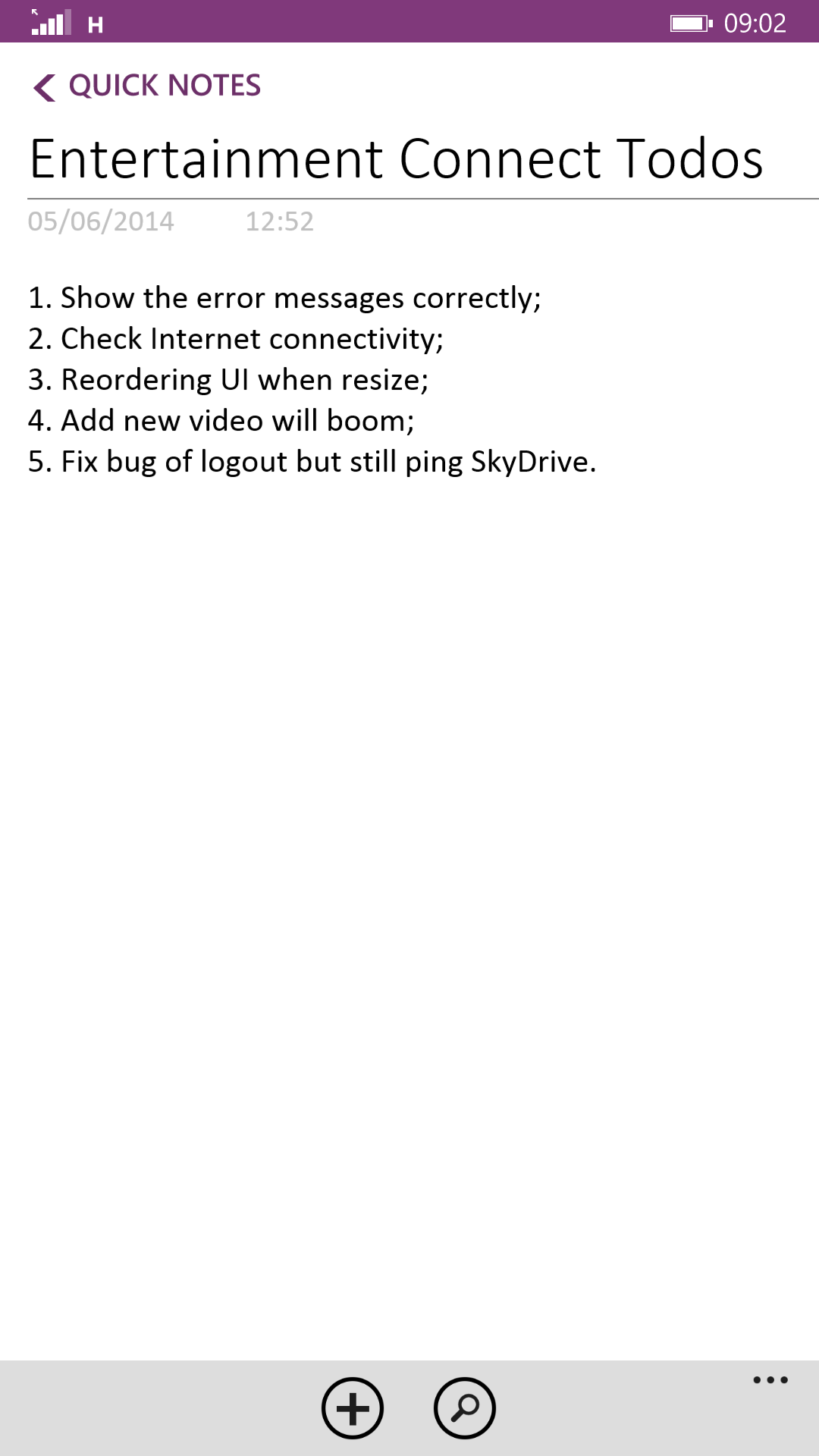
Simple to-do list kept in OneNote

I have learnt the key to finishing a personal project is to work on the project every day. However, I have a full-time work which requires me to OT always. Sleeping has thus become my top priority after work. However, I still try to at least work on the project by writing a few lines of code or just staring at Visual Studio for a few minutes. So, after 6 months of doing so, I am finally able to publish Entertainment Connect.

There is a saying, “Only do side projects you are absolutely crazy about.” Hence, I also installed Entertainment Connect on my laptop so I got to use it daily. The reason of doing so is to force me to remember about the project and to easily find out bugs in the app.

Today, I am happy that I successfully realize the dream of Eugene about a Windows 8 app that he can use to connect to play the media files stored in his OneDrive. In fact, I am very happy to have taken up this challenge and complete the app by myself even though the entire process is tiring.

Prize

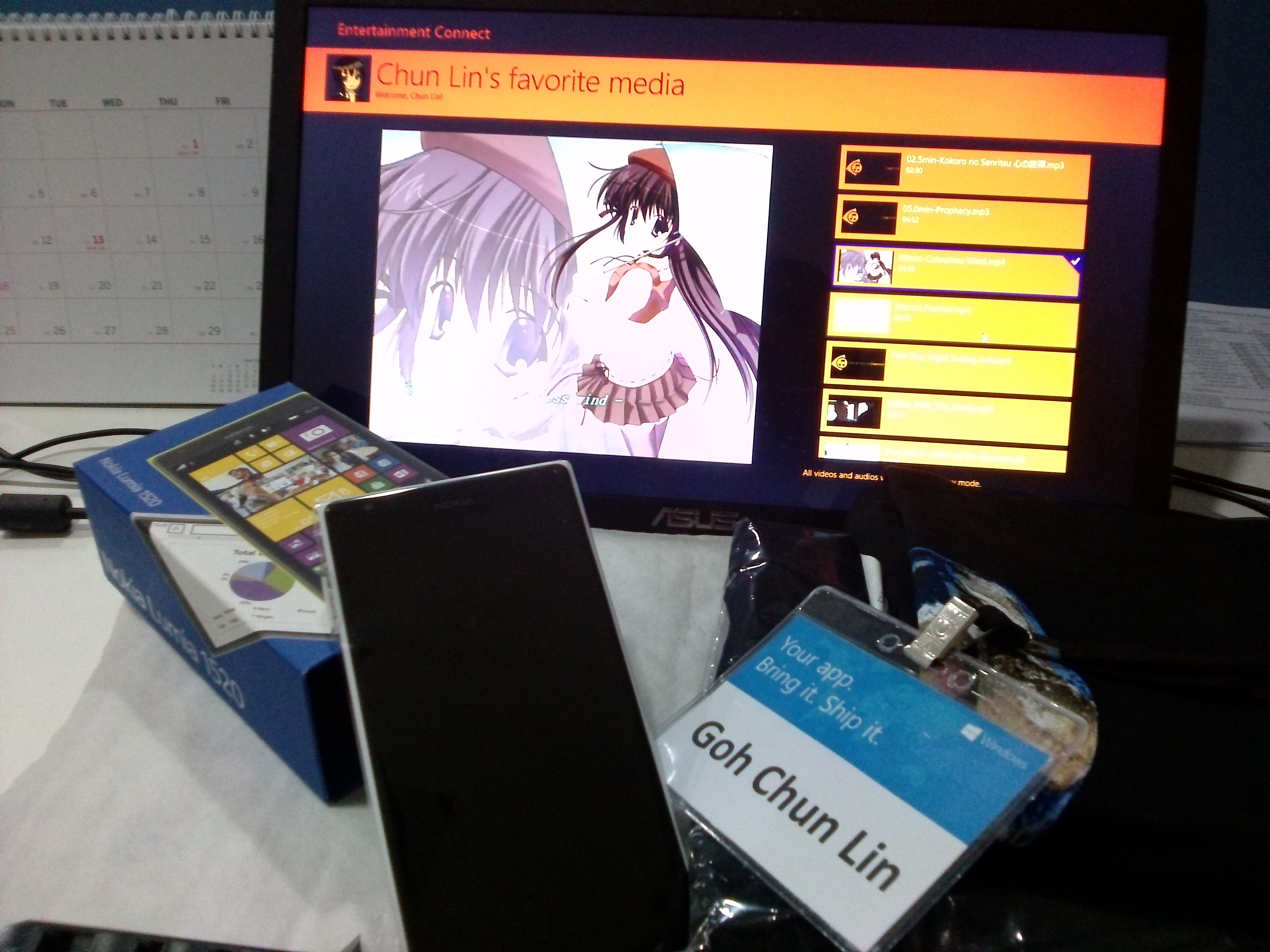
Prize is Nokia Lumia 1520!

I’d also like to take this chance to thank Microsoft Singapore team for giving me a special prize for Entertainment Connect during //publish/. It was a brand new Nokia Lumia 1520. Coincidentally, my Android phone stopped functioning few days before the event. So, I managed to get a new modern smart phone for free.

I should blog about the phone next time to show how good/bad Nokia Lumia 1520 is. =P

Downloads

Entertainment Connect is now available at Windows Store. You can visit the page http://apps.microsoft.com/windows/en-us/app/entertainment-connect/41d91a6b-6b56-4ae8-94b9-9b5f1053ca92 to download it now. It is free. =)

For developers who are interested to read the codes of app written in WinJS, please checkout the source code of Entertainment Connect on GitHub: https://github.com/goh-chunlin/EntertainmentConnect.

Entertainment Connect is now on GitHub!
Entertainment Connect is now on GitHub: https://github.com/goh-chunlin/EntertainmentConnect!

OneSimpleTablePaging 2.0: Now with Floating Table Header!

It has been more than two years since I first published OneSimpleTablePaging, a simple JavaScript library which does HTML table paging on web pages. The purpose of working on this project is to provide an alternative by just doing all the table pagination in one JavaScript file without using any image.

Floating Table Header <thead>

I blogged about this two years ago. Since then, I have been receiving feedback from readers on how to make the library do more.

OneSimpleTablePaging.JS Demo Site
OneSimpleTablePaging.JS Demo Site at https://db.tt/6DUQxQzv.

One of the suggestions from trdunsworth is to implement a floating table header. This will help the header of the table to be fixed at the original position when readers scrolling the web page up and down. I like this idea very much.

Fortunately, there are many resources available online which shows how a floating table header can be done easily. A very simple solution that I first found is suggested by Andrew Whitaker on StackOverflow. He even nicely provided a demo on JSFiddle. However, his solution is too simple. It does not take into the consideration of, for example, hiding the floating header if the table has been scrolled too way up and is no longer visible. Another solution on CodePen thus gave me some ideas on how to improve the code further.

After spending one afternoon, I successfully implemented the feature and published a new version of OneSimpleTablePaging. I also did a simple demo page to show how the pagingnation and floating header work: https://db.tt/6DUQxQzv.

From Google Code to GitHub

I have been using Google Code since the time when I was studying in university. Recently, with the increasing popularity of GitHub, I decided to try it out. Hence, I have moved the project OneSimpleTablePaging to GitHub: https://github.com/goh-chunlin/one-simple-table-paging.

Yup, so now please visit the new homepage for OneSimpleTablePaging at GitHub! Thanks. =)

OneSimpleTablePaging is now on GitHub!
OneSimpleTablePaging is now on GitHub: https://github.com/goh-chunlin/one-simple-table-paging!