Pinecone worked well, but as the project grew, I wanted more control, something open-source, and a cheaper option. That is when I found pgvector, a tool that adds vector search to PostgreSQL and gives the flexibility of an open-source database.
About HSR and Relic Recommendation System
Honkai: Star Rail (HSR) is a popular RPG that has captured the attention of players worldwide. One of the key features of the game is its relic system, where players equip their characters with relics like hats, gloves, or boots to boost stats and unlock special abilities. Each relic has unique attributes, and selecting the right sets of relics for a character can make a huge difference in gameplay.
As a casual player, I often found myself overwhelmed by the number of options and the subtle synergies between different relic sets. Finding the good relic combination for each character was time-consuming.
This is where LLMs like Gemini come into play. With the ability to process and analyse complex data, Gemini can help players make smarter decisions.
In November 2024, I started a project to develop a Gemini-powered HSR relic recommendation system which can analyse a player’s current characters to suggest the best options for them. In the project, I have been storing embeddings in Pinecone.
Embeddings and Vector Database
An embedding is a way to turn data, like text or images, into a list of numbers called a vector. These vectors make it easier for a computer to compare and understand the relationships between different pieces of data.
For example, in the HSR relic recommendation system, we use embeddings to represent descriptions of relic sets. The numbers in the vector capture the meaning behind the words, so similar relics and characters have embeddings that are closer together in a mathematical sense.
This is where vector databases like Pinecone or pgvector come in. Vector databases are designed for performing fast similarity searches on large collections of embeddings. This is essential for building systems that need to recommend, match, or classify data.
pgvector is an open-source extension for PostgreSQL that allows us to store and search for vectors directly in our database. It adds specialised functionality for handling vector data, like embeddings in our HSR project, making it easier to perform similarity searches without needing a separate system.
Unlike managed services like Pinecone, pgvector is open source. This meant we could use it freely and avoid vendor lock-in. This is a huge advantage for developers.
Finally, since pgvector runs on PostgreSQL, there is no need for additional managed service fees. This makes it a budget-friendly option, especially for projects that need to scale without breaking the bank.
Choosing the Right Model
While the choice of the vector database is important, it is not the key factor in achieving great results. The quality of our embeddings actually is determined by the model we choose.
For my HSR relic recommendation system, when our embeddings were stored in Pinecone, I started by using the multilingual-e5-large model from Microsoft Research offered in Pinecone.
When I migrated to pgvector, I had the freedom to explore other options. For this migration, I chose the all-MiniLM-L6-v2 model hosted on Hugging Face, which is a lightweight sentence-transformer designed for semantic similarity tasks. Switching to this model allowed me to quickly generate embeddings for relic sets and integrate them into pgvector, giving me a solid starting point while leaving room for future experimentation.
The all-MiniLM-L6-v2 model hosted on Hugging Face.
Using all-MiniLM-L6-v2 Model
Once we have decided to use the all-MiniLM-L6-v2 model, the next step is to generate vector embeddings for the relic descriptions. This model is from the sentence-transformers library, so we first need to install the library.
pip install sentence-transformers
The library offers SentenceTransformer class to load pre-trained models.
from sentence_transformers import SentenceTransformer

model_name = 'all-MiniLM-L6-v2'
model = SentenceTransformer(model_name)
At this point, the model is ready to encode text into embeddings.
The SentenceTransformer model takes care of tokenisation and other preprocessing steps internally, so we can directly pass text to it.
# Function to generate embedding for a single text
def generate_embedding(text):
    # No need to tokenise separately, it's done internally
    # No need to average the token embeddings
    embeddings = model.encode(text)

    return embeddings
In this function, when we call model.encode(text), the model processes the text through its transformer layers, generating an embedding that captures its semantic meaning. The output is already optimised for tasks like similarity search.
Setting up the Database
After generating embeddings for each relic sets using the all-MiniLM-L6-v2 model, the next step is to store them in the PostgreSQL database with the pgvector extension.
Here, a dimension refers to one of the “features” that helps describe something. When we talk about vectors and embeddings, each dimension is just one of the many characteristics used to represent a piece of text. These features could be things like the type of words used, their relationships, and even the overall meaning of the text.
Updating the Database
After the table is created, we can proceed to create INSERT INTO SQL statements to insert the embeddings and their associated text into the database.
In this step, I load the relic information from a JSON file and process it.
import json

# Load your relic set data from a JSON file
with open('/content/hsr-relics.json', 'r') as f:
    relic_data = json.load(f)

# Prepare data
relic_info_data = [
    {"id": relic['name'], "text": relic['two_piece'] + " " + relic['four_piece']}  # Combine descriptions
    for relic in relic_data
]
The relic_info_data will then be passed to the following function to generate the INSERT INTO statements.
# Function to generate INSERT INTO statements with vectors
def generate_insert_statements(data):
    # Initialise list to store SQL statements
    insert_statements = []

    for record in data:
        # Extracting text and id from the record
        id = record.get('id')
        text = record.get('text')

        # Generate the embedding for the text
        embedding = generate_embedding(text)

        # Convert the embedding to a list
        embedding_list = embedding.tolist()

        # Create the SQL INSERT INTO statement
        sql_statement = f"""
        INSERT INTO embeddings (id, vector, text)
        VALUES (
          '{id.replace("'", "''")}',
          ARRAY{embedding_list},
          '{text.replace("'", "''")}')
        ON CONFLICT (id) DO UPDATE
        SET vector = EXCLUDED.vector, text = EXCLUDED.text;
        """

        # Append the statement to the list
        insert_statements.append(sql_statement)

    return insert_statements
The embeddings of the relic sets are successfully inserted to the database.
How It All Fits Together: Query the Database
Once we have stored the vector embeddings of all the relic sets in our PostgreSQL database, the next step is to find the relic sets that are most similar to a given character’s relic needs.
Just like what we have done for storing relic set embeddings, we need to generate an embedding for the query describing the character’s relic needs. This is done by passing the query through the model as demonstrated in the following code.
The generated embedding is an array of 384 numbers. We simply use this array in our SQL query below.
SELECT id, text, vector <=> '[<embedding here>]' AS distance
FROM embeddings
ORDER BY distance
LIMIT 3;
The key part of the query is the <=> operator. This operator calculates the “distance” between two vectors based on cosine similarity. In our case, it measures how similar the query embedding is to each stored embedding. The smaller the distance, the more similar the embeddings are.
We use LIMIT 3 to get the top 3 most similar relic sets.
Test Case: Finding Relic Sets for Gallagher
Gallagher is a Fire and Abundance character in HSR. He is a sustain unit that can heal allies by inflicting a debuff on the enemy.
According to the official announcement, Gallagher is a healer. (Image Source: Honkai: Star Rail YouTube)
The following screenshot shows the top 3 relic sets which are closely related to a HSR character called Gallagher using the query “Suggest the best relic sets for this character: Gallagher is a Fire and Abundance character in Honkai: Star Rail. He can heal allies.”
The returned top 3 relic sets are indeed recommended for Gallagher.
One of the returned relic sets is called the “Thief of Shooting Meteor”. It is the official recommended relic set in-game, as shown in the screenshot below.
Gallagher’s official recommended relic set.
Future Work
In our project, we will not be implementing indexing because currently in HSR, there are only a small number of relic sets. Without an index, PostgreSQL will still perform vector similarity searches efficiently because the dataset is small enough that searching through it directly will not take much time. For small-scale apps like ours, querying the vector data directly is both simple and fast.
However, when our dataset grows larger in the future, it is a good idea to explore indexing options, such as the ivfflat index, to speed up similarity searches.
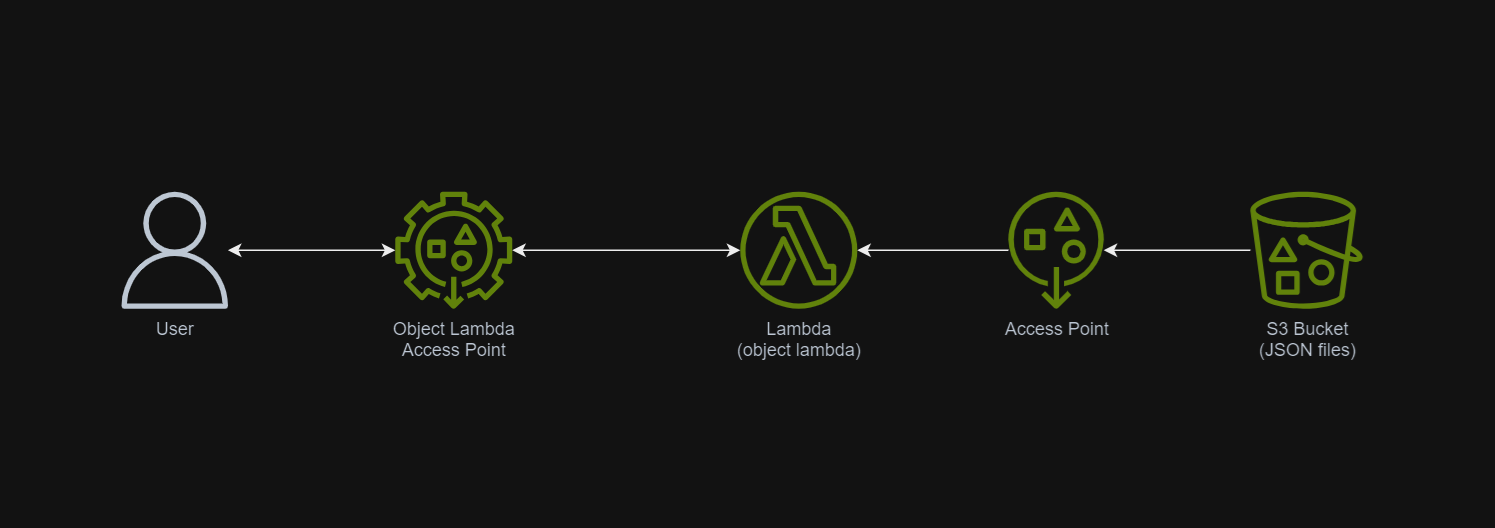
In the previous article, we talked about using the S3 Object Lambda to transform the medical records, which are stored in a JSON file, into a presentable web page. However, maintaining medical records in JSON files could be challenging. In this article, we will further investigate how we can generate those JSON files.
The part highlighted in red will be the focus of this article.
About Pkl
Pkl streamlines the creation of JSON scripts, enhancing maintainability and reducing verbosity through reuse, templating, and abstraction, all supported seamlessly right out of the box.
As we can expect from our medical records in JSON, the JSON files will grow larger over time. Hence it will be increasingly difficult to maintain. Pkl can help reduce the size and complexity of our JSON files by introducing abstractions for common elements and describing similar elements in terms of their differences.
Pkl comes with basic types, such as Numbers, Strings, Durations, etc. Having a notation for basic types, we can thus write typed objects. For example, the following module shows how we will define our medical records structure in Pkl.
module medicalVisitTemplate

class MedicalVisit {

    medicalCentreName: String

    centreType: "clinic"|"specialist"|"hospital"

    visitStartDate: Date

    visitEndDate: Date

    remark: String

    treatments: Listing<Treatment>

}

class Treatment {

    name: String

    type: "medicine"|"operation"|"scanning"

    amount: String

    startDate: Date

    endDate: Date

}

class Date {

    year: Int(isBetween(2000, 2100))

    month: Int(isBetween(1, 12))

    day: Int(isBetween(1, 31))
}

visits: Listing<MedicalVisit>
Listing is a collection in Pkl. It contains exclusively Elements, i.e., object members. In the code above, we define visits to be a collection of MedicalVisits. The MedicalVisit class contains information about the visit, for example type and name of the medical centres the patient visited, visiting period, remark, etc. The visiting period is then defined by Date class which stores year, month, and day.
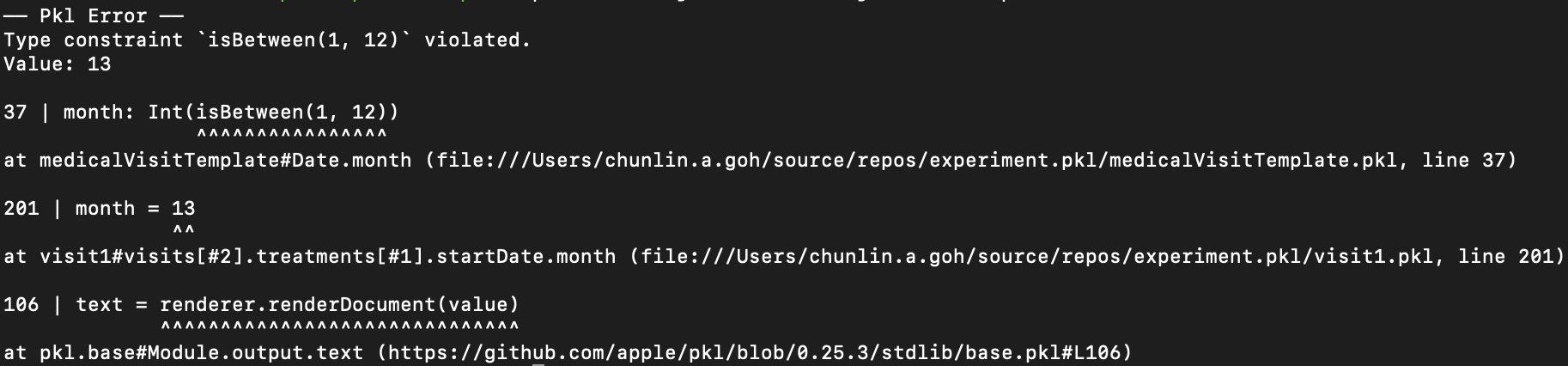
In the Date class, since the month can only be an integer from 1 to 12, so we can restrict it to an integer range by using Int and isBetween constraint. Later, as Pkl evaluates our configuration, if there is an invalid value, for example 13, provided to the month, there will be an error shown to us, as demonstrated below.
Pkl CLI will evaluate our configuration and show detected invalid values.
Generate JSON with Pkl
So now how do we generate JSON with the module above?
So, to generate the chunlin.json file that was shown in the previous blog post, we can amend the medicalVisitTemplate module above with another Pkl file called chunlin.pkl as shown below.
amends "medicalVisitTemplate.pkl"

visits = new Listing<MedicalVisit> {

    ...
    // Omitted for brevity

    new {

        medicalCentreName = "Tan Tock Seng Hospital"

        centreType = "hospital"

        visitStartDate {

            year = 2024

            month = 3

            day = 24

        }

        visitEndDate {

            year = 2024

            month = 4

            day = 19

        }

        remark = ""

        treatments = new Listing<Treatment> {

            ...
            // Omitted for brevity

            new {

                name = "Betamethasone (Valerate) 0.025% Cream 15g - Dermasone"

                type = "medicine"

                amount = "Applied after shower"

                startDate {

                    year = 2024

                    month = 3

                    day = 26

                }

                endDate {

                    year = 2024

                    month = 4

                    day = 19

                }

            }

            new {

                name = "Betamethasone (Valerate) 0.1% Cream 15g - Uniflex(TM)"

                type = "medicine"

                amount = "Applied after shower"

                startDate {

                    year = 2024

                    month = 3

                    day = 26

                }

                endDate {

                    year = 2024

                    month = 4

                    day = 19

                }

            }

        }

    }

}
Now if we execute the command below on Pkl CLI to evaluate the given modules and render the
With the command above, we can get the same output as we see in chunlin.json.
Maintain Pkl in GitHub
Static files like Pkl or JSON can be easily maintained in code repositories such as GitHub. Using GitHub for version control allows us to track changes to our PKL files over time. This makes it easy to revert to previous versions if something goes wrong, compare changes, and understand the evolution of our configuration files. Additionally, we can use GitHub Actions to automate various tasks related to our PKL files, enhancing efficiency and reliability in our workflow.
GitHub Actions is an automation tool that allows us to create workflows triggered by events within our repository. These workflows can automate tasks like testing, building, and deploying code, or even running scripts. By using GitHub Actions, we can streamline the development and transformation process of our Pkl files, ensure consistency, and improve efficiency.
Thus, our mission is now to configure GitHub Actions so that a JSON file can be produced from the Pkl file and sent to the Amazon S3 bucket that we setup in another article earlier.
Configure GitHub Actions Workflow
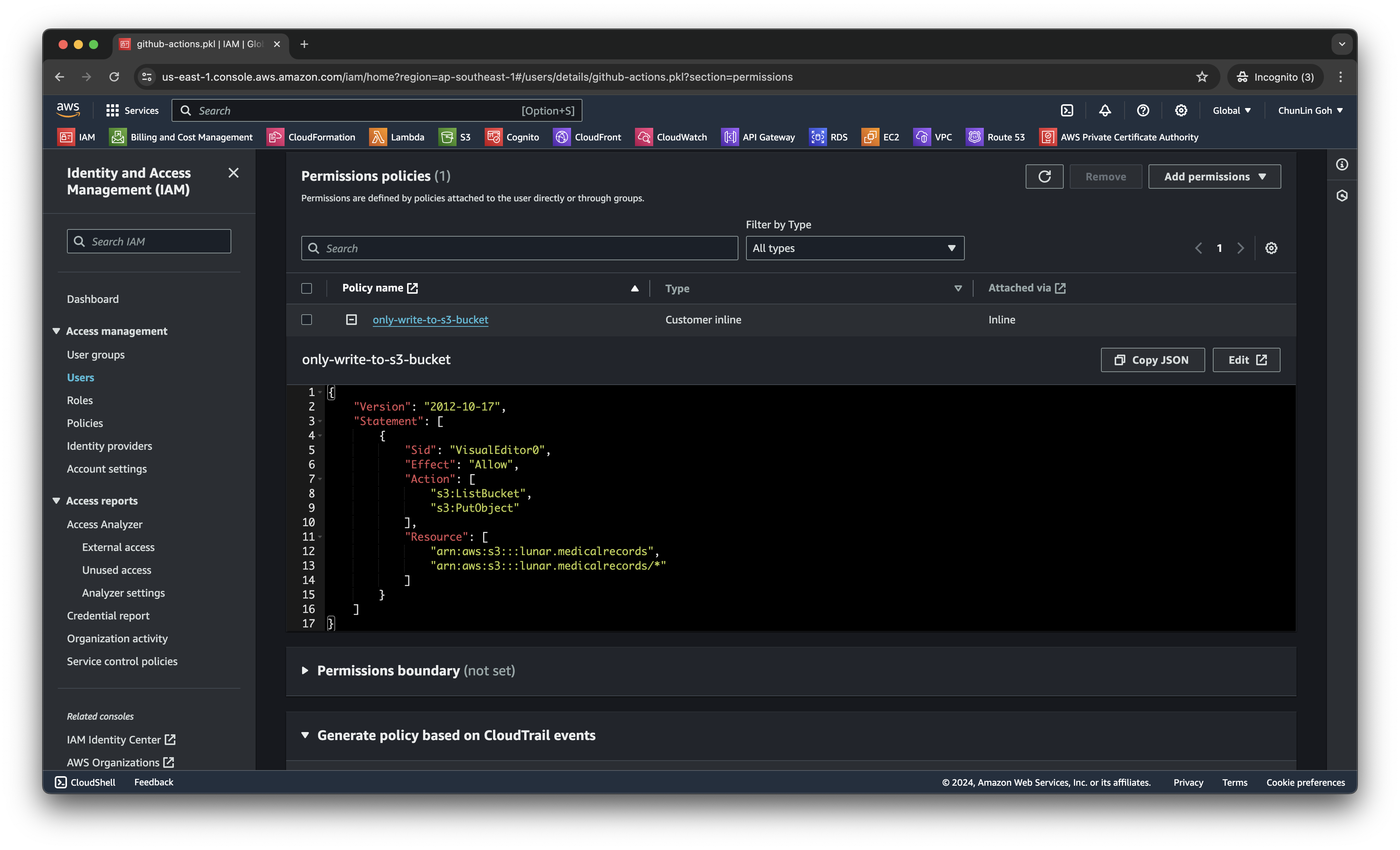
Firstly, we need to give permission to GitHub Actions to access our S3 bucket. To do so, we will create a new user in AWS Console with appropriate rights.
We only need two permissions, s3:ListBucket and s3:PutObject, to copy files from local to the S3 bucket.
After attaching the policy, we proceed to generate an access key for this newly created user.
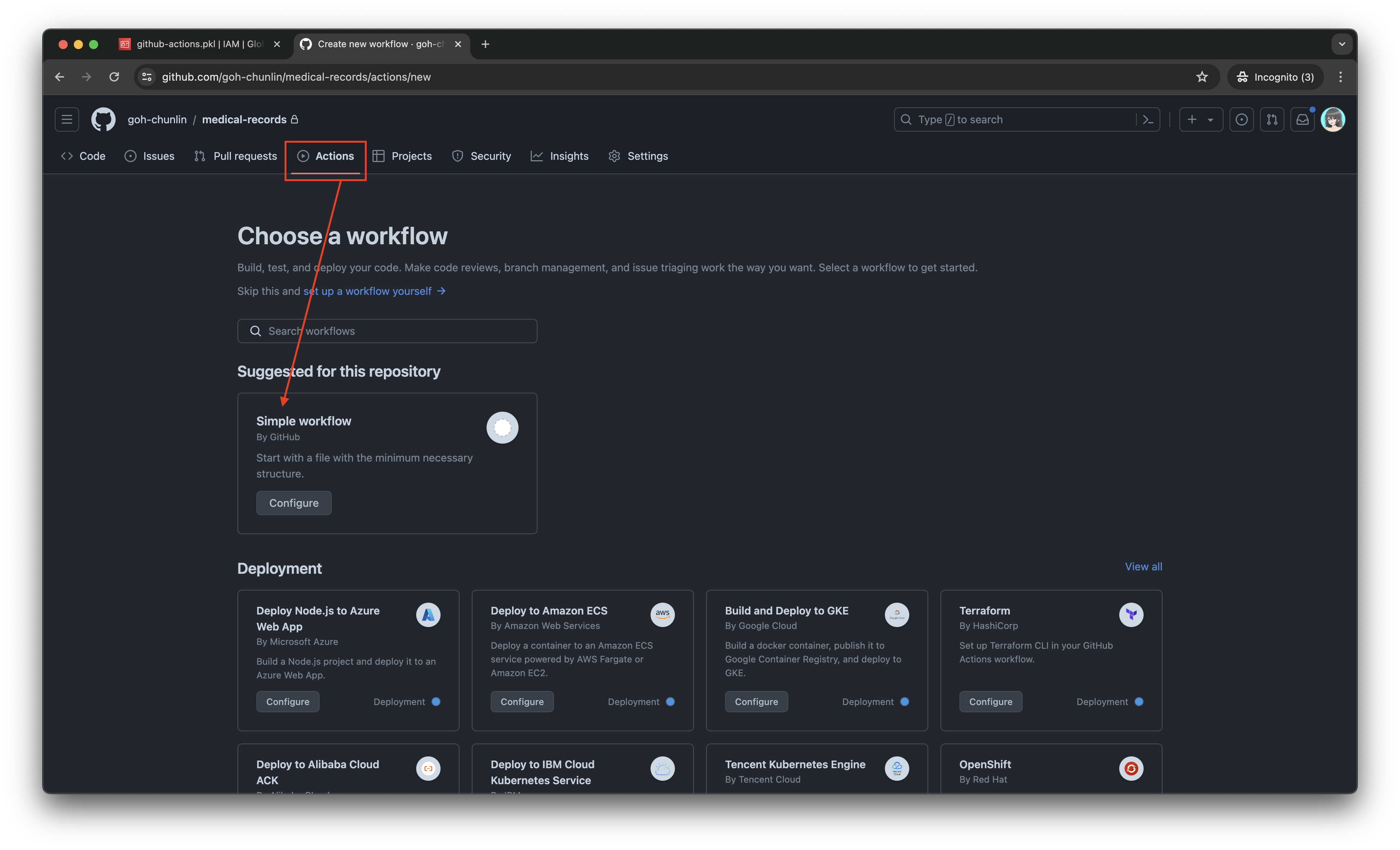
Secondly, we need to navigate to our repository and then click on the Actions tab to create a new simple workflow, as shown below.
- name: Install Linter run: go install github.com/Drafteame/pkl-linter@latest
- name: Run pkl-linter run: pkl-linter medical-records
The linter analyses our code and shows detected stylistic errors.
Next, we need to install the Pkl CLI to evaluate Pkl modules and write their output to a file. There are native executables available for us to use. As shown in the workflow above, the GitHub Actions runner is ubuntu-latest, which uses the Ubuntu 22.04 LTS image as of Jun 2024. It uses the amd64 architecture. Hence, we can download the Pkl Linux executable for amd64 architecture.
- name: Grant execute permission to Pkl CLI run: chmod +x pkl
- name: Get Pkl CLI version run: ./pkl --version
- name: Eval the Pkl files run: | cd medical-records files=$(find . -name "*.pkl") count=0 for file in $files; do output_filename="${file%.pkl}.json" ../pkl eval -f json -o ../output/$output_filename $file done cd ..
When my workflow is executed in June 2024, the version of the Pkl CLI is “Pkl 0.25.3 (Linux 5.15.0-1053-aws, native)”.
As shown in the last step above, it will loop through the JSON file in the medical-records folder and evaluate them one-by-one using the Pkl CLI. The JSON files generated will be stored in the output folder.
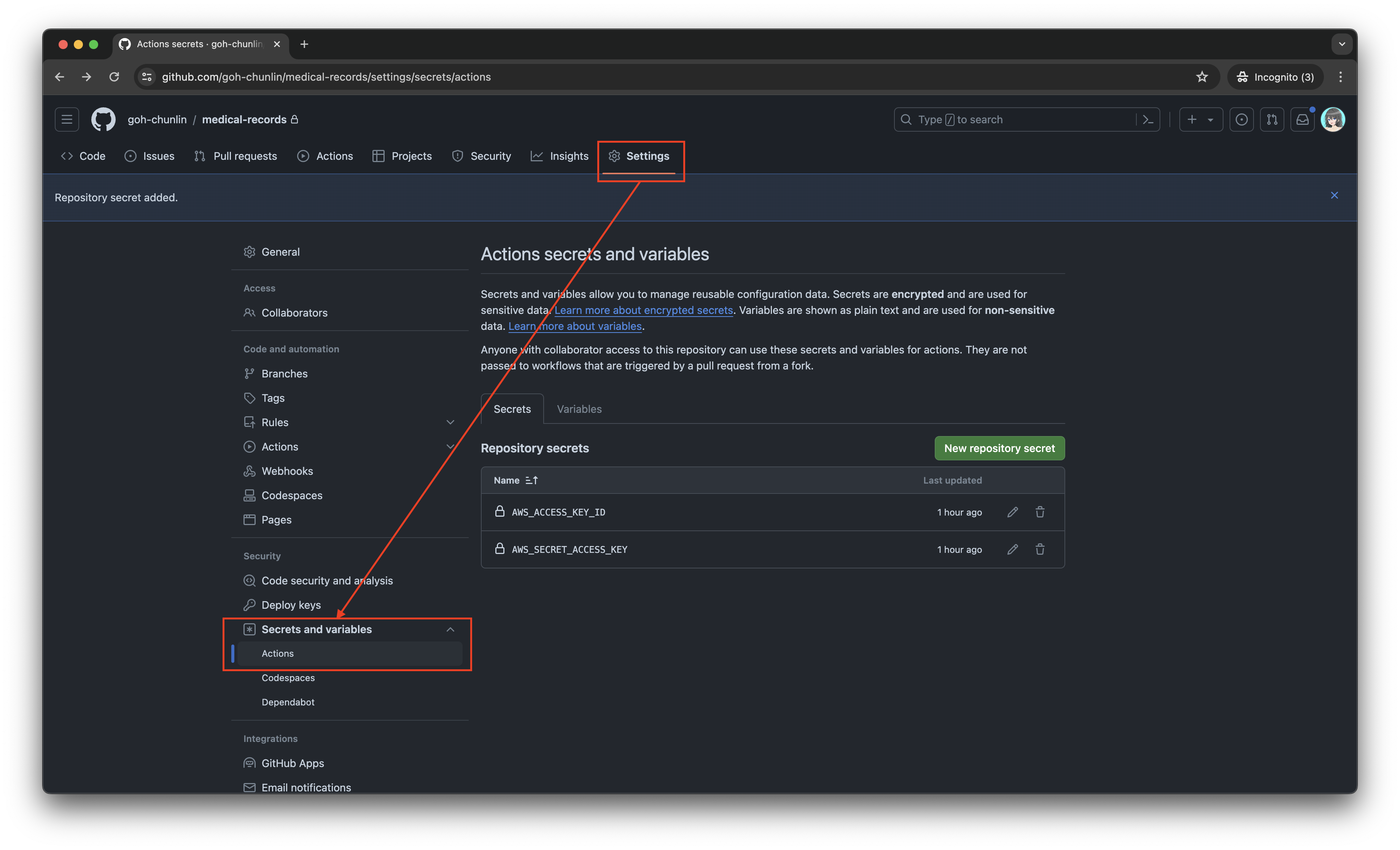
Eventually, what we need to do is to upload the file over to our AWS S3 bucket. However, before that, let’s make sure the AWS access key and secret access key we generated earlier are stored securely on GitHub Actions, a shown in the screenshot below.
The AWS access key and secret access key should be stored as GitHub Actions secrets.
Now, we can easily setup AWS CLI with the secrets above and use the s3 cp command to move the generated JSON files over to our S3 bucket. To do so, we only need to complete our workflow with the following.
In conclusion, utilising Pkl for generating and maintaining JSON files offers significant advantages in terms of reducing complexity and enhancing maintainability. By abstracting common elements and leveraging typed objects, Pkl simplifies the management of large and evolving datasets. The structured approach provided by Pkl not only minimises redundancy but also ensures that configurations remain consistent and error-free through its robust validation features.
Additionally, by using GitHub Actions, we can automate the process of evaluating Pkl files, generating the corresponding JSON files as output, and uploading these JSON files to our S3 bucket. This automation not only enhances efficiency but also ensures that changes are tracked and managed effectively.
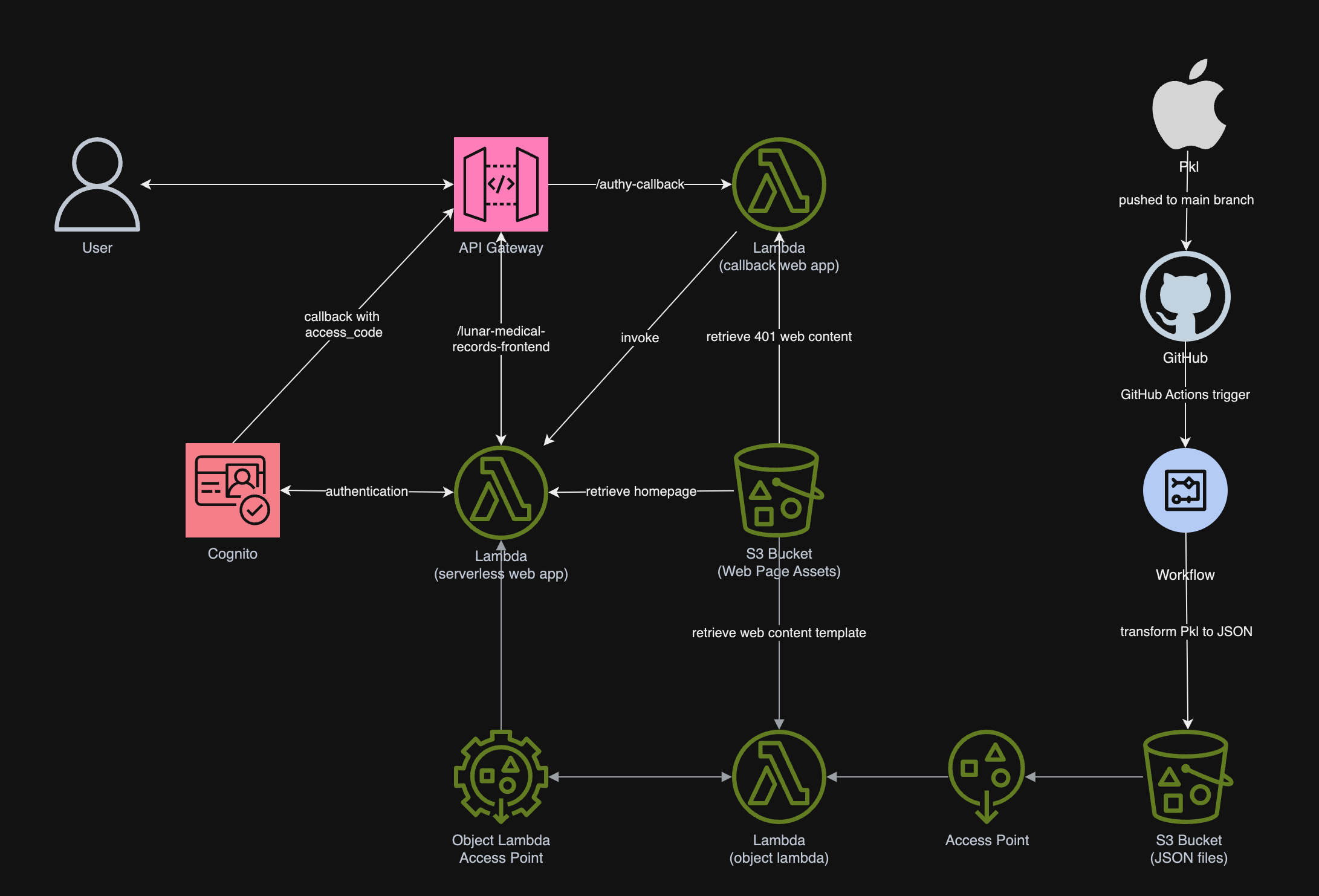
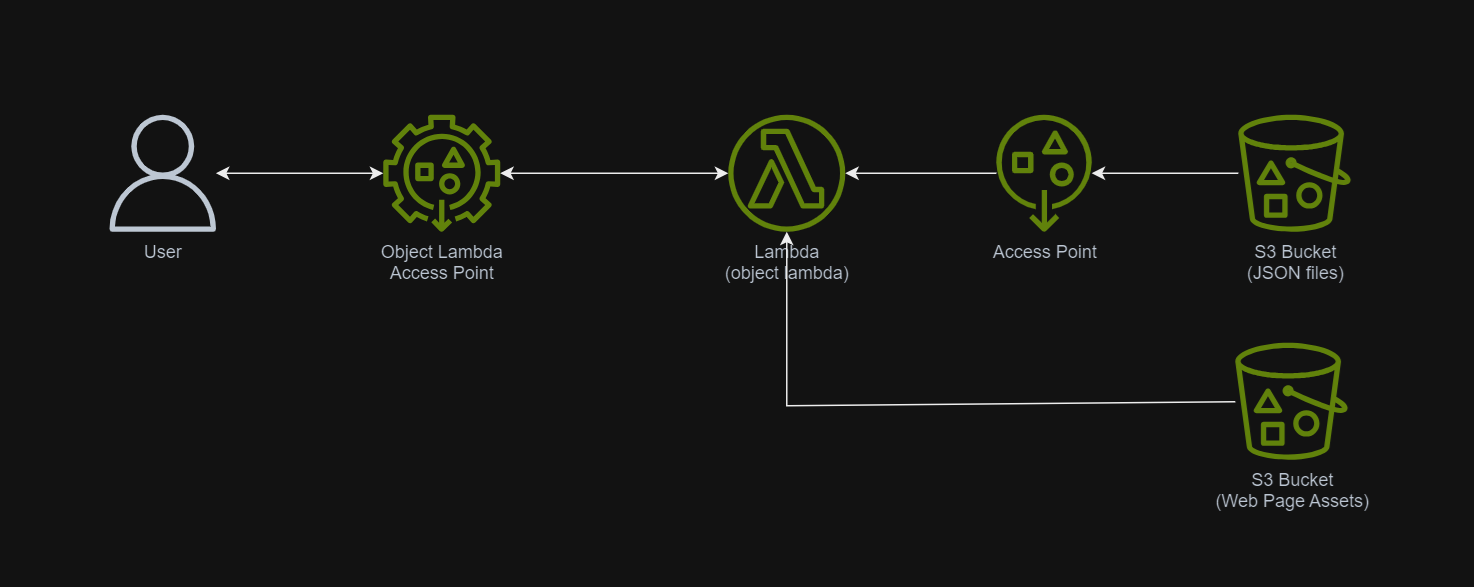
In summary, we can conclude the infrastructure that we have gone through above and our previous article in the following diagram.
For API developers, Postman is a popular tool that streamlines the process of testing APIs. Postman is like having a Swiss Army knife for API development as it allows developers to interact with APIs efficiently.
In March 2023, Postman Flows was officially announced. Postman Flows is a no-code visual tool within the Postman platform designed to help us create API workflows by dragging and dropping components, making it easier to build complex sequences of API calls without writing extensive code.
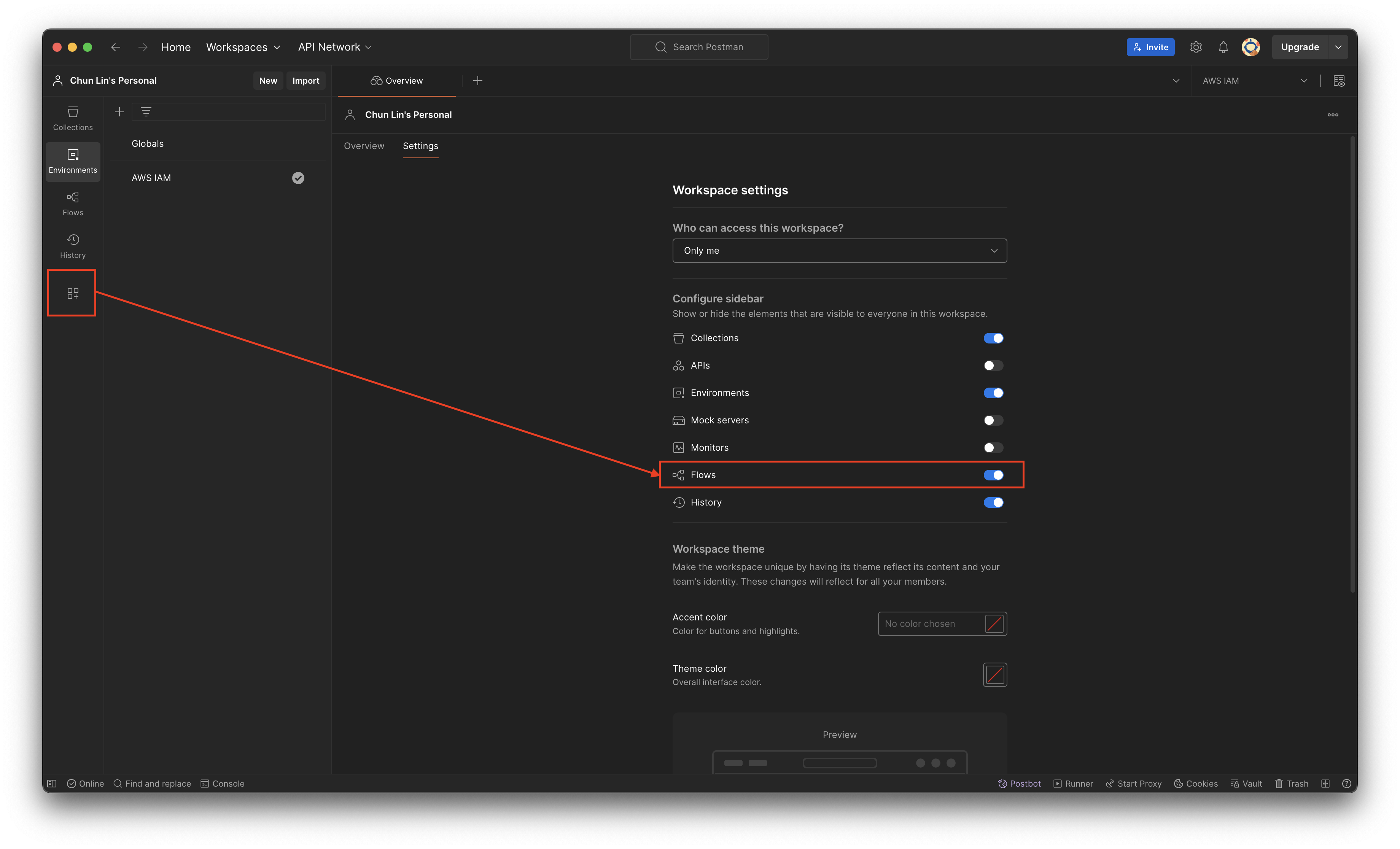
Please make sure Flows is enabled in our Postman Workspace.
Recently, my teammate demonstrated how Postman Flows works, and I’d like to share what I’ve learned from him in this article.
Use Case
Assume that there is a list of APIs that we need to call in sequence every time, then we can make use of Postman Flows. For demonstration purpose, let’s say we have to call the following three AWS APIs for a new user registration.
We will first need to define the environment variables, as shown in the following screenshot.
We keep the region variable to be empty because the region of IAM setup should be Global.
Next, we will setup the three API calls. For example, to create a new user on AWS, we need to make an HTTP GET request to the IAM base URL with CreateUser as the action, as shown in the following screenshot.
The UserName will be getting its value from the variable userName.
To tag the user, for example assigning the user above to a team in the organisation, we can do so by setting TagUser as the action, as shown in the screenshot below. The team that the user will be assigned to is based on their employee ID, which we will discuss later in this article.
The teamName is a variable with value determined by another variable.
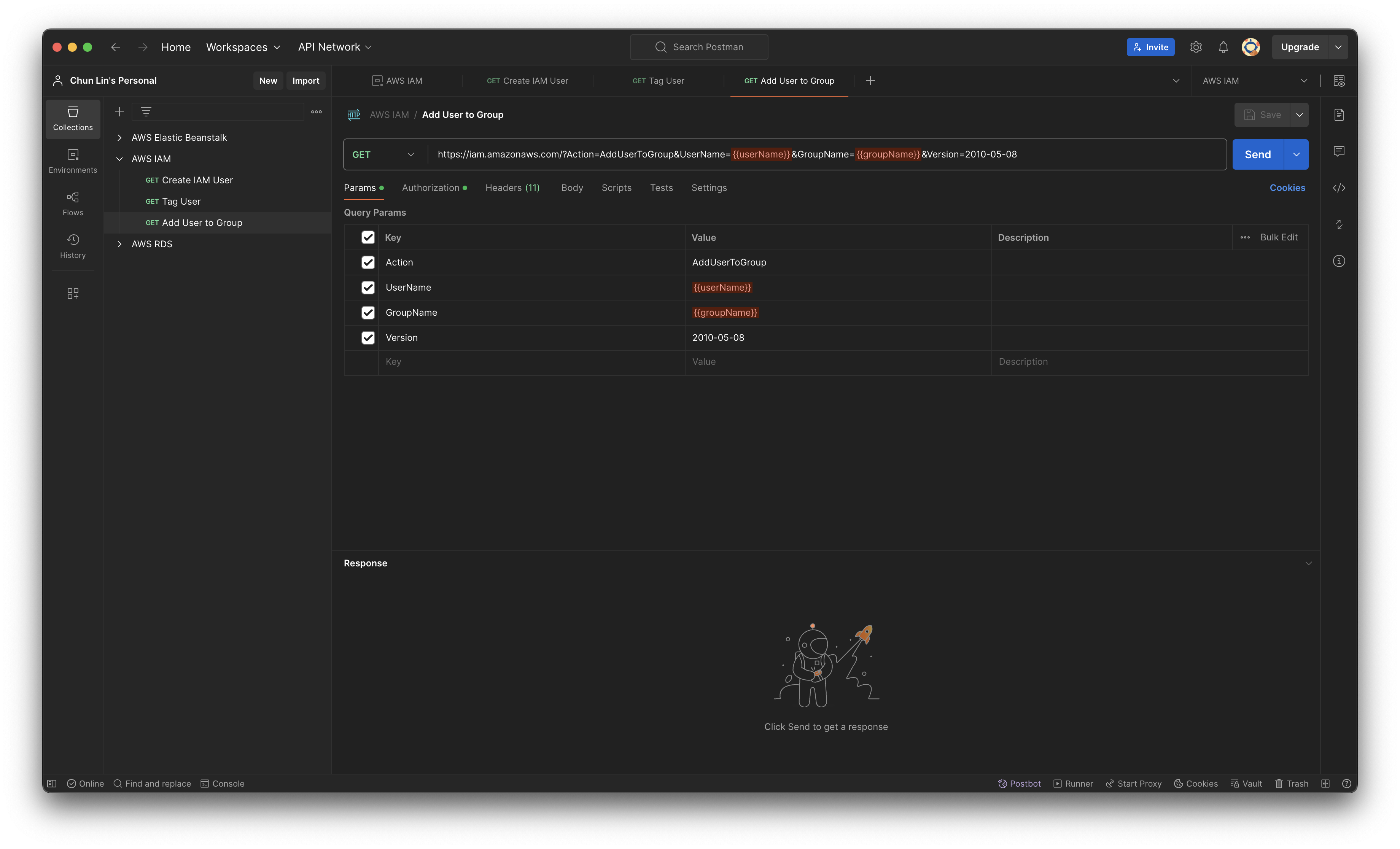
Finally, we will assign the user to an existing user group by setting AddUserToGroup as its action.
The groupName must be having a valid existing group name in our AWS account.
Create the Flow
As demonstrated in the previous section, calling the three APIs sequentially is straightforward. However, managing variables carefully to avoid input errors can be challenging. Postman Flows allows us to automate these API calls efficiently. By setting up the Flow, we can execute all the API requests with just a few clicks, reducing the risk of mistakes and saving time.
Firstly, we will create a new Flow called “AWS IAM New User Registration”, as shown below.
Created a new Flow.
By default, it comes with three options that we can get started. We will go with the “Send a request” since we will be sending a HTTP GET request to create a user in IAM. As shown in the following screenshot, a list of variables that we defined earlier will be available. We only need to make sure that we choose a correct Environment. The values of service, region, accessKey, and secretKey will then be retrieved from the selected Environment.
Choosing the environment for the block.
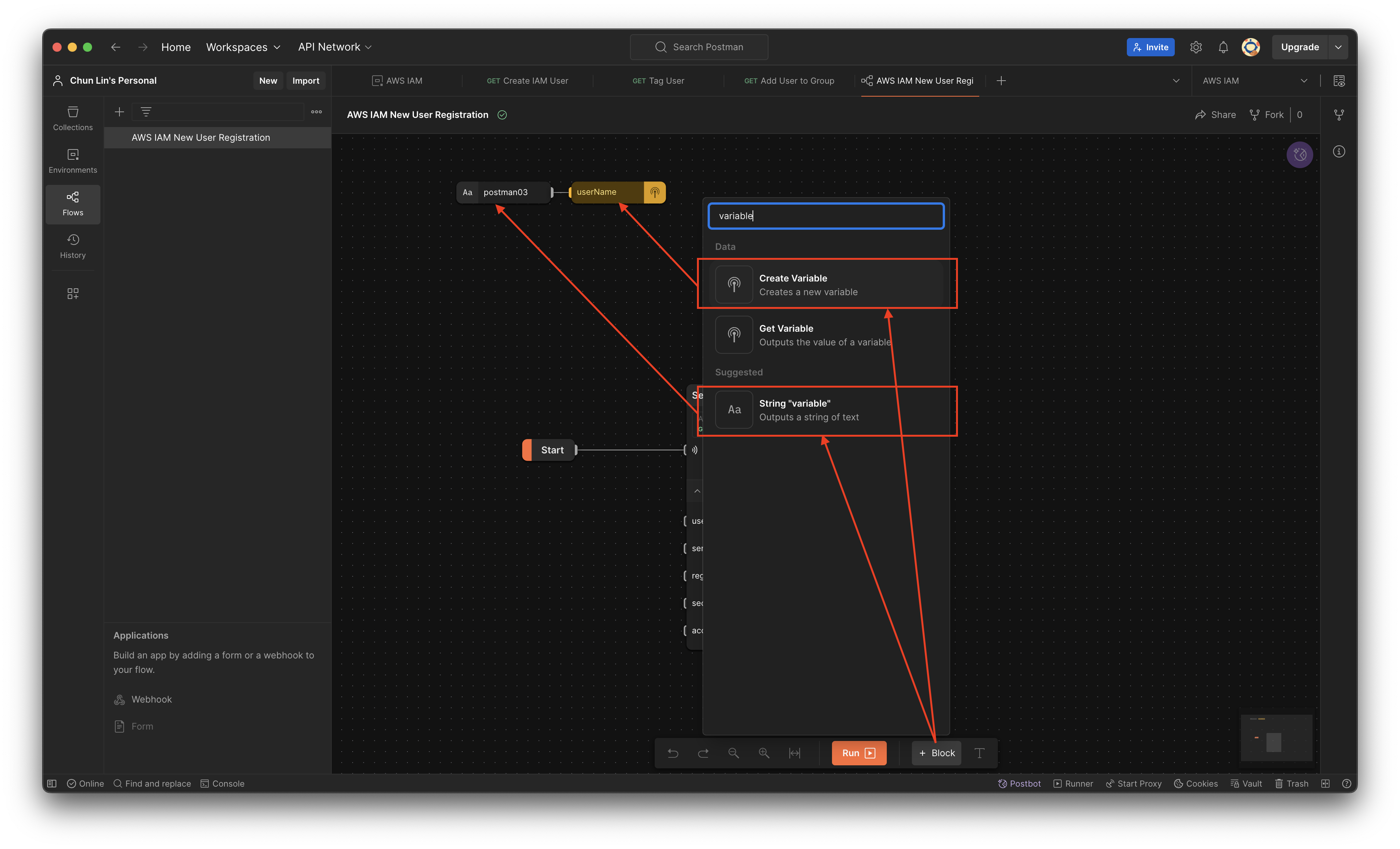
Since the variable userName will be used in all three API calls, let’s create a variable block and assign it a value called “postman03”.
Created a variable and assigned a string value to it.
Next, we simply need to tell the API calling block to assign the value of userName to the field userName.
Assigning variable to the query string in the API call.
Now if we proceed to click on the “Run” button, by right, the call should respond with HTTP 200 and relevant info returned from AWS, as demonstrated below.
Yes, the user “postman03” is created successfully on AWS IAM.
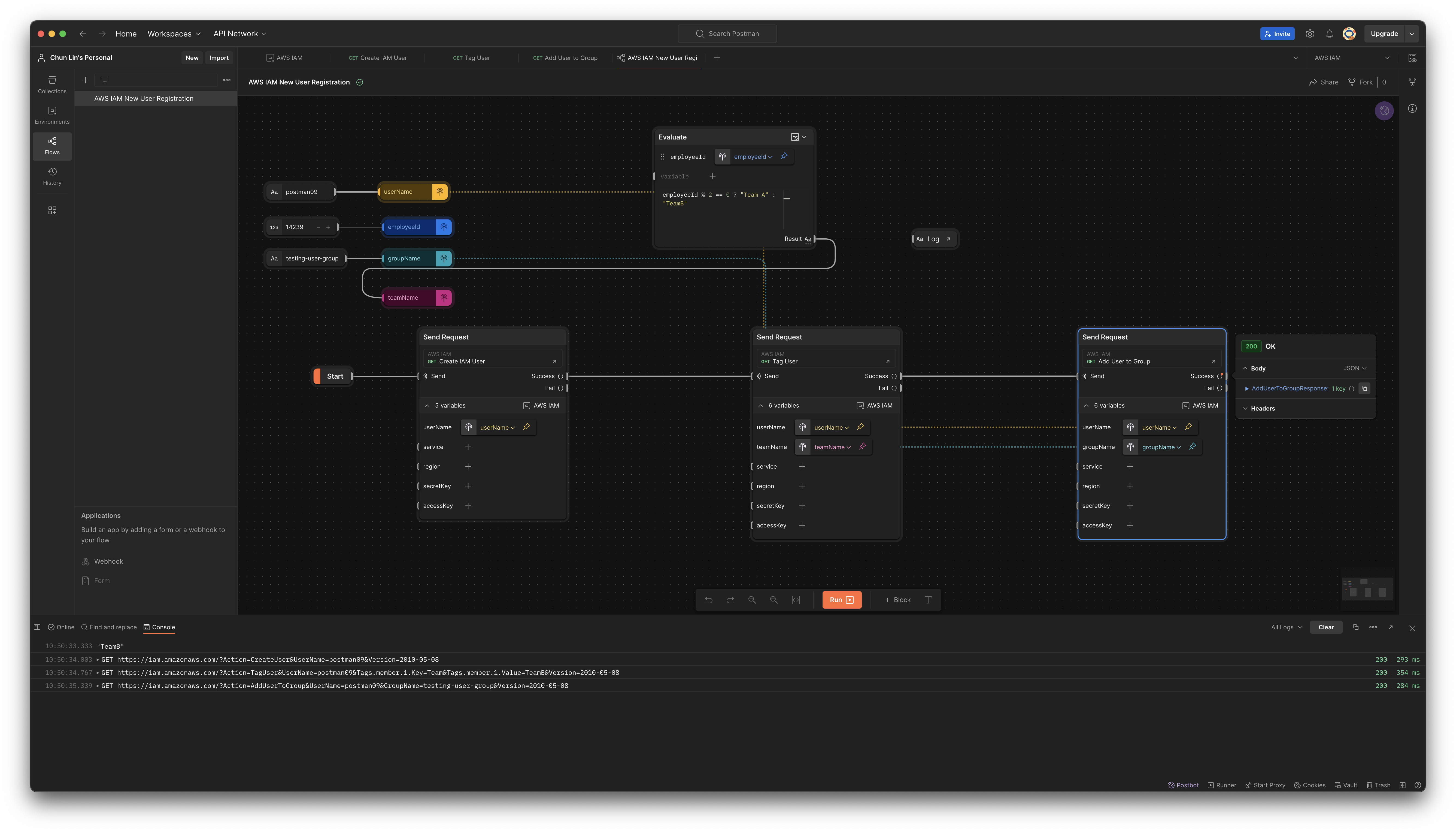
With the success of user creation, the next step is to call the user tagging API. In this API, we will have two variables, i.e. userName and teamName. Let’s assume that the teamName is assigned based on whether the user’s employeeId is an even or odd number, we can design the Flow as shown in the following screenshot.
With two different employeeId, the teamNames are different too.
As shown in the Log, when we assign an even number to the user postman06, the team name assigned to it is “Team A”. However, when we assign an odd number to another user postman07, its team name is “Team B”.
Finally, we can complete the Flow with the third API call as shown below.
The groupName variable is introduced for the third API call.
Now, we can visit AWS Console to verify that the new user postman09 is indeed assigned to the testing-user-group.
The new user is assigned to the desired user group.
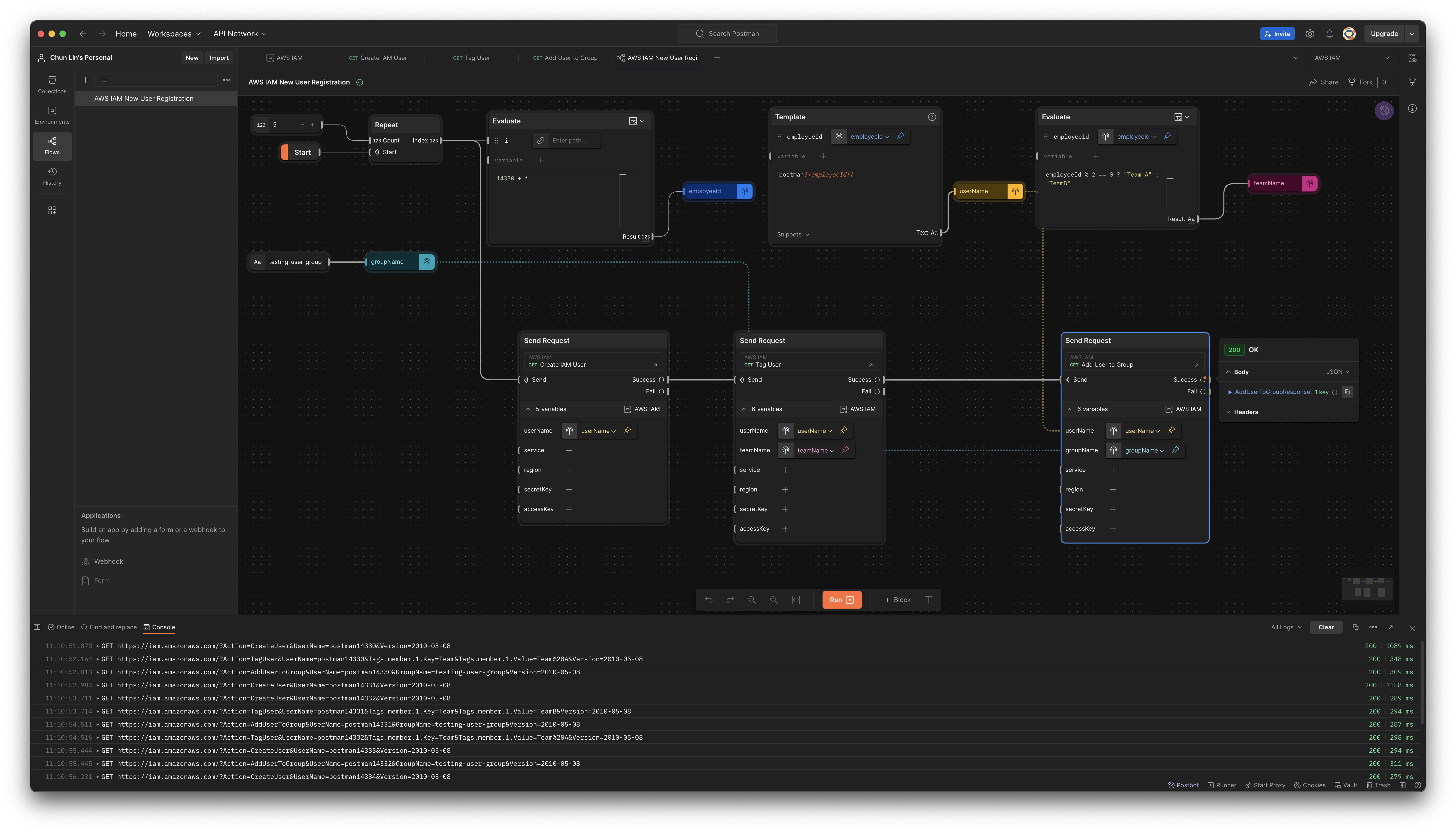
The Flow above only can create one new user in every Flow execution. By using the Repeat block which takes a numeric input N and iterates over it from 0 to N - 1, we can create multiple users in a single run, as shown in the following updated Flow.
This flow will create 5 users in one single execution.
Variable Limitation in Flows
Could we save the response in a variable that allows us to reuse its value in other Flow? We would guess this is possible with variables in Postman.
The variable with the broadest scope in Postman is the global variables which are available throughout a workspace. So what we can do is actually storing the response in the global variables.
To do so, we need to update our request in the Collection. One of the snippets provided is actually about setting a global variable, so we can use it. For example, we add it to the post-response script of “Create IAM User” request, as shown in the screenshot below.
Postman provides snippets to help us quickly generate boilerplate code for common tasks, including setting global variables.
Let’s change the boilerplate code to be as follows.
pm.globals.set("my_global", pm.response.code);
Now, if we send a “Create IAM User” request, we will notice that a new global variable called my_global has been created, as demonstrated below.
The response code received is 400 and thus my_global is 400.
However, now if we run our Flow, we will realise that my_global is not being updated even though the response code received is 200, as illustrated in the following screenshot.
According to Saswat, global variables and environment variables are now treated as read-only values in the Flows, and any updates made to them through script are not respected.
So the answer to the question whether we can share variable across different Flows earlier is simply a big no by design currently.
Do It with CLI: Newman
Is there any alternative way that we can use instead of relying on the GUI of Postman?
A command-line Collection Runner is basically a tool that allows users to execute API requests defined in Postman collections directly from the command line. So, could we use Newman to do what we have done above with Postman Flows as well?
Before we can use Newman, we first need to export our Collection as well as the corresponding Environment. To do so, firstly, we click on the three dots (…) next to the collection name and select Export. Then, we choose the format (usually Collection v2.1 is recommended) and click Export. Secondly, we proceed to click on the three dots (…) next to the environment name and select Export as well.
Once we have the two exported files in the same folder, for example a folder canned “experiment.postman.newman”, we can run the following command.
While Newman and Postman Flows can both be used to automate API requests, they are tailored for different use cases: Newman is better suited for automated testing, integration into CI/CD pipelines, and command-line execution. Postman Flows, on the other hand, is ideal for visually designing the workflows and interactions between API calls.
We use Amazon S3 to store data for easy sharing among various applications. However, each application has its unique requirements and might require a different perspective on the data. To solve this problem, at times, we store additional customised datasets of the same data, ensuring that each application has its own unique dataset. This sometimes creates another set of problems because we now need to maintain additional datasets.
In March 2021, a new feature known as S3 Object Lambda was introduced. Similar to the idea of setting up a proxy layer in front of S3 to intercept and process data as it is requested, Object Lambda uses AWS Lambda functions to automatically process and transform your data as it is being retrieved from S3. With Object Lambda, we only need to change our apps to use the new S3 Object Lambda Access Point instead of the actual bucket name to retrieve data from S3.
Simplified architecture diagram showing how S3 Object Lambda works.
Example: Turning JSON to Web Page with S3 Object Lambda
I have been keeping details of my visits to medical centres as well as the treatments and medicines I received in a JSON file. So, I would like to take this opportunity to show how S3 Object Lambda can help in doing data processing.
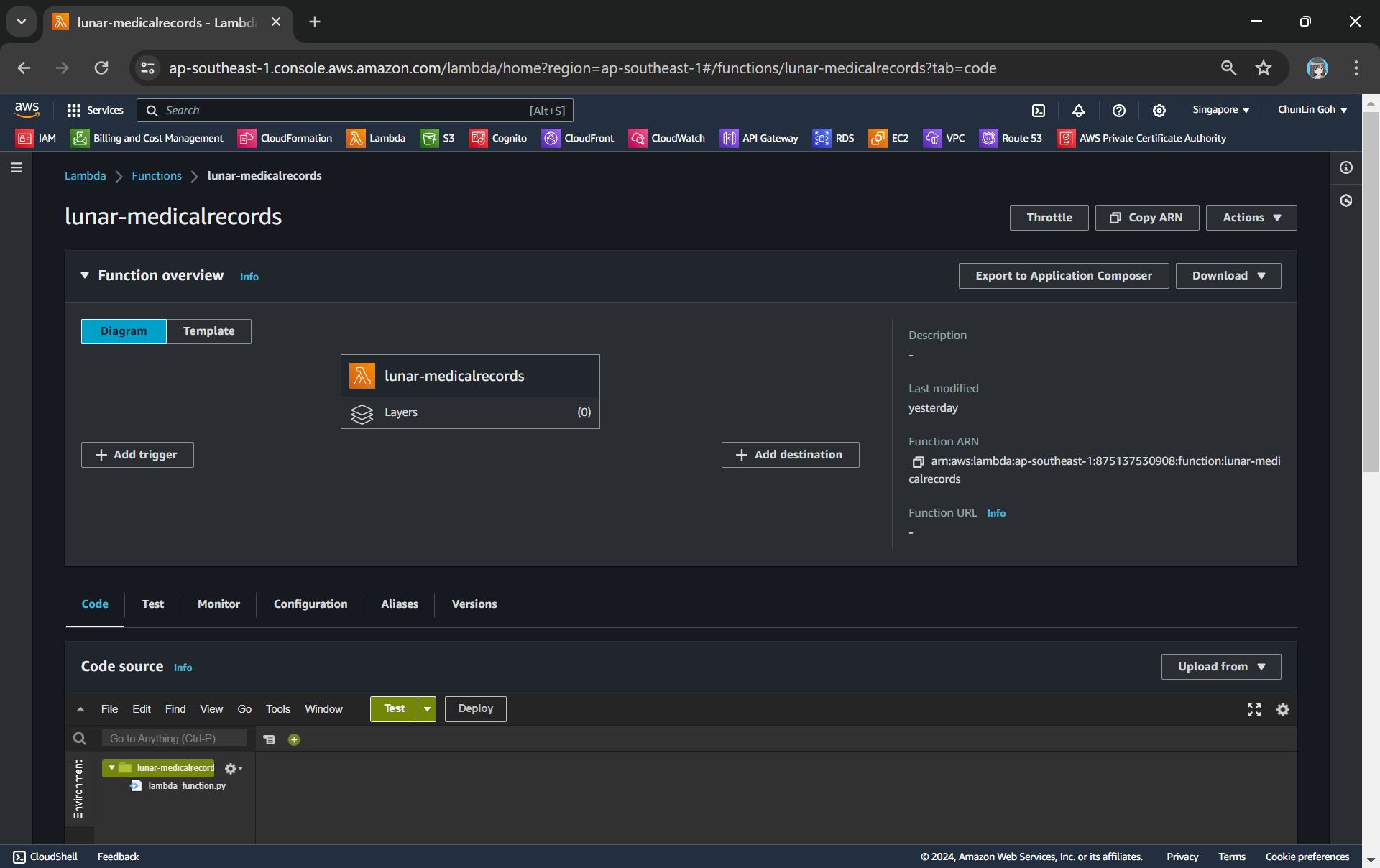
We need a Lambda Function to do the data format transformation from JSON to HTML. To keep things simple, we will be developing the Function using Python 3.12.
Object Lambda does not need any API Gateway since it should be accessed via the S3 Object Lambda Access Point.
In the beginning, we can have the code as follows. The code basically does two things. Firstly, it performs some logging. Secondly, it reads the JSON file from S3 Bucket.
import json import os import logging import boto3 from urllib import request from urllib.error import HTTPError from types import SimpleNamespace
def lambda_handler(event, context): object_context = event["getObjectContext"] # Get the presigned URL to fetch the requested original object from S3 s3_url = object_context["inputS3Url"] # Extract the route and request token from the input context request_route = object_context["outputRoute"] request_token = object_context["outputToken"]
# Get the original S3 object using the presigned URL req = request.Request(s3_url) try: response = request.urlopen(req) responded_json = response.read().decode() except Exception as err: logger.error(f'Exception reading S3 content: {err}') return {'status_code': 500}
Step 1.1: Getting the JSON File with Presigned URL
In the event that an Object Lambda receives, there is a property known as the getObjectContext, which contains useful information for us to figure out the inputS3Url, which is the presigned URL of the object in S3.
By default, all S3 objects are private and thus for a Lambda Function to access the S3 objects, we need to configure the Function to have S3 read permissions to retrieve the objects. However, with the presigned URL, the Function can get the object without the S3 read permissions.
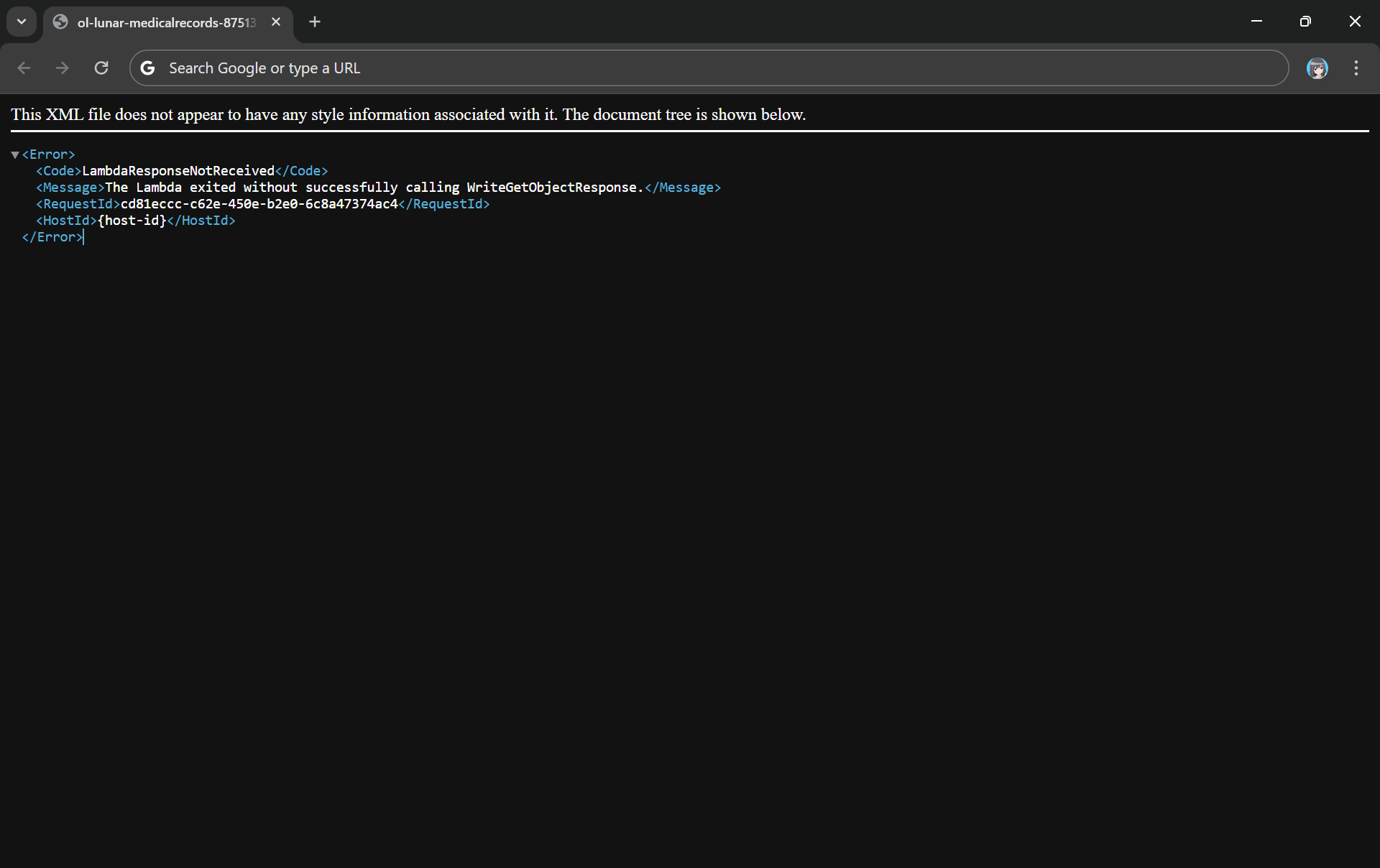
Since the purpose of Object Lambda is to process and transform our data as it is being retrieved from S3, we need to pass transformed object to a GetObject operation in the Function via the method write_get_object_response. Without this method, there will be an error from the Lambda complaining that it is missing.
Error: The Lambda exited without successfully calling WriteGetObjectResponse.
html = template_content.replace('{{DYNAMIC_TABLE}}', dynamic_table)
Step 2: Give Lambda Function Necessary Permissions
With the setup we have gone through above, we understand that our Lambda Function needs to have the following permissions.
s3-object-lambda:WriteGetObjectResponse
s3:GetObject
Step 3: Create S3 Access Point
Next, we will need to create a S3 Access Point. It will be used to support the creation of the S3 Object Lambda Access Point later.
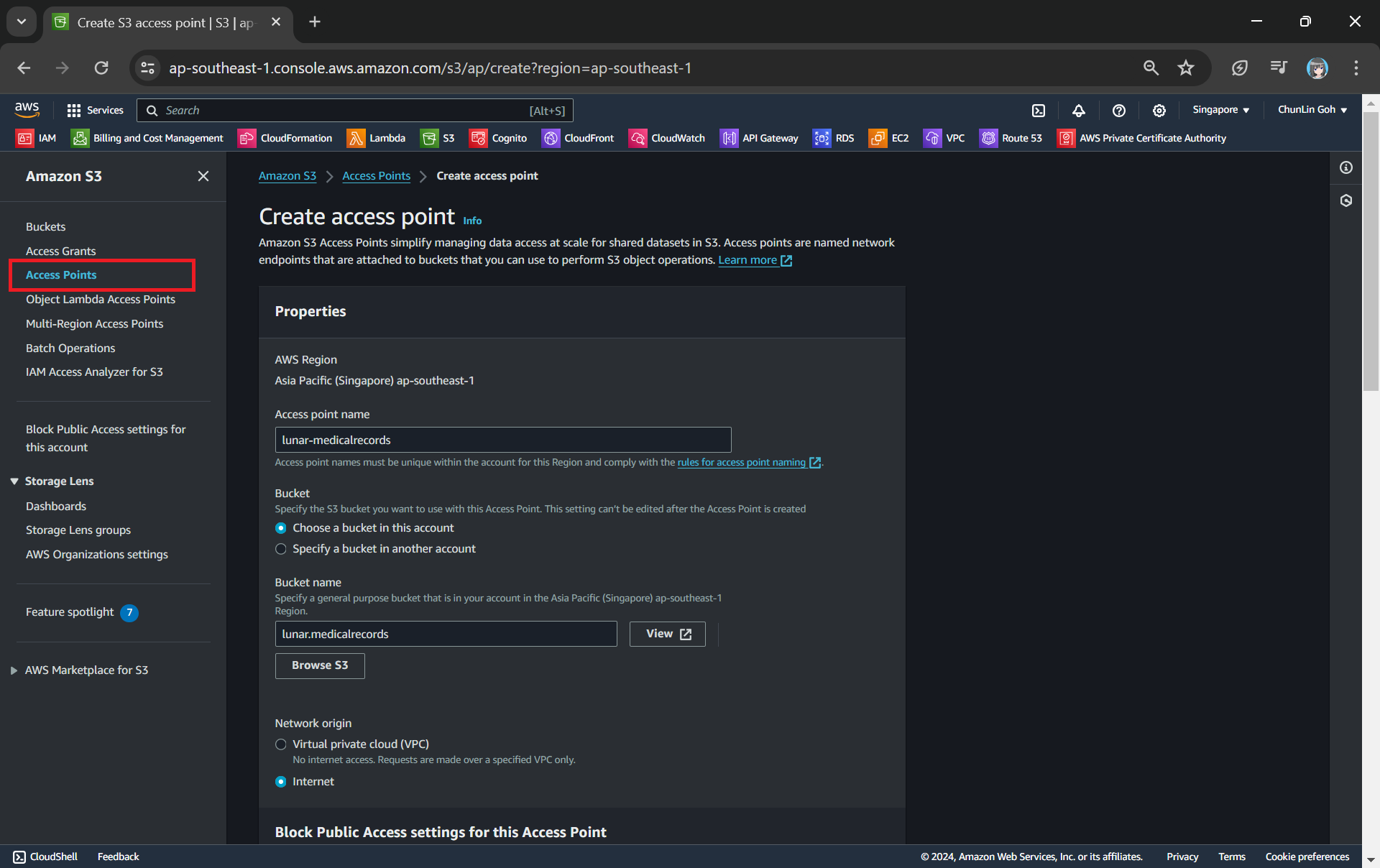
One of the features that S3 Access Point offers is that we can specify any name that is unique within the account and region. For example, as shown in the screenshot below, we can actually have a “lunar-medicalrecords” access point in every account and region.
Creating an access point from the navigation pane of S3.
When we are creating the access point, we need to specify the bucket which resides in the same region that we want to use with this Access Point. In addition, since we are not restricting the access of it to only a specific VPC in our case, we will be choosing “Internet” for the “Network origin” field.
After that, we keep all other defaults as is. We can directly proceed to choose the “Create access point” button.
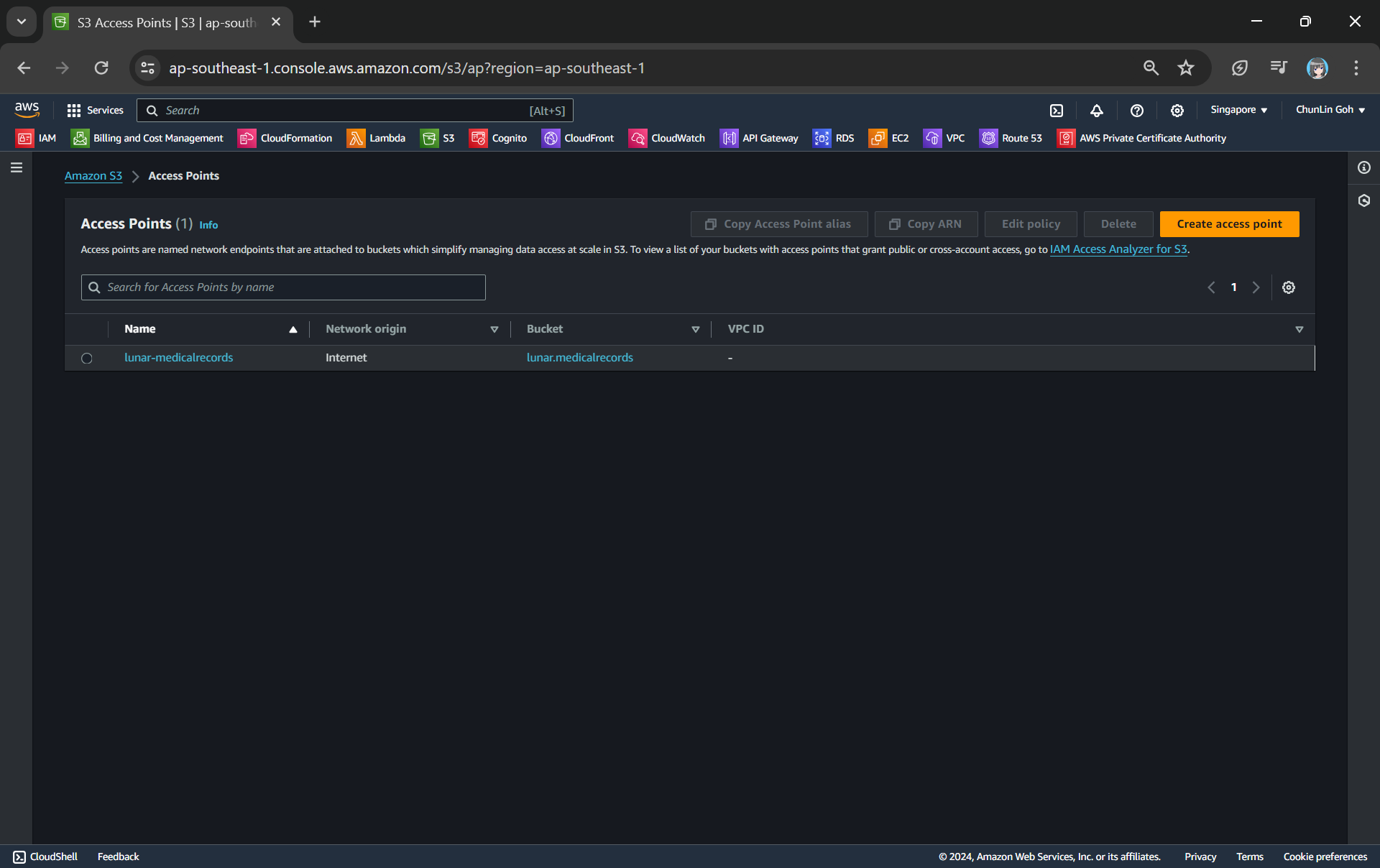
Our S3 Access Point is successfully created.
Step 4: Create S3 Object Lambda Access Point
After getting our S3 Access Point set up, we can then move on to create our S3 Object Lambda Access Point. This is the actual access point that our app will be using to access the JSON file in our S3 bucket. It then should return a HTML document generated by the Object Lambda that we built in Step 1.
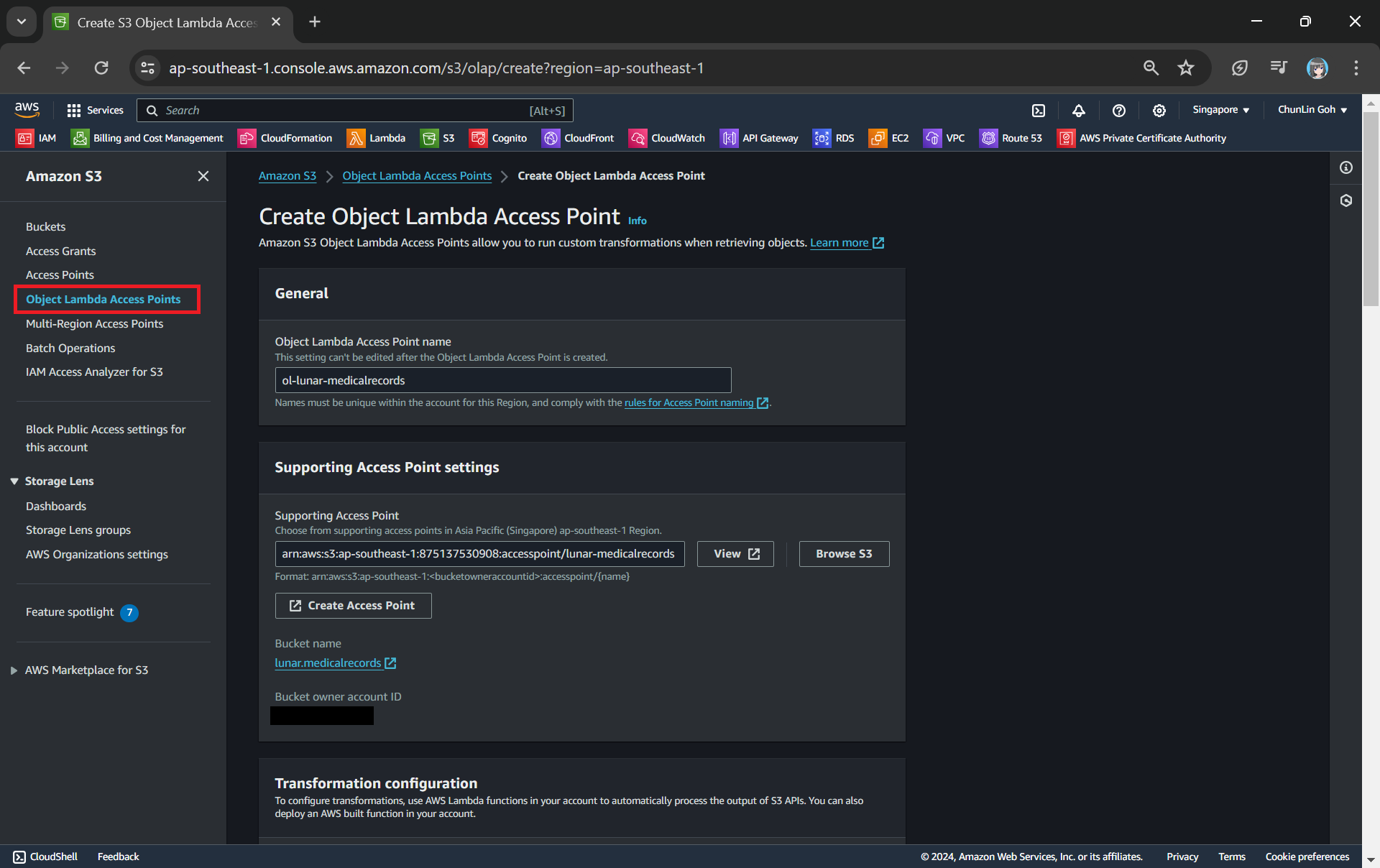
Creating an object lambda access point from the navigation pane of S3.
In the Object Lambda Access Point creation page, after we give it a name, we need to provide the Supporting Access Point. This access point is the Amazon Resource Name (ARN) of the S3 Access Point that we created in Step 3. Please take note that both the Object Lambda Access Point and Supporting Access Point must be in the same region.
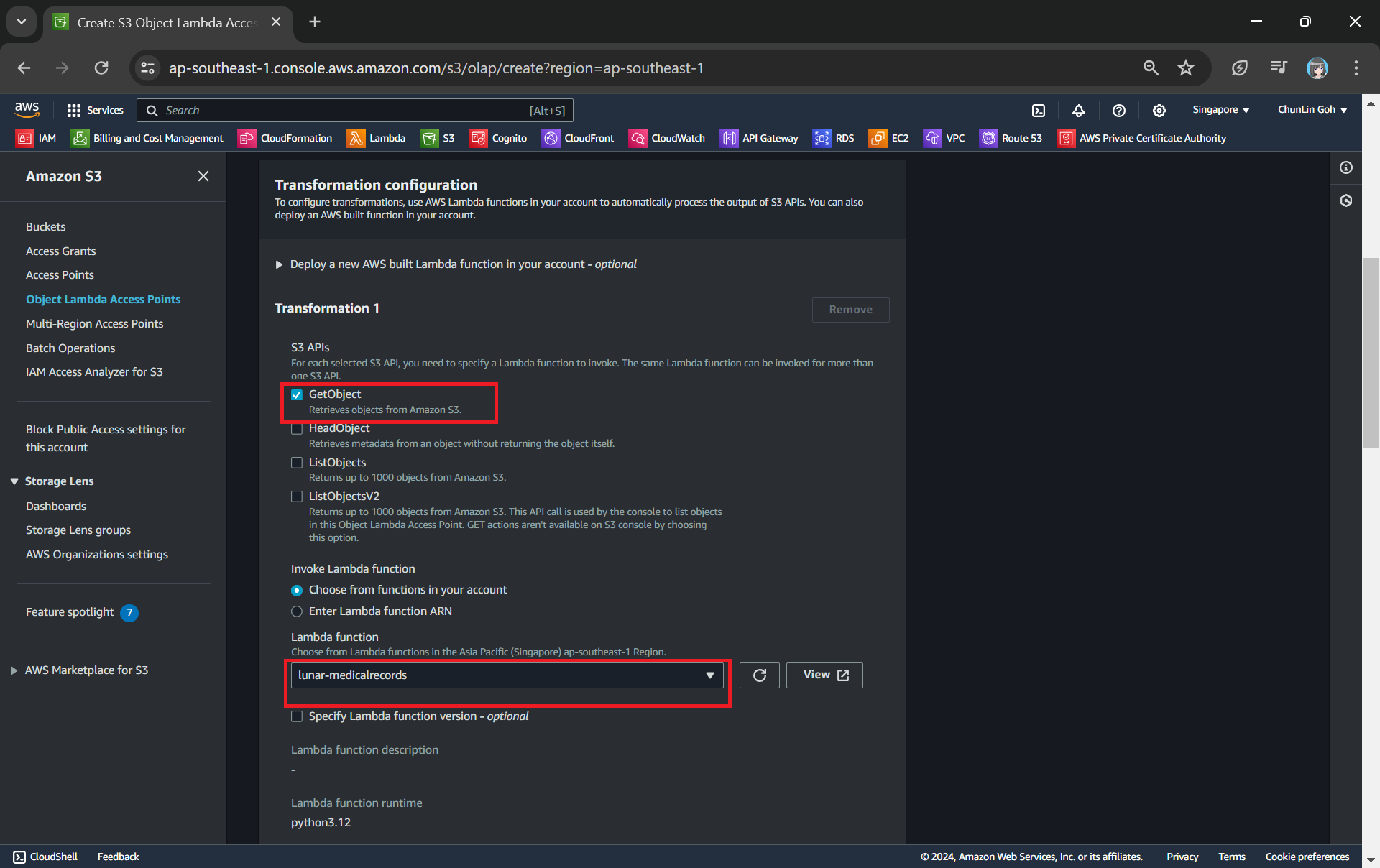
Next we need to setup the transformation configuration. In our case, we will be retrieving the JSON file from the S3 bucket to perform the data transformation via our Lambda Function, so we will be choosing GetObject as the S3 API we will be using, as shown in the screenshot below.
Configuring the S3 API that will be used in the data transformation and the Lambda Function to invoke.
Once all these fields are keyed in, we can proceed to create the Object Lambda Access Point.
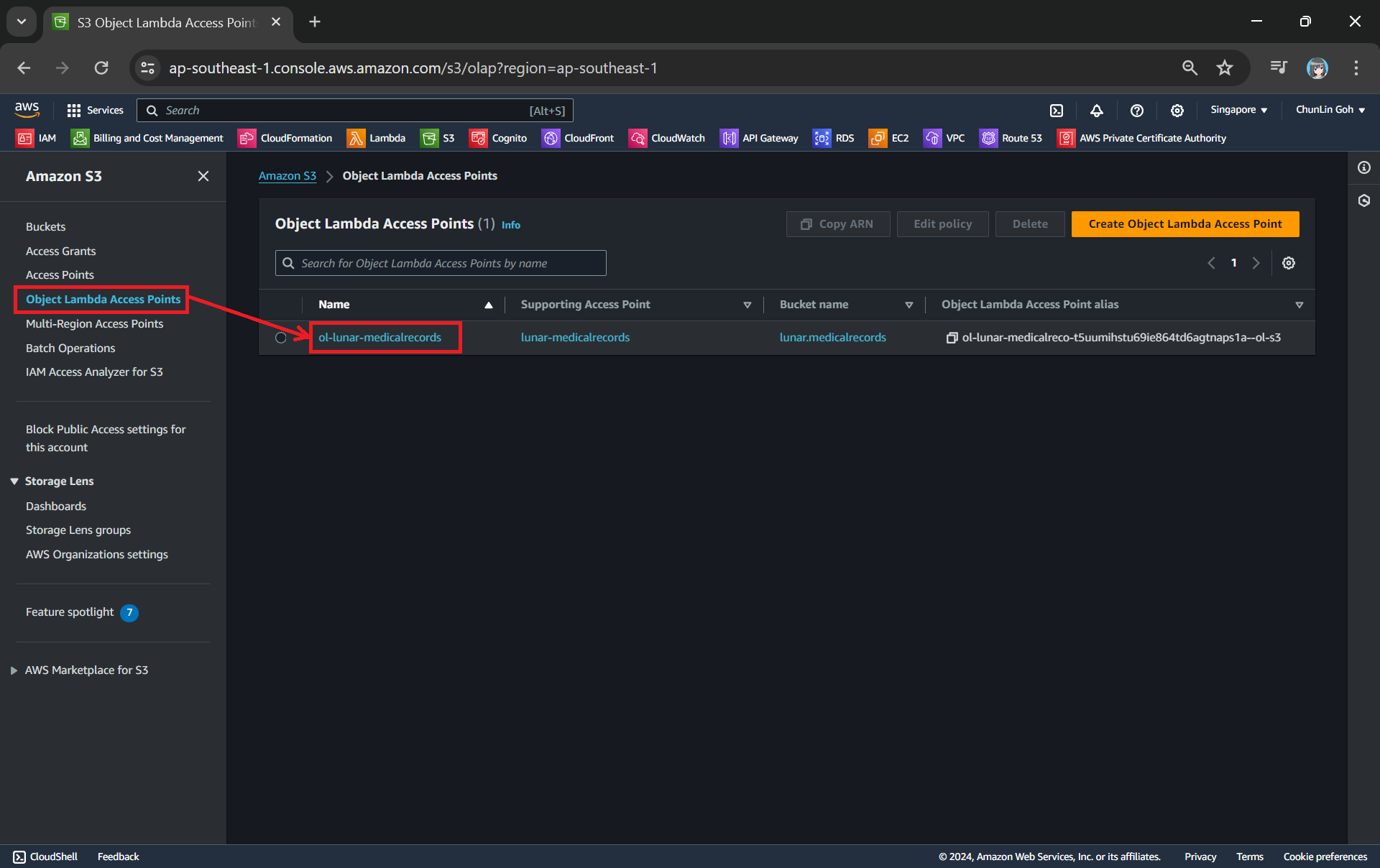
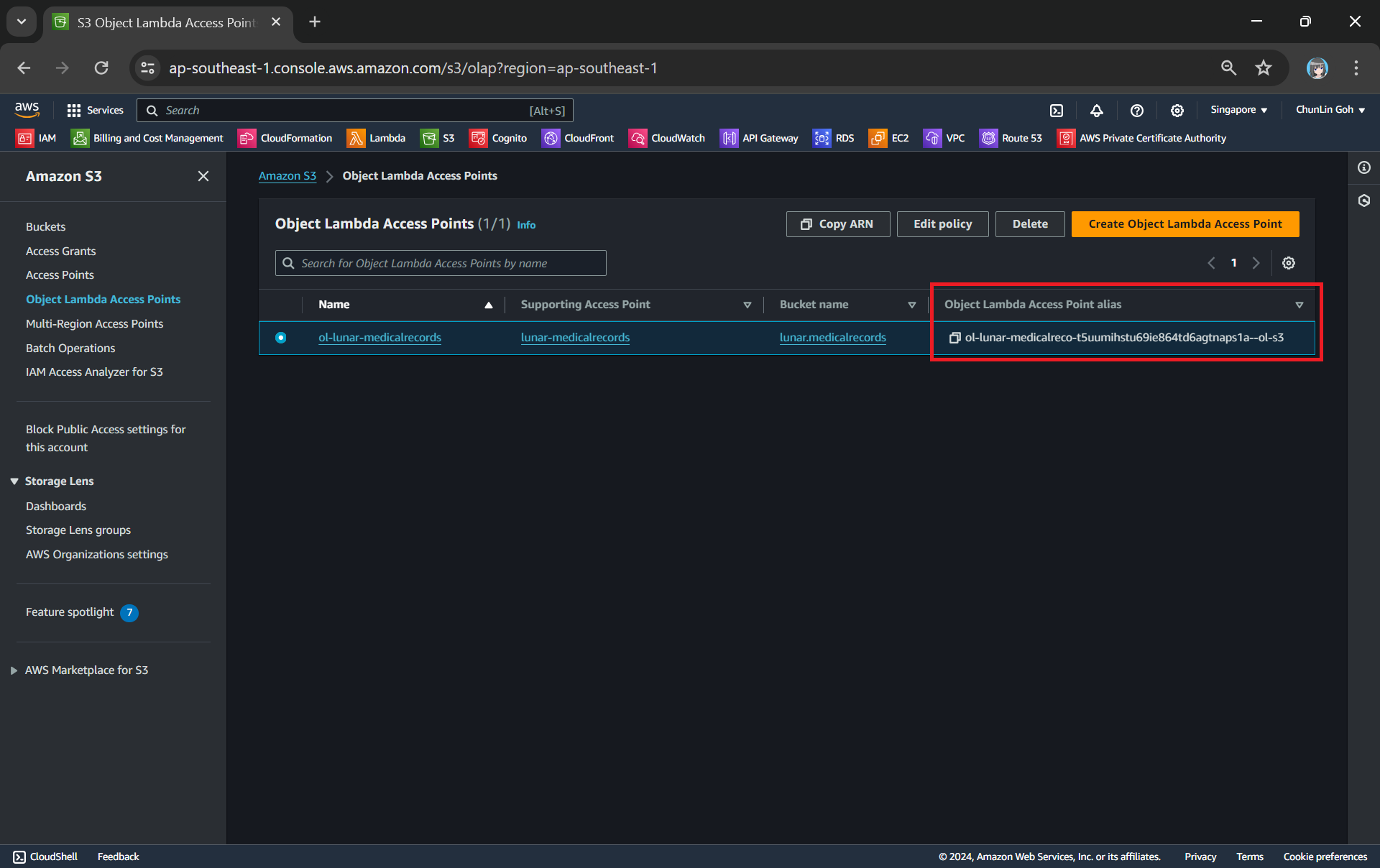
Now, we will access the JSON file via the Object Lambda Access Point to verify that the file is really transformed into a web page during the request. To do so, firstly, we need to select the newly create Object Lambda Access Point as shown in the following screenshot.
Locate the Object Lambda Access Point we just created in the S3 console.
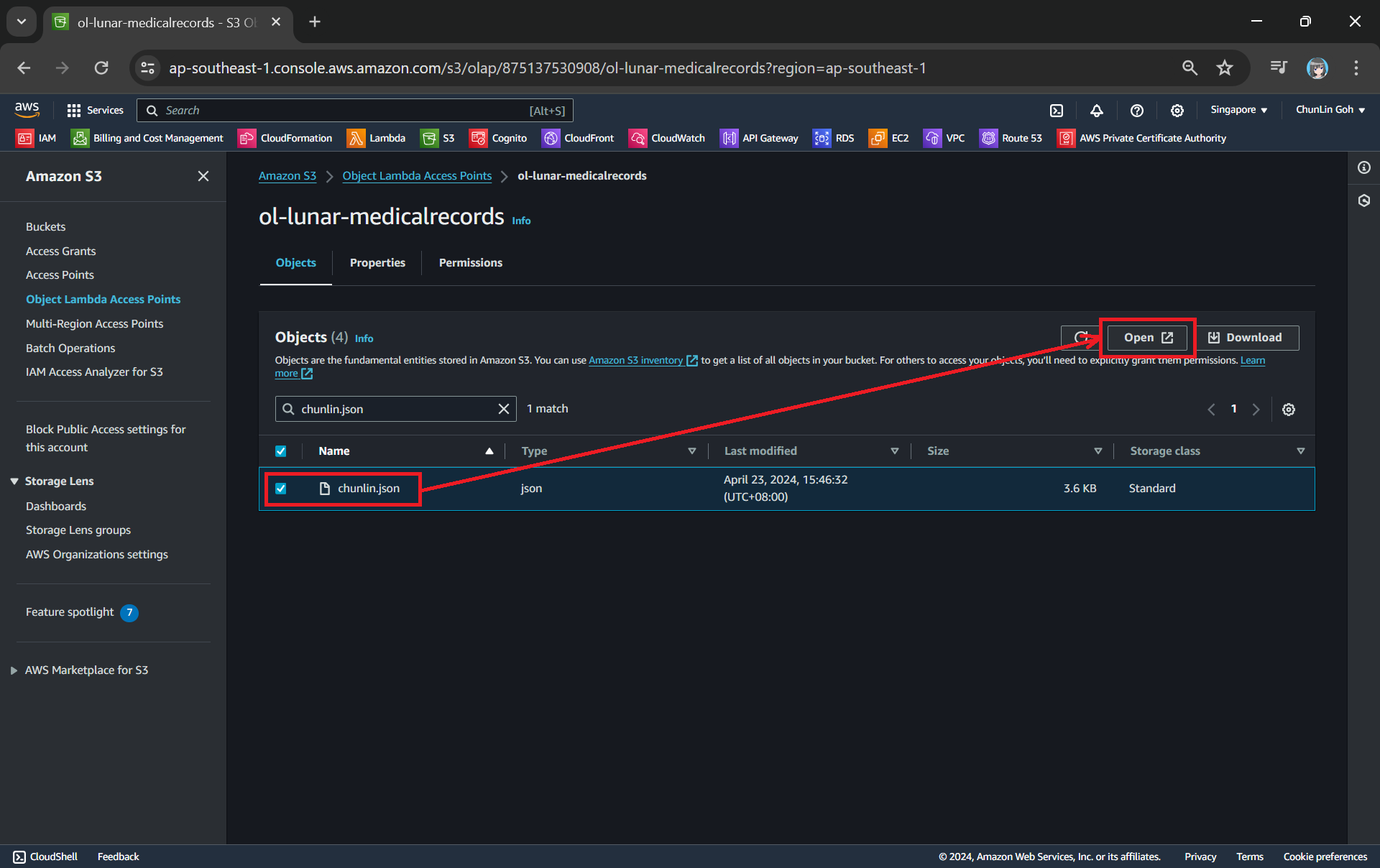
Secondly, we will be searching for our JSON file, for example chunlin.json in my case. Then, we will click on the “Open” button to view it. The reason why I name the JSON file containing my medical records is because later I will be adding authentication and authorisation to only allow users retrieving their own JSON file based on their login user name.
This page looks very similar to the usual S3 objects listing page. So please make sure you are doing this under the “Object Lambda Access Point”.
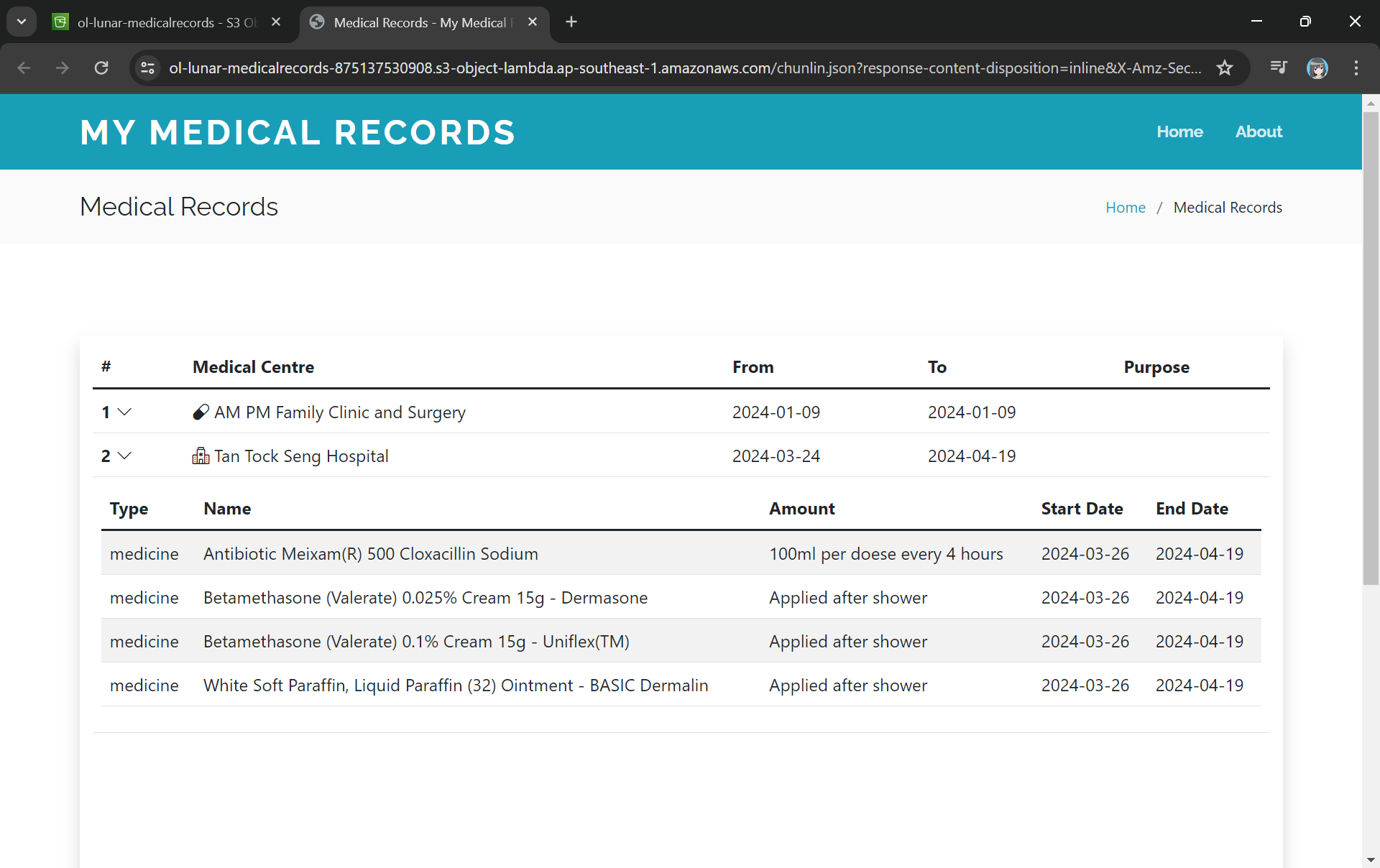
There will be new tab opened showing the web page as demonstrated in the screenshot below. As you have noticed in the URL, it is still pointing to the JSON file but the returned content is a HTML web page.
The domain name is actually no longer the usual S3 domain name but it is our Object Lambda Access Point.
Using the Object Lambda Access Point from Our App
With the Object Lambda Access Point successfully setup, we will show how we can use it. To not overcomplicate things, for the purposes of this article, I will host a serverless web app on Lambda which will be serving the medical record website above.
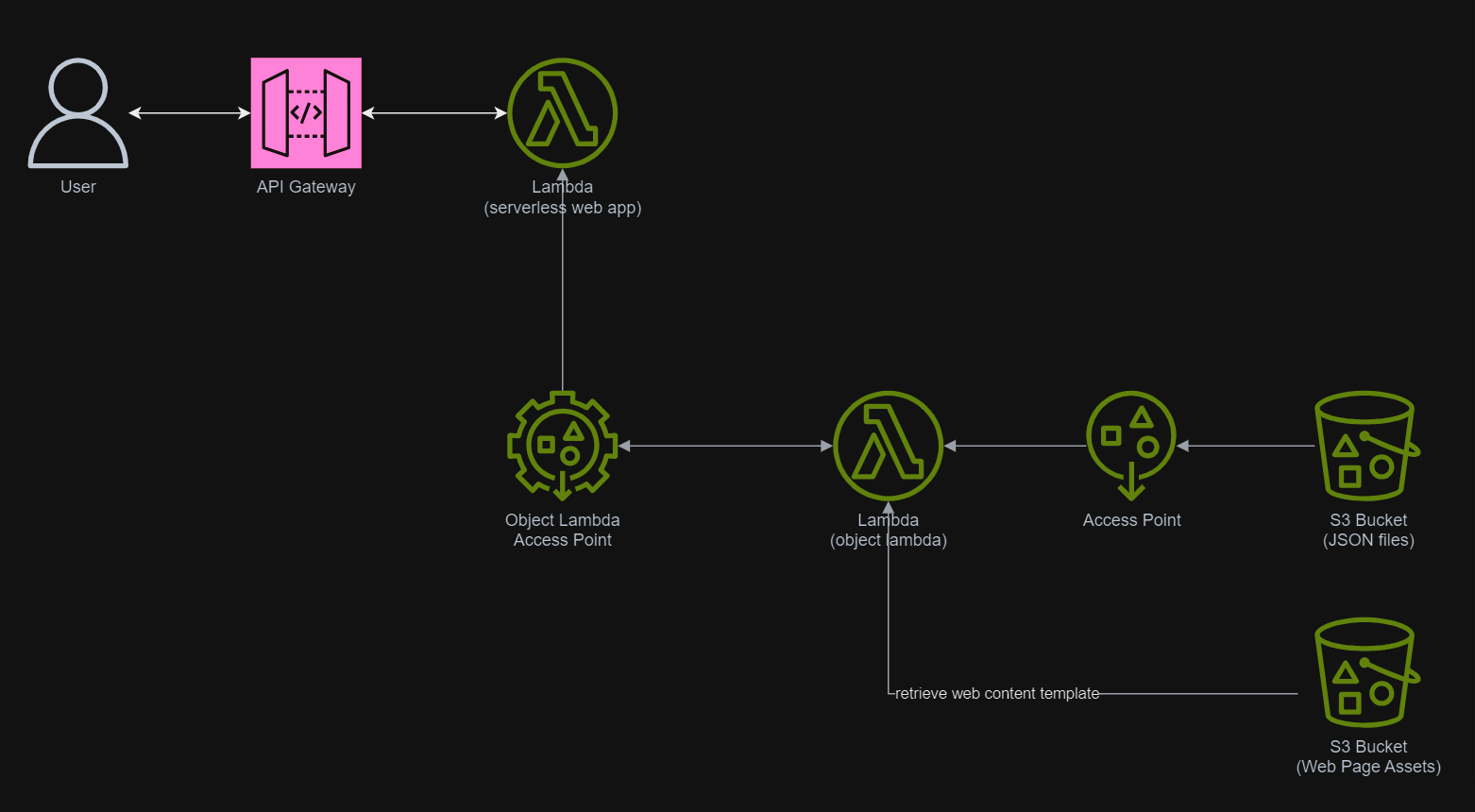
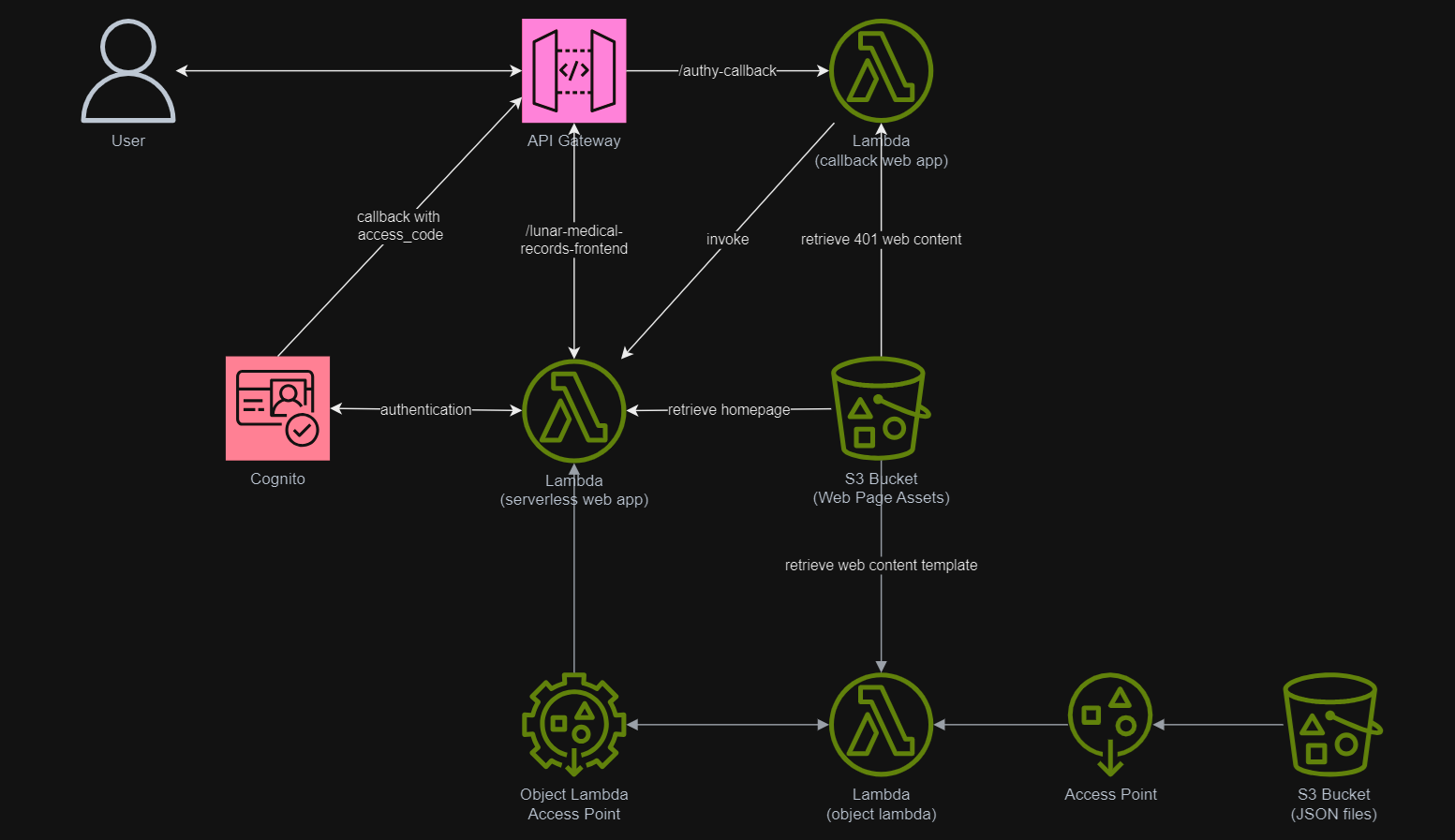
In addition, since Lambda Functions are by default not accessible from the Internet, we will be using API Gateway so that we can have a custom REST endpoint in the AWS and thus we can map this endpoint to the invokation of our Lambda Function. Technically speaking, the architecture diagram now looks as follows.
This architecture allows public to view the medical record website which is hosted as a serverless web app.
In the newly created Lambda, we will still be developing it with Python 3.12. We name this Lambda lunar-medicalrecords-frontend. We will be using the following code which will retrieve the HTML content from the Object Lambda Access Point.
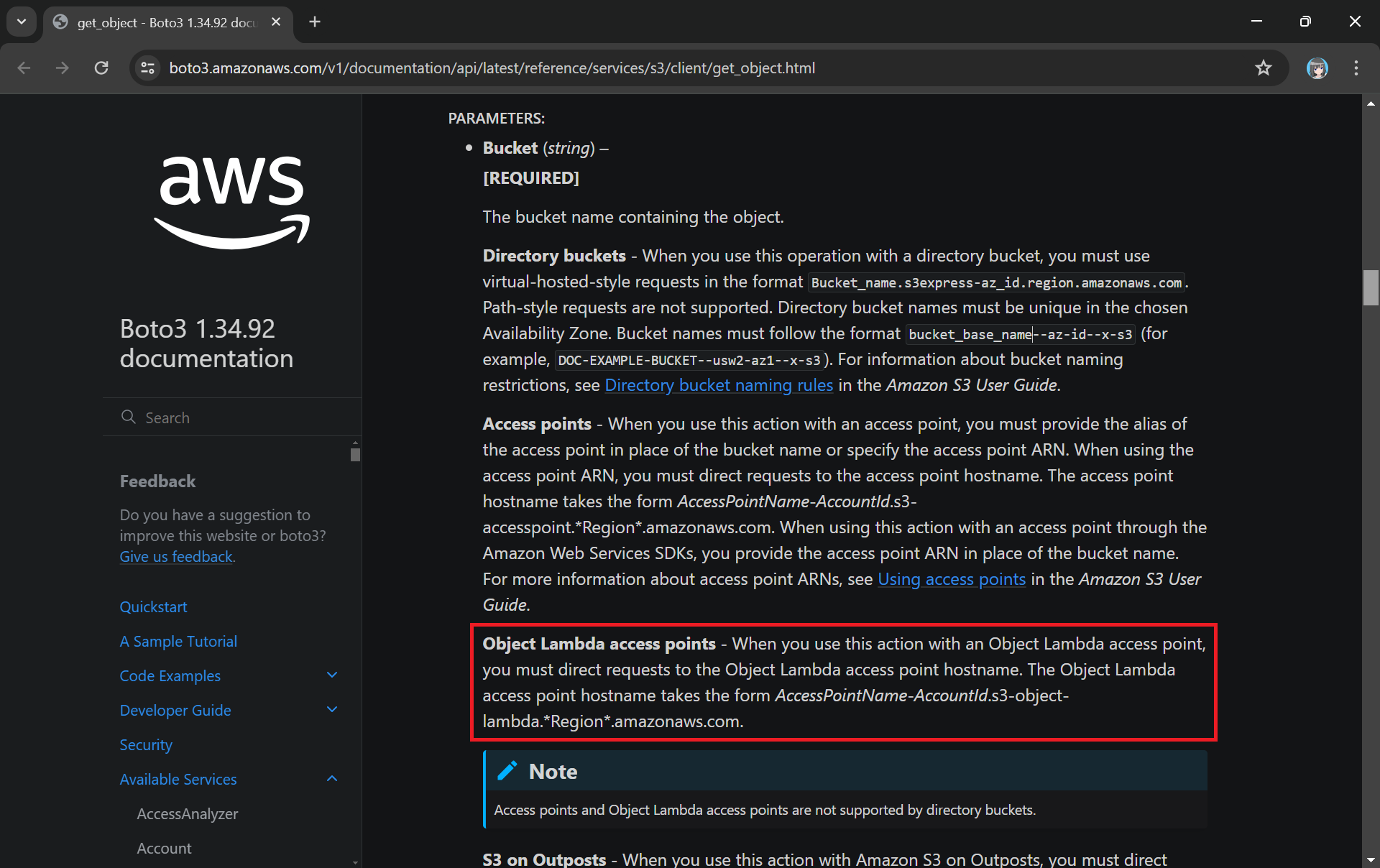
The Boto3 documentation highlights the use of Object Lambda Access Point in get_object.
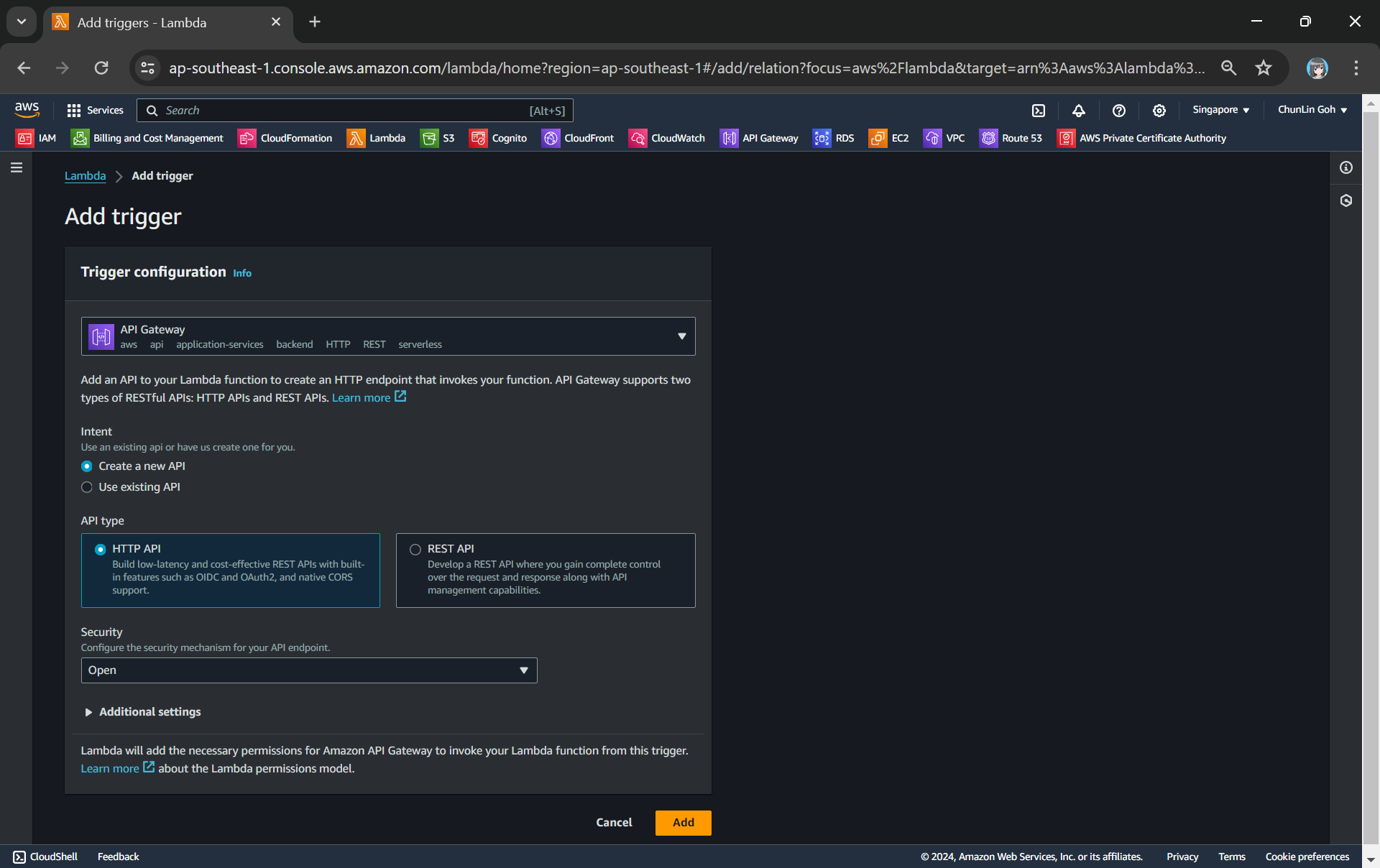
The API Gateway for the Lambda Function is created with HTTP API through the “Add Trigger” function (which is located at the Function overview page). For the Security field, we will be choosing “Open” for now. We will add the login functionality later.
Adding API Gateway as a trigger to our Lambda.
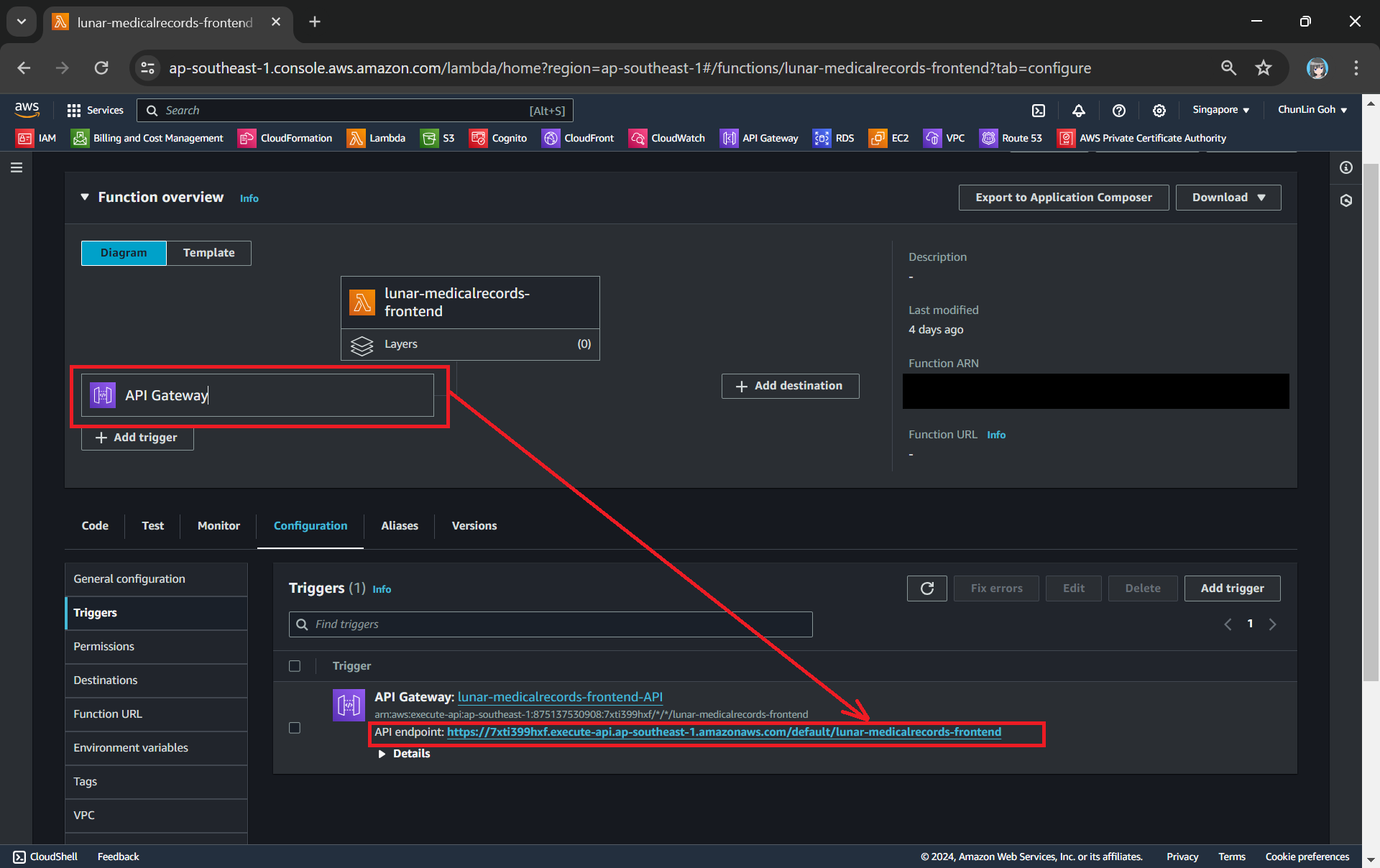
Once this is done, we will be provided an API Gateway endpoint, as shown in the screenshot below. Visiting the endpoint should be rendering the same web page listing the medical records as we have seen above.
Getting the API endpoint of the API Gateway.
Finally, for the Lambda Function permission, we only need to grand it the following.
s3:GetObject.
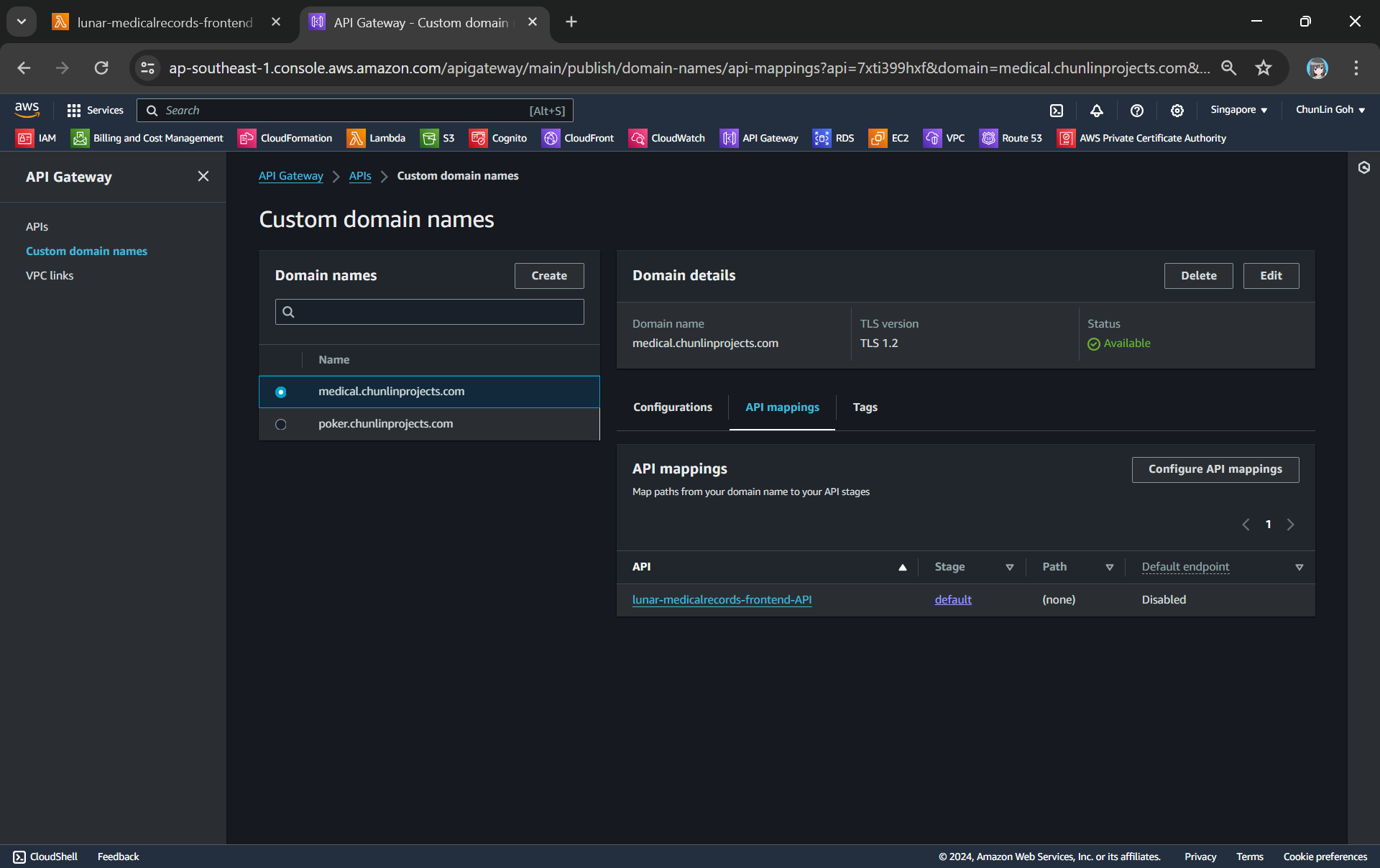
To make the API Gateway endpoint looks more user friendly, we can also introduce Custom Domain to the API Gateway, following the guide in one of our earlier posts.
Assigned medical.chunlinprojects.com to our API Gateway.
Protecting Data with Cognito
In order to ensure that only authenticated and authorised users can access their own medical records, we need to securely control access to our the app with the help from Amazon Cognito. Cognito is a service that enables us to add user sign-in and access control to our apps quickly and easily. Hence it helps authenticate and authorise users before they can access the medical records.
Step 1: Setup Amazon Cognito
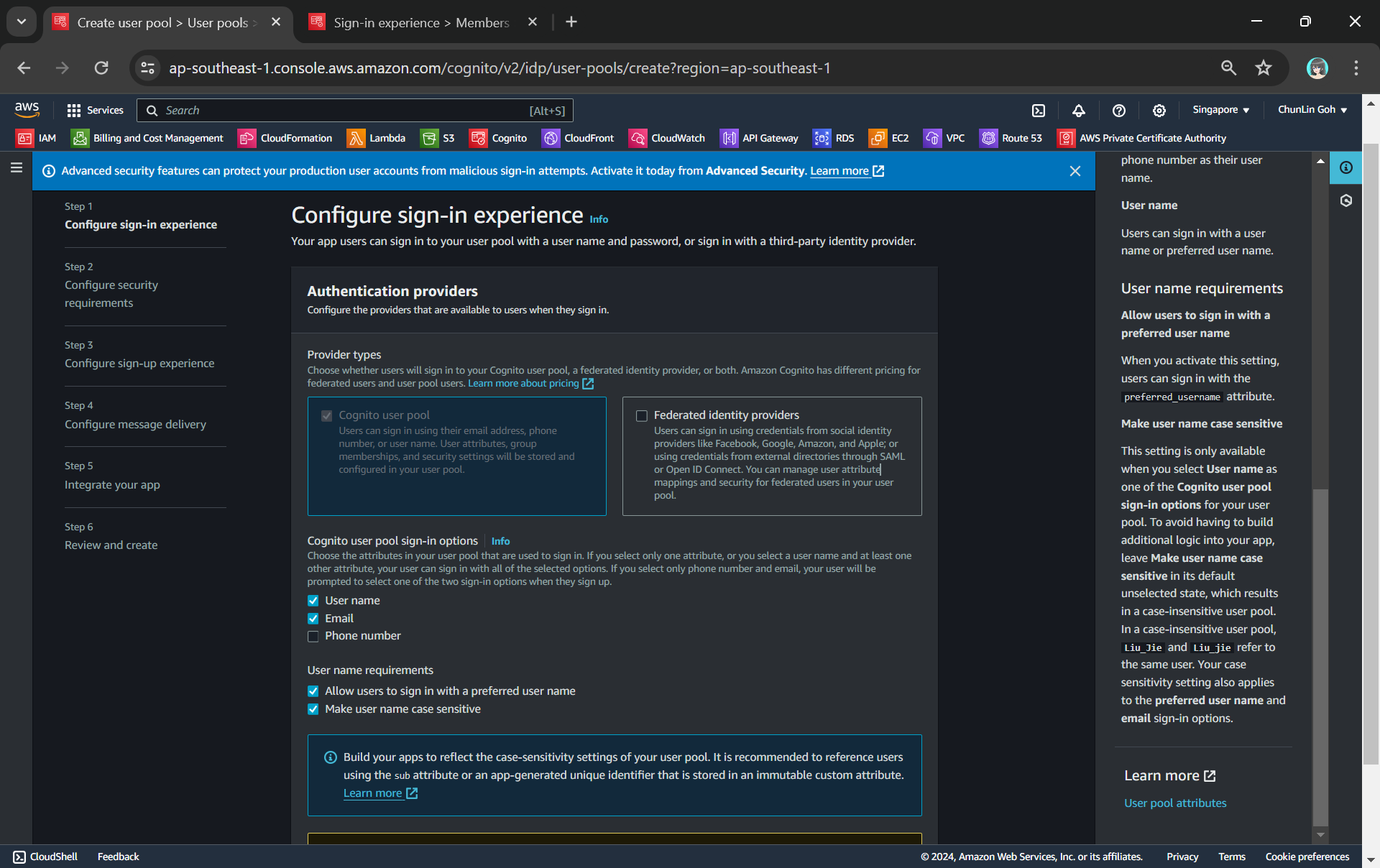
To setup Cognito, firstly, we need to configure the User Pool by specifying sign-in options. User pool is a managed user directory service that provides authentication and user management capabilities for our apps. It enables us to offload the complexity of user authentication and management to AWS.
Configuring sign-in options and user name requirements.
Please take note that Cognito user pool sign-in options cannot be changed after the user pool has been created. Hence, kindly think carefully during the configuration.
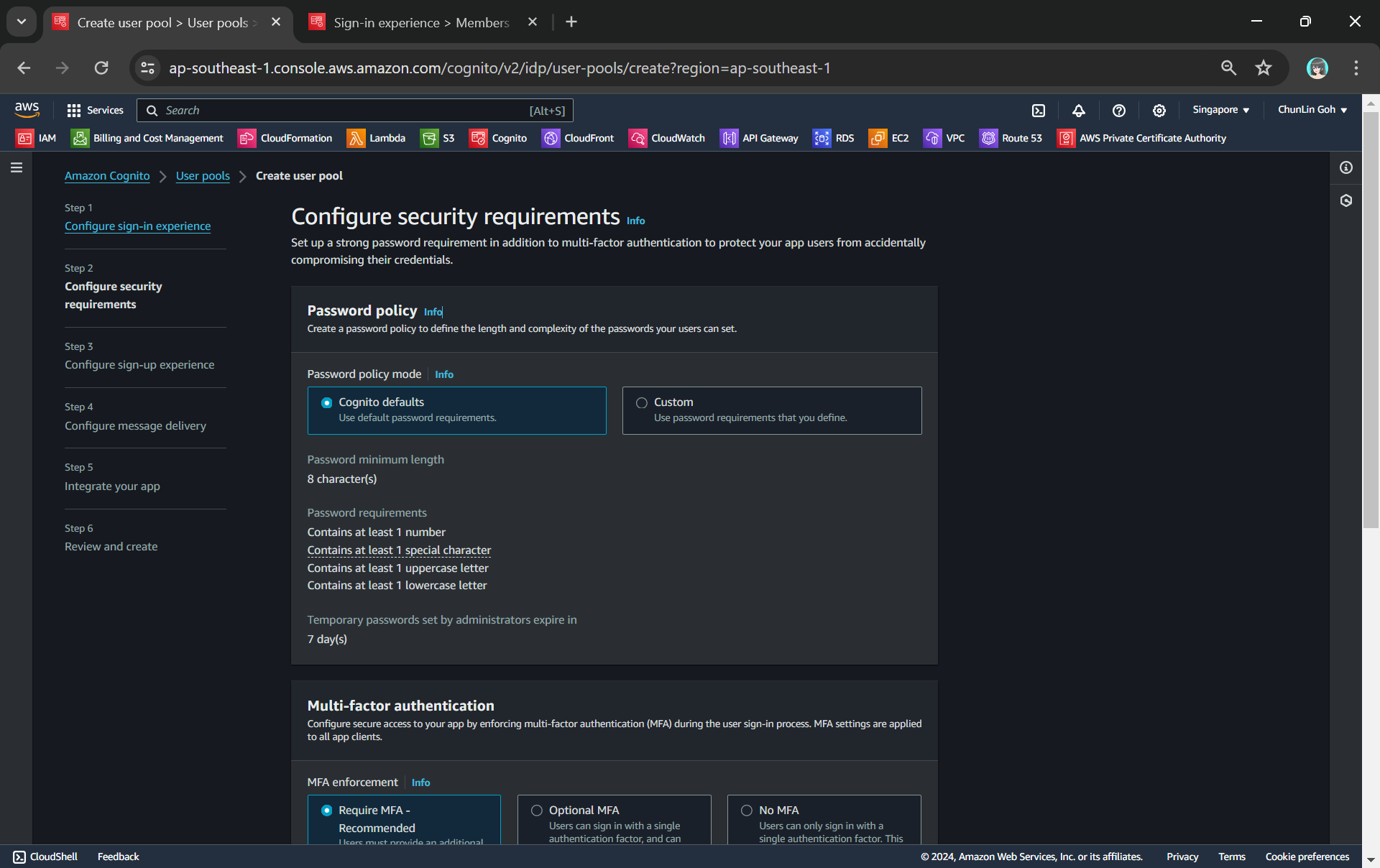
Configuring password policy.
Secondly, we need to configure password policy and choose whether to enable Multi-Factor Authentication (MFA).
By default, Cognito comes with a password policy that ensures our users maintain a password with a minimum length and complexity. For password reset, it will also generate a temporary password to the user which will expire in 7 days, by default.
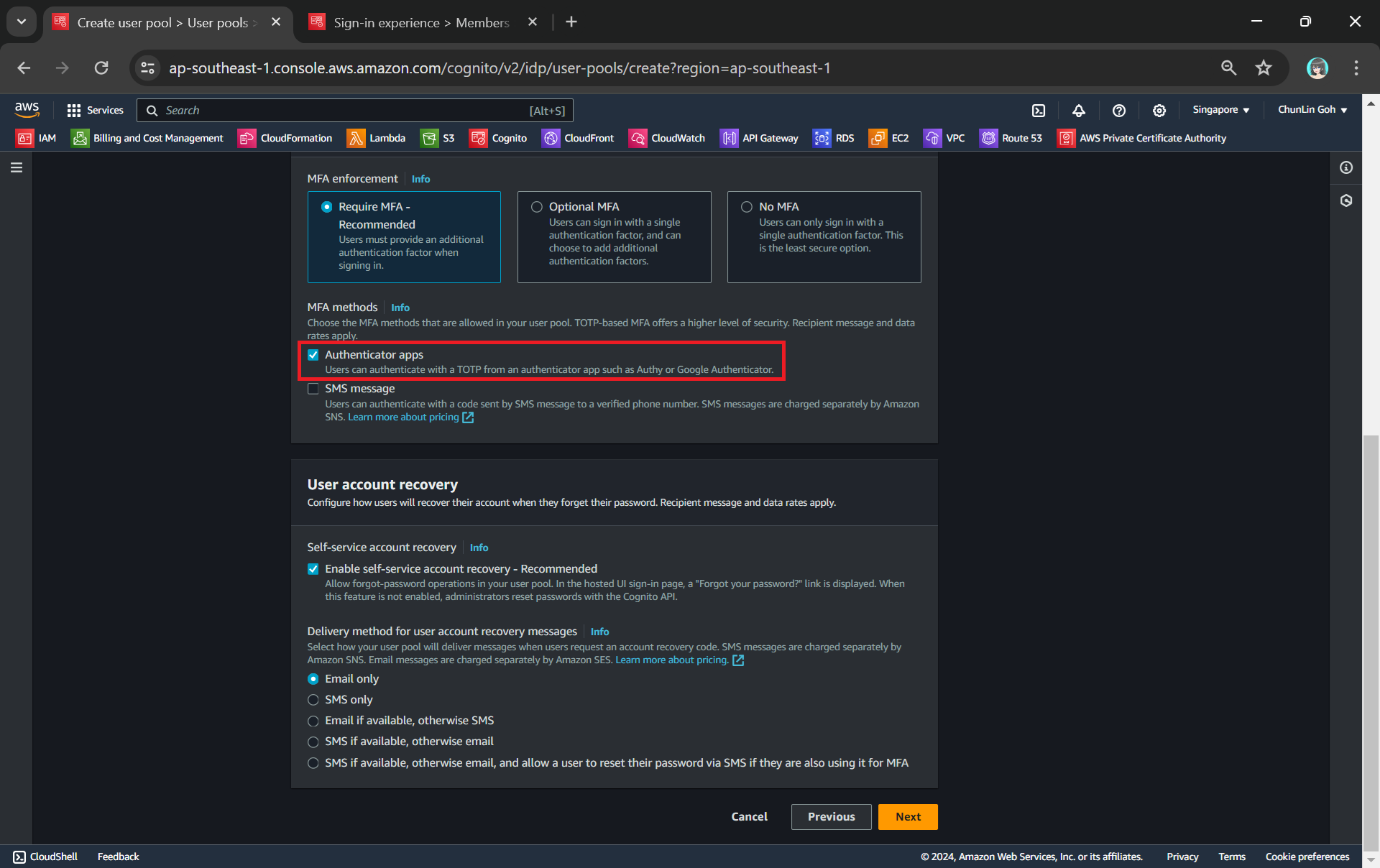
MFA adds an extra layer of security to the authentication process by requiring users to provide additional verification factors to gain access to their accounts. This reduces the risk of unauthorised access due to compromised passwords.
Enabling MFA in our Cognito user pool.
As shown in the screenshot above, one of the methods is called TOTP. TOTP stands for Time-Based One-Time Password. It is a form of multi-factor authentication (MFA) where a temporary passcode is generated by the authenticator app, adding a layer of security beyond the typical username and password.
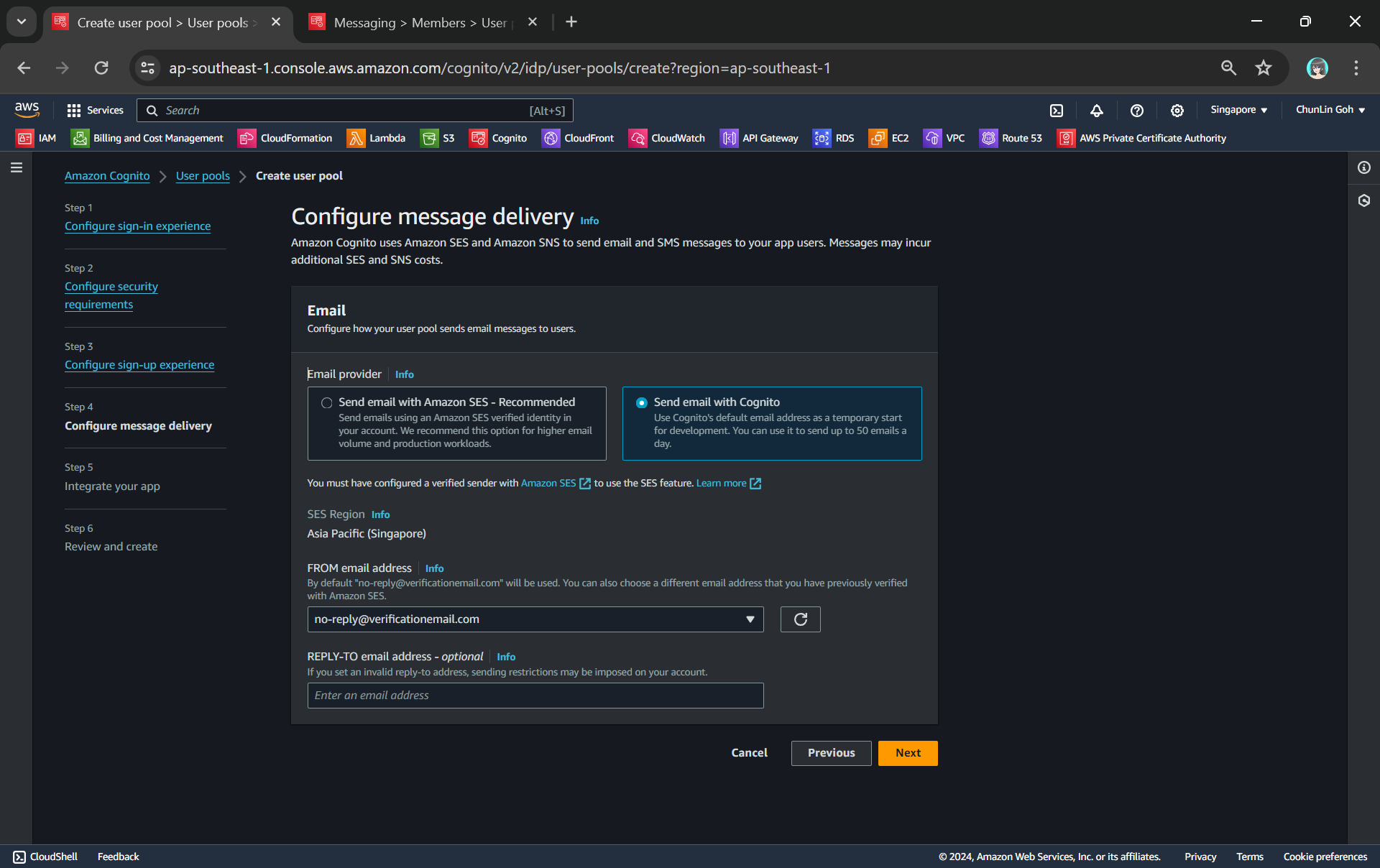
Thirdly, we will be configuring Cognito to allow user account recovery as well as new user registration. Both of these by default require email delivery. For example, when users request an account recovery code, an email with the code should be sent to the user. Also, when there is a new user signing up, there should be emails sent to verify and confirm the new account of the user. So, how do we handle the email delivery?
We can choose to send email with Cognito in our development environment.
Ideally, we should be setting up another service known as Amazon SES (Simple Email Service), an email sending service provided by AWS, to deliver the emails. However, for testing purpose, we can choose to use Cognito default email address as well. This approach is normally only suitable for development purpose because we can only use it to send up to 50 emails a day.
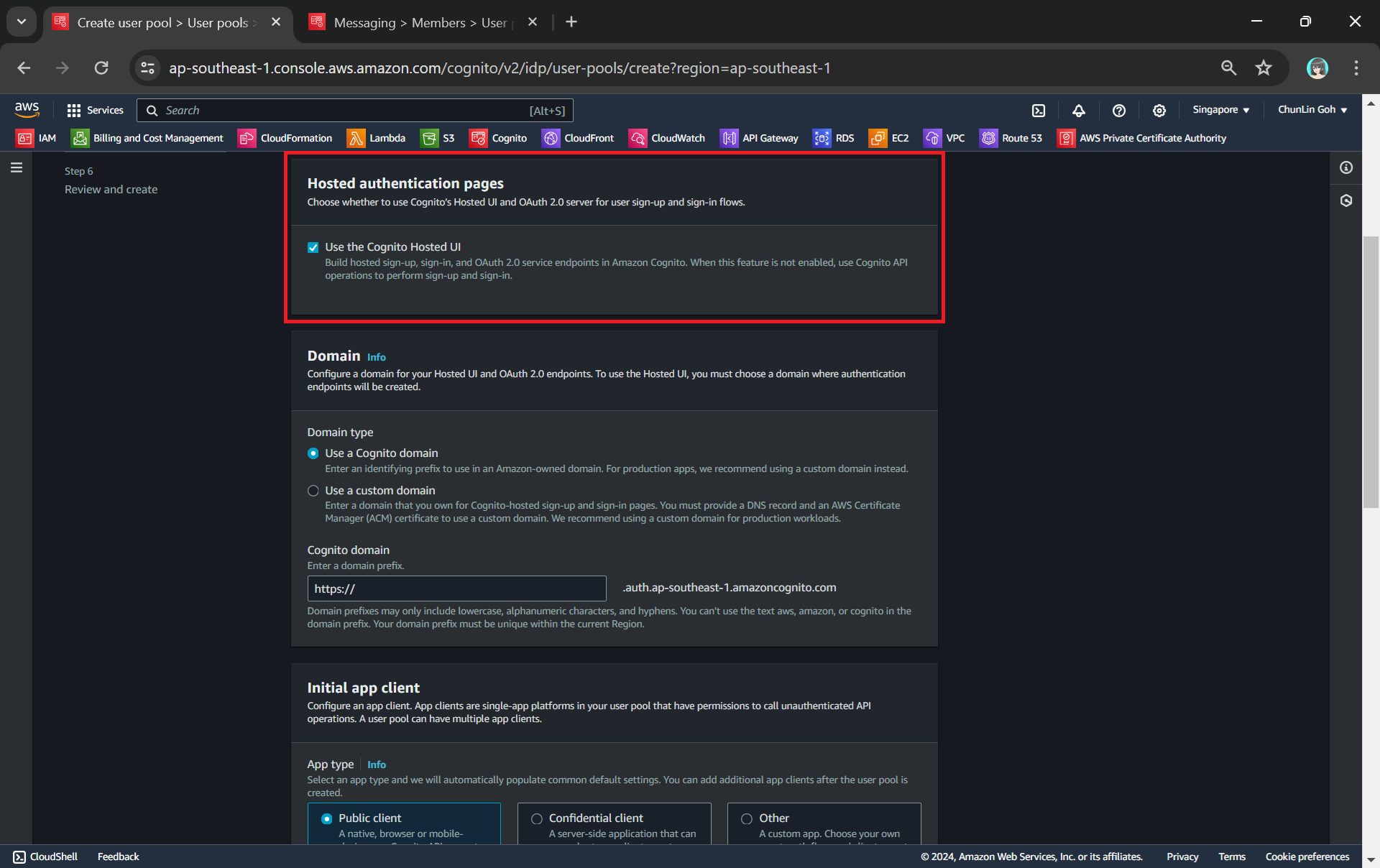
Finally, we will be using the hosted authentication pages for user sign-in and sign-up, as demonstrated below.
Using hosted UI so that we can have a simple frontend ready for sign-in and sign-up.
Step 2: Register Our Web App in Cognito
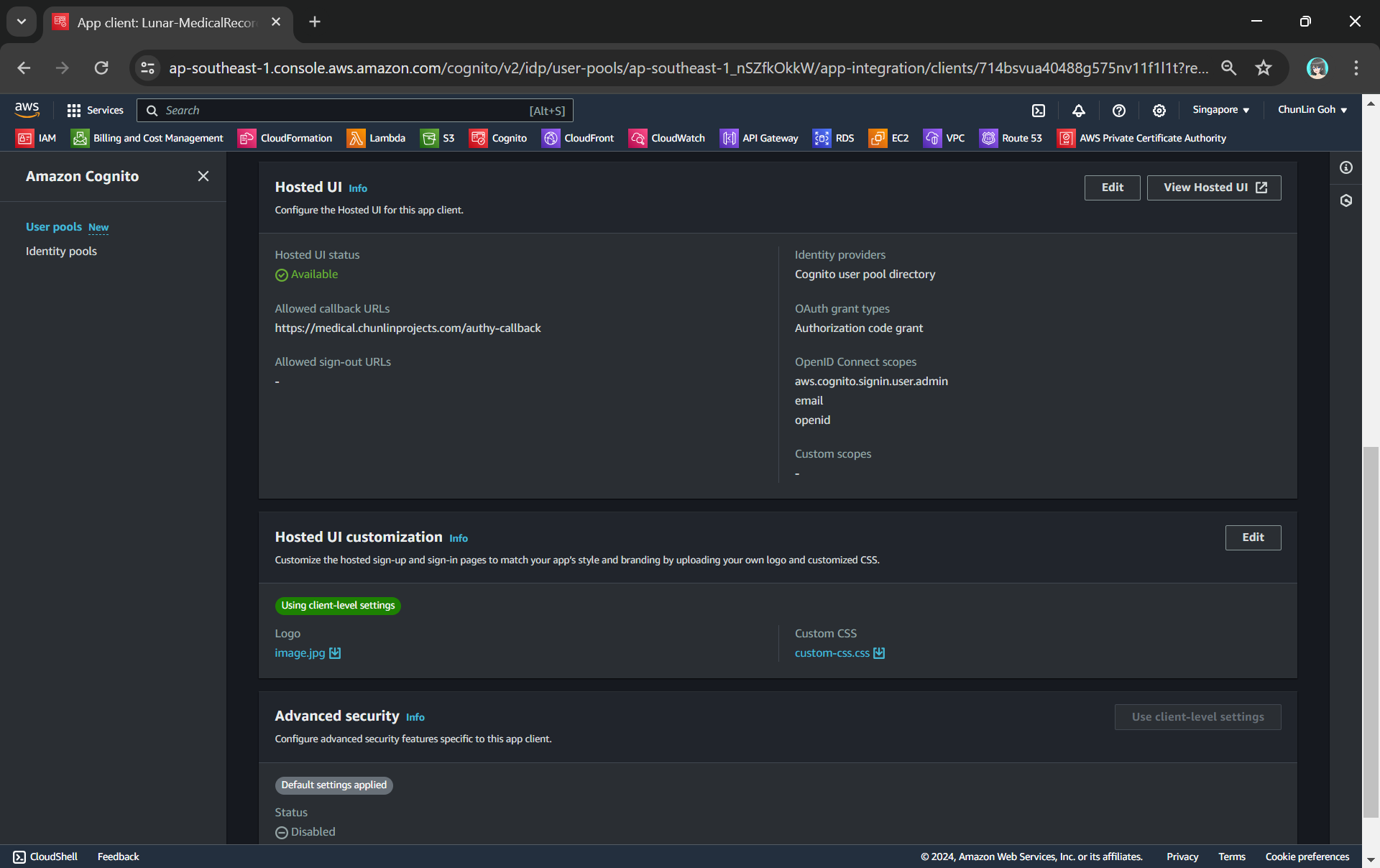
To integrate our app with Cognito, we still need to setup the app client. An App Client is a configuration entity that allows our app to interact with the user pool. It is essentially an application-specific configuration that defines how users will authenticate and interact with our user pool. For example, we have setup a new app client for our medical records app as shown in the following screenshot.
We customise the hosetd UI with our logo and CSS.
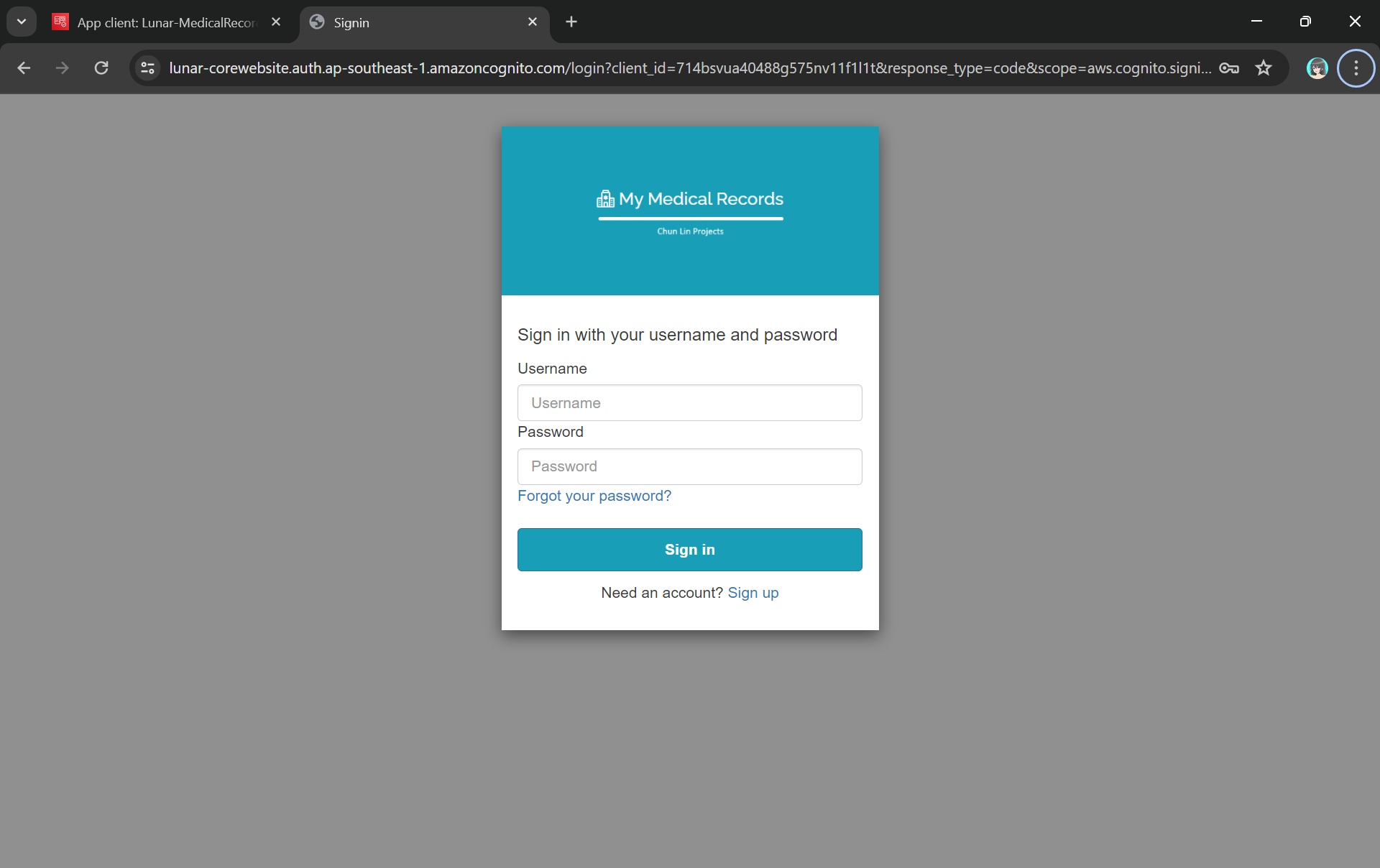
As shown in the screenshot above, we are able to to specify customisation settings for the built-in hosted UI experience. Please take note that we are only able to customise the look-and-feel of the default “login box”, so we cannot modify the layout of the entire hosted UI web page, as demonstrated below.
The part with gray background cannot be customised with the CSS.
In the setup of the app client above, we have configured the callback URL to /authy-callback. So where does this lead to? It actually points to a new Lambda function which is in charge of the authentication.
Step 3: Retrieve Access Token from Cognito Token Endpoint
Here, Cognito uses the OAuth 2.0 authorization code grant flow. Hence, after successful authentication, Cognito redirects the user back to the specified callback URL with an authorisation code included in the query string with the name code. Our authentication Lambda function thus needs to makes a back-end request to the Cognito token endpoint, including the authorisation code, client ID, and redirect URI to exchange the authorisation code for an access token, refresh token, and ID token.
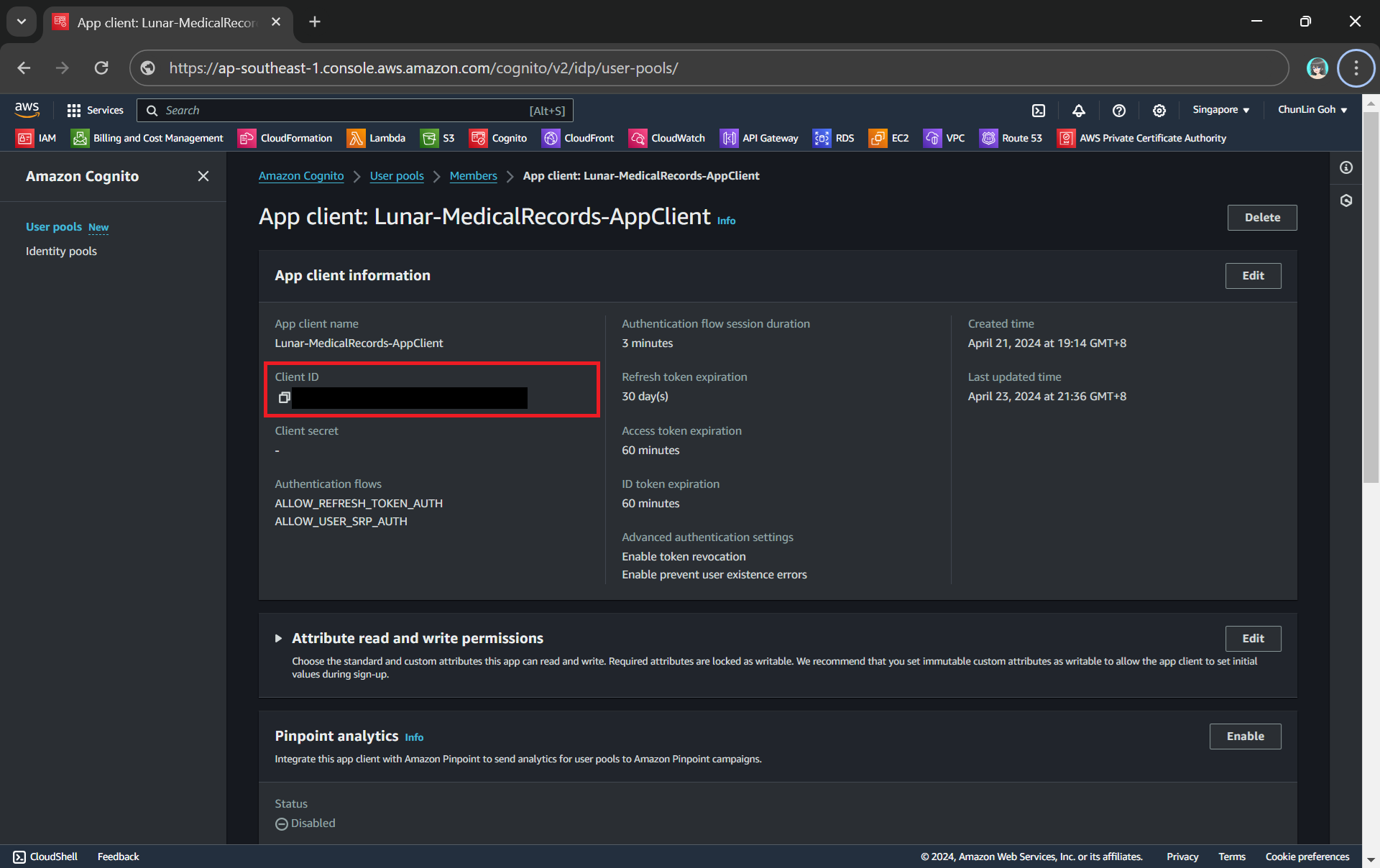
Client ID can be found under the “App client information” section.
token_url = "https://lunar-corewebsite.auth.ap-southeast-1.amazoncognito.com/oauth2/token" client_id = "<client ID to be found in AWS Console>" callback_url = "https://medical.chunlinprojects.com/authy-callback"
A successful response from the token endpoint typically is a JSON object which includes:
access_token: Used to access protected resources;
id_token: Contains identity information about the user;
refresh_token: Used to obtain new access tokens;
expires_in: Lifetime of the access token in seconds.
Hence we can retrieve the medical records if there is an access_token but return an “HTTP 401 Unauthorized” response if there is no access_token returned.
if 'access_token' not in tokens: return { 'statusCode': 401, 'body': get_401_web_content(), 'headers': { 'Content-Type': 'text/html' } }
The function get_401_web_content is responsible to retrieve a static web page showing 401 error message from the S3 bucket and return it to the frontend, as shown in the code below.
For the get_web_content function, we will be passing the access token to the Lambda that we developed earlier to retrieve the HTML content from the Object Lambda Access Point. As shown in the following code, we invoke the Lambda function synchronously and wait for the response.
In the Lambda function lunar-medicalrecords-frontend, we will no longer need to hardcode the object key as chunlin.json. Instead, we can just retrieve the user name from the Cognito using the access token, as highlighted in bold in the code below.
... import boto3
cognito_idp_client = boto3.client('cognito-idp')
def lambda_handler(event, context): if 'access_token' not in event: return { 'statusCode': 200, 'body': get_homepage_web_content(), 'headers': { 'Content-Type': 'text/html' } }
The get_homepage_web_content function above basically is to retrieve a static homepage from the S3 bucket. It is similar to how the get_401_web_content function above works.
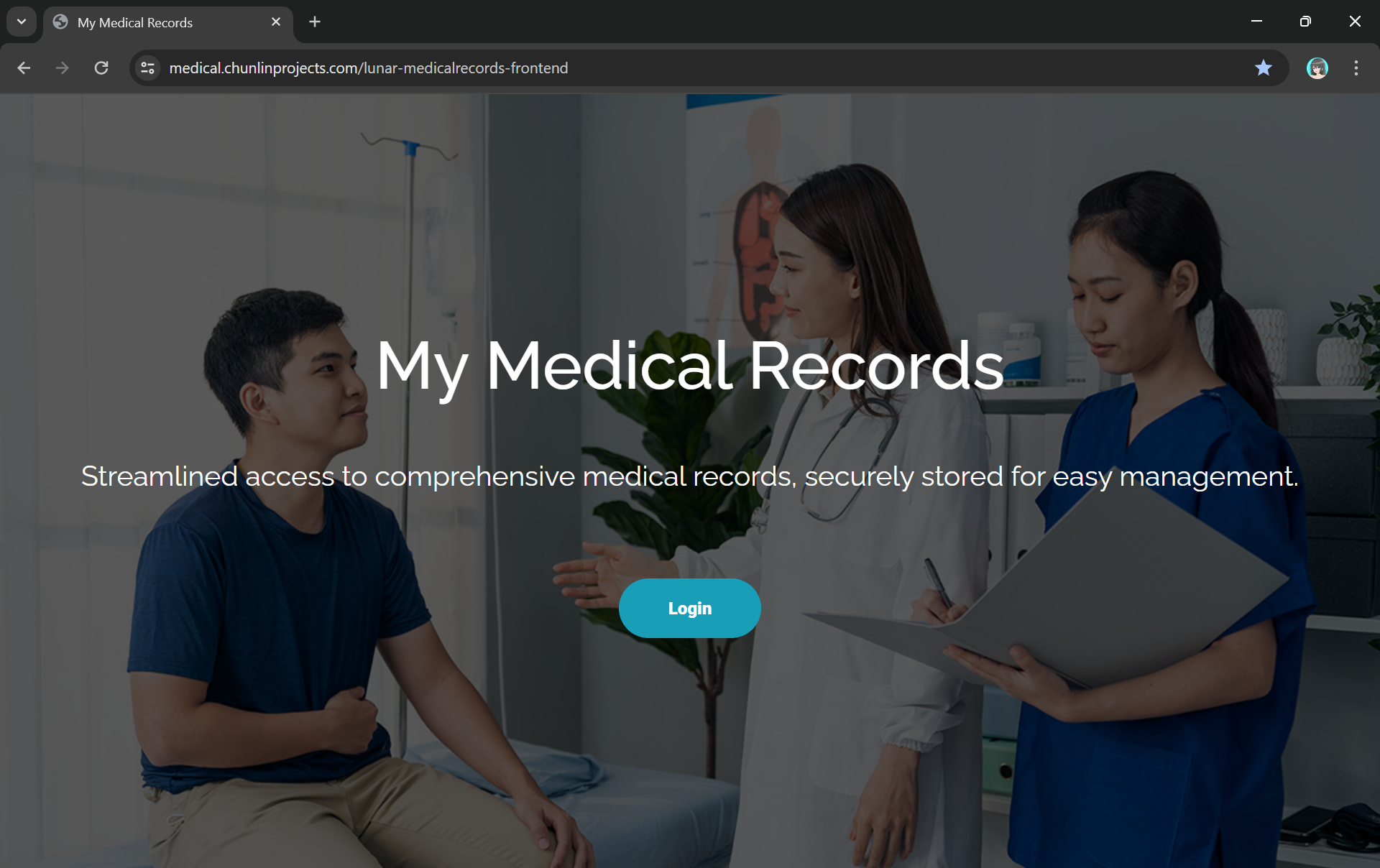
The homepage comes with a Login button redirecting users to Hosted UI of our Cognito app client.
Step 5: Store Access Token in Cookies
We need to take note that the auth_code above in the OAuth 2.0 authorisation code grant flow can only be used once. This is because single-use auth_code prevents replay attacks where an attacker could intercept the authorisation code and try to use it multiple times to obtain tokens. Hence, our implementation above will break if we refresh our web page after logging in.
To solve this issue, we will be saving the access token in a cookie when the user first signs in. After that, as long as we detect that there is a valid access token in the cookie, we will not use the auth_code.
In order to save an access token in a cookie, there are several important considerations to ensure security and proper functionality:
Set the Secure attribute to ensure the cookie is only sent over HTTPS connections. This helps protect the token from being intercepted during transmission;
Use the HttpOnly attribute to prevent client-side scripts from accessing the cookie. This helps mitigate the risk of cross-site scripting (XSS) attacks;
Set an appropriate expiration time for the cookie. Since access tokens typically have a short lifespan, ensure the cookie does not outlive the token’s validity.
Thus the code at Step 3 above can be improved as follows.
def lambda_handler(event, context): now = datetime.now(timezone.utc)
if 'cookies' in event: for cookie in event['cookies']: if cookie.startswith('access_token='): access_token = cookie.replace("access_token=", "") break














 cuteprogramming